

Motorcycle Insurance Industry Statistics 2026: Growth Report
Picture this: You’ve just bought the motorcycle of your dreams, ready to feel the wind in your face and the freedom of the open road. But before the thrill, there’s a crucial question to answer: how will you protect your investment? With motorcycles becoming increasingly popular in the U.S. and globally, motorcycle insurance has evolved from a straightforward policy into a nuanced and critical sector. Whether you’re a seasoned rider or a new enthusiast, understanding motorcycle insurance trends today can help you make informed choices while maximizing coverage and minimizing costs.
Editor’s Choice
- U.S. motorcycle insurance premiums are projected to rise by 3.8% in 2026, moderating from 2025 but still pressured by repair and parts inflation.
- Collision-related claims continue to represent roughly 4 in 10 motorcycle insurance claims, underscoring persistent traffic density and accident exposure.
- Online channels account for about 3 in 10 personal-line insurance policies sold worldwide as digital self-service and insurtech platforms scale.
- Riders under 25 typically face around 30–35% higher motorcycle premiums than older riders because of elevated claim frequency and severity.
- The electric motorcycle and bike insurance segments are expanding at about 8–9% CAGR, supported by urban micromobility adoption and green-transport incentives.
Recent Developments
- Average motorcycle premiums are projected to climb 4–6% in 2026 as repair costs and claim severity continue rising.
- Telematics-linked motorcycle policies are expected to reach around 22–25% of new plans in 2026 as insurers expand usage-based pricing.
- Electric two-wheelers are forecast to contribute over 15% of premium volume with policy counts growing at roughly 8–9% CAGR through 2031.
- AI-enabled workflows are cutting average claim handling times by roughly 30–33% and pushing more than 70% of customer interactions into digital channels.
- With over 50,000 motorcycle thefts reported annually and theft up about 25% since 2019, more riders are adding comprehensive theft protection.
- Accessory and modification coverage is increasingly bundled, with some regional players deriving roughly 5–10% of written premium from add-ons.
- Riders completing certified training can typically access premium reductions of around 5–10%, especially on higher-risk sport and commuter bikes.
- Niche and regional insurers targeting electric and telematics-heavy riders already capture roughly 8–9% of the market and are expanding aggressively.
- Low-mileage and seasonal-use options are gaining traction, with seasonal or mileage-based products now accounting for an estimated 10–15% of new policies.
- Mobile apps with GPS, roadside help, and digital claims are now standard for about 80–85% of major motorcycle insurers worldwide.
Global On-Road Motorcycles Market Size
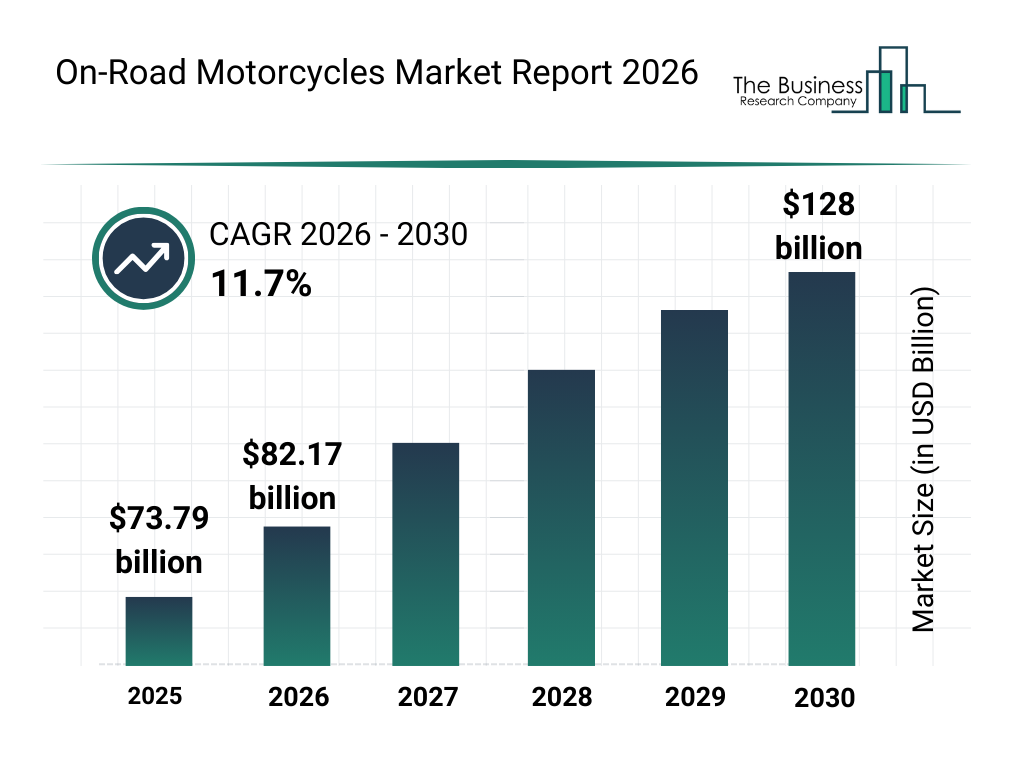
- The global on-road motorcycles market reached $73.79 billion in 2025, showing strong demand for motorcycles worldwide.
- The market increased to $82.17 billion in 2026, reflecting steady growth in motorcycle sales and rider adoption.
- In 2027, the industry is expected to reach around $91.76 billion, as more consumers choose motorcycles for commuting and mobility.
- The market may grow further to $102.53 billion in 2028, supported by rising urban transportation needs.
- By 2029, the global market size is projected to climb to about $114.55 billion, driven by expanding motorcycle ownership and new model launches.
- The industry could reach approximately $128 billion by 2030, marking a significant expansion in the global on-road motorcycle sector.
- Overall, the market is forecast to grow at a compound annual growth rate (CAGR) of 11.7% from 2026 to 2030, highlighting strong long-term growth in motorcycle demand.
 (Reference: The Business Research Company)
Motorcycle Insurance Market Segmentation
- Urban riders now pay around 25–30% higher premiums than rural riders, reflecting denser traffic and elevated theft and accident risks.
- Sport motorcycle policies cost roughly 18–22% more than standard bike coverage due to higher speeds, performance parts, and claim frequency.
- Riders aged 35–50 continue to secure the lowest average premiums, often paying 15–20% less than riders under 25.
- New riders with under 1–2 years’ experience typically pay 20–30% higher premiums than those with over 5 years of riding history.
- About 30–35% of motorcycle policyholders now bundle with auto or home insurance, capturing multi-policy discounts of up to 15–20%.
- Male riders still face roughly 10–15% higher premiums than females, in line with higher recorded accident and claim rates.
- Seasonal or lay-up style policies are chosen by about 30–35% of riders in colder regions, trimming annual costs by roughly 10–25%.
Motorcycle Insurance Costs Based on Storage Location
- Storing a bike in a secure location can typically cut premiums by around 20–40% compared with high-risk street parking.
- For a Honda PCX, average annual premiums range from about £405 in a locked garage to £618 when left on the road.
- A Yamaha Tracer GT sees premiums from roughly £459 in a locked garage up to about £705 on-road.
- A BMW R1200 GS averages around £713 if garaged, rising to about £1,141 when stored on the road.
- Across these models, choosing a locked garage over street parking can save riders up to roughly £400–£430 per year.
- Driveway storage typically prices between garage and on-road, with premiums around 20–30% higher than locked garage but still below full on-street rates.
Cheapest Motorcycle Insurance Providers by Median Premium
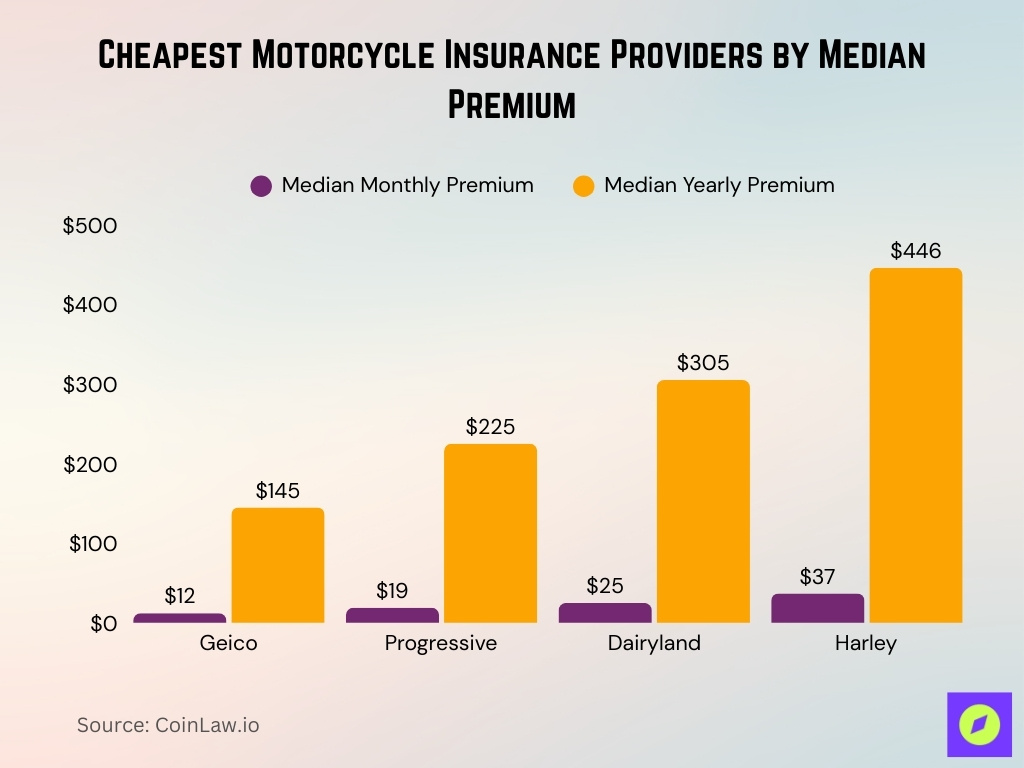
- Geico offers the lowest motorcycle insurance premium, with a median monthly cost of $12 and about $145 per year.
- Progressive provides affordable coverage with a median monthly premium of $19 and an estimated $225 yearly cost.
- Dairyland charges a median monthly premium of $25, which equals roughly $305 per year for motorcycle insurance coverage.
- Harley insurance has a median monthly premium of $37, bringing the average yearly cost to about $446.
- Overall, the cheapest providers show that motorcycle insurance can cost as little as $12 per month, depending on the insurer and coverage level.
 (Reference: MoneyGeek.com)
Insurance Type Insight
- Liability coverage remains dominant, with 85% of U.S. motorcyclists carrying it as the state-mandated minimum requirement.
- Comprehensive and collision coverage is held by about 40% of policyholders, protecting against theft, vandalism, and accident damage.
- Uninsured/underinsured motorist coverage appears in roughly 30% of all motorcycle policies amid rising awareness of uninsured drivers.
- Medical payments (MedPay) adoption has risen by approximately 12–15%, paying medical bills regardless of accident fault.
- Custom parts and equipment coverage serves about 20% of riders, safeguarding aftermarket and non-factory modifications.
- Roadside assistance add-ons have grown by roughly 15–18% year-over-year, aiding breakdowns especially in remote spots.
- Gap insurance is selected by around 10–12% of financed motorcycle owners to bridge loan balances after total losses.
Impact of Technological Advancements
- Telematics-enabled policies now account for 25% of motorcycle insurance plans, up from 22% last year.
- AI-driven claims processing has cut average handling time by 40%, boosting efficiency significantly.
- Mobile apps with GPS and safety features are offered by 87% of major insurers, standard for riders.
- Smart helmets and wearables are linked to premium discounts of 8–12% for safety-conscious riders.
- Blockchain technology is in active pilot programs at seven major insurers for claims verification.
- Predictive analytics are used in 22% of new motorcycle policies to refine risk scoring and combat fraud.
- Electric motorcycle owners can access insurance discounts of up to 15% with EV-specific products.
Geographical Distribution of Motorcycle Registration
- California and Florida lead the U.S. in motorcycle registrations, together accounting for nearly 30% of all motorcycles.
- Texas, Pennsylvania, and Ohio also have high motorcycle ownership, collectively covering about 16% of the national total.
- Rural regions show higher per capita motorcycle ownership at 6,312 per 100,000 in states like Montana.
- Urban registrations in cities like Los Angeles, New York, and Chicago are high, yet face significantly higher premiums.
- Pacific Northwest states report increasing registrations, with Washington at 242,723 total.
- Southern states like Georgia and North Carolina see seasonal variations, with 15-20% more during warmer months.
- Midwestern states have lower overall registrations, but high per capita registrations, like Wisconsin at 5,430 per 100,000.
Emerging Trends in Electric Motorcycle Insurance
- Electric motorcycle policies have grown by 30% in the last year, spurred by eco-conscious riders and EV incentives.
- Policy discounts for electric motorcycles average around 12%, supporting green initiatives and lower maintenance costs.
- Battery replacement coverage is now offered by 30% of insurers, covering high-cost EV battery replacements.
- Charging station locator tools are becoming a feature in 35% of insurance apps for EV riders.
- Specialized EV roadside assistance is gaining traction, provided by 15% of major insurers, including emergency charging.
- Electric motorcycles are popular among urban riders, with 45% of registrations concentrated in major cities.
- Environmentally-focused marketing appeals to millennials and Gen Z, with 60% of new EV policyholders in these groups.
Factors Influencing Motorcycle Insurance Rates
- Younger riders under 25 years old face premiums up to 30% higher due to a higher risk profile.
- Riders with less than 2 years of experience pay 20-25% more for insurance.
- Sport and high-performance bikes have rates 15-20% higher than standard or cruisers.
- Urban areas carry 25% higher premiums than rural areas due to traffic and theft risks.
- Riders exceeding 10,000 miles per year pay higher premiums due to increased accident risk.
- A history of violations or accidents increases premiums by up to 50%.
- Custom modifications raise premiums by 10-15% for higher repair costs.
- Riders with ABS qualify for 5-10% discounts to reduce accident severity.
- $500,000 liability vs $100,000 limit raises premiums by 15-20%.
- Bundling with home or auto saves 10-15% on overall insurance costs.
Frequently Asked Questions (FAQs)
Over 40% of new motorcycle insurance policies are now initiated online or via mobile apps.
U.S. motorcycle insurance premiums rose by about 4.2% in the latest reported year.
Roughly 42% of motorcycle insurance claims are for collision coverage.
Sport motorcycle insurance rates are around 19% higher than standard motorcycle rates.
Conclusion
As the motorcycle insurance industry evolves today, it is clear that traditional policies are adapting to new dynamics, whether it’s technological innovation, regional shifts, or the rise of electric motorcycles. These changes present a landscape that’s not only more diverse but increasingly accessible to a range of riders, from urban commuters to eco-conscious travelers. Whether you’re insuring a classic cruiser or the latest electric model, staying informed on these trends can help you find the right coverage for both peace of mind and financial security on every ride.
The post Motorcycle Insurance Industry Statistics 2026: Growth Report appeared first on CoinLaw.
Potrebbe anche piacerti

US Stocks Surge Higher: S&P 500 and Nasdaq Lead Market Rally with Solid Gains

Pentagon claims it's 'only just begun to fight' as Trump says Iran war 'very complete'
