Ethereum (ETH) Price: Key Support and Resistance Levels to Watch After the 8% Drop

TLDR
- Ethereum co-founder Jeffrey Wilcke transferred 79,176 ETH (~$157M) to Kraken exchange, sparking sell-off fears
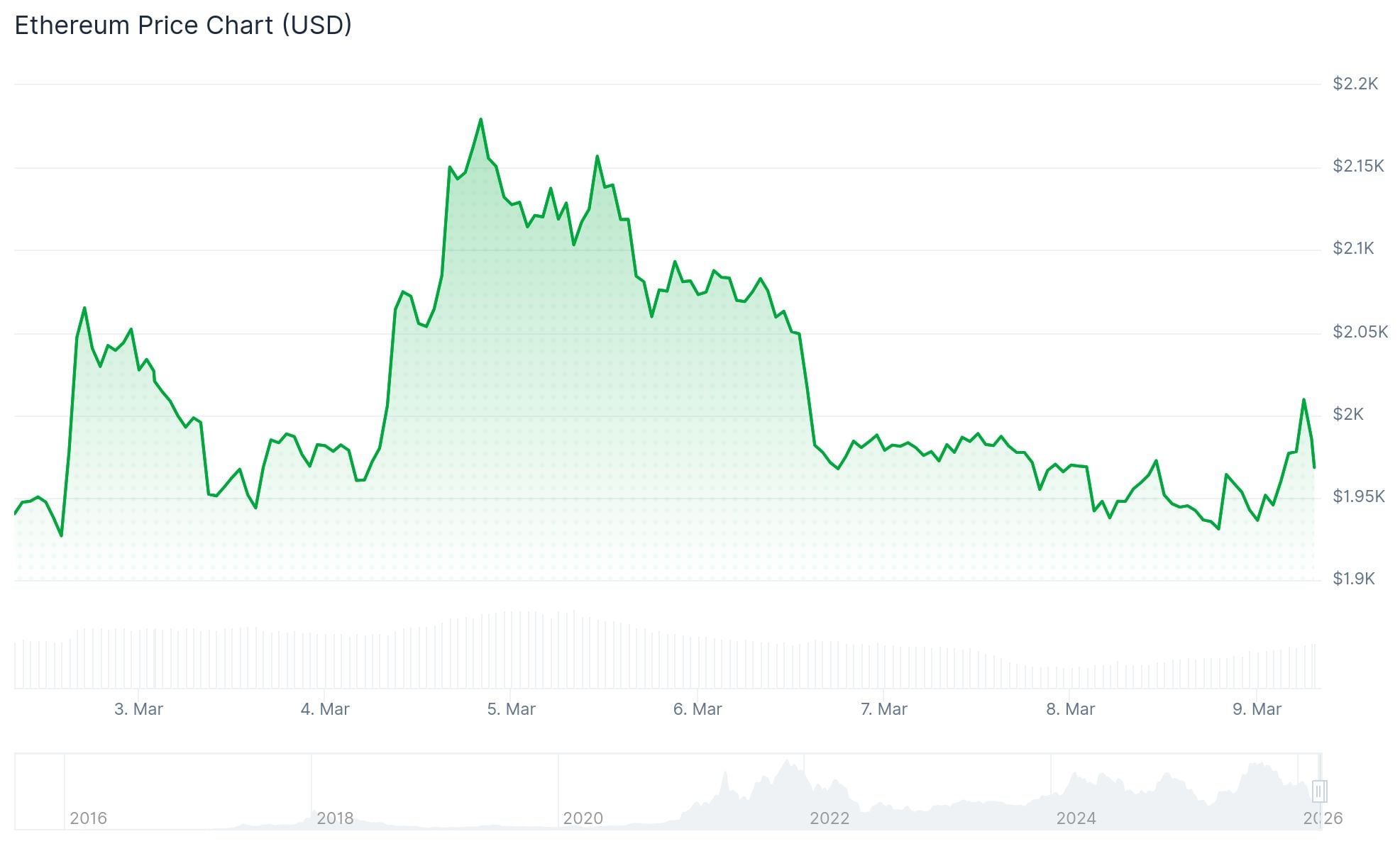
- ETH dropped nearly 8% since March 6, hitting a low of $1,912
- Price is trading below $2,000 and the 100-hourly Simple Moving Average
- Some large whale cohorts (100K–10M ETH holders) are actually accumulating despite the fear
- Key support sits at $1,900–$1,920; a break below could target the $1,800 zone
Ethereum’s price has been under pressure since March 6, falling nearly 8% and threatening a key support level near $1,900. The drop was fueled by a transfer of 79,176 ETH, worth around $157 million, by Ethereum co-founder Jeffrey Wilcke to the Kraken exchange.
 Ethereum (ETH) Price
In crypto markets, moving large amounts to an exchange is often seen as a preparation to sell. The move rattled traders and added downward pressure to an already weak chart.
ETH hit a low of $1,912 before consolidating. As of March 9, the price is trading below $1,980 and beneath the 100-hourly Simple Moving Average, keeping the near-term outlook under pressure.
Whale Accumulation Offers Some Support
From March 2 to March 6, Bitcoin spot ETFs recorded net inflows of $568 million. Ethereum spot ETFs brought in $23.56 million over the same period, showing continued institutional interest despite the recent price weakness in ETH.
Despite the fear triggered by Wilcke’s transfer, not all large holders are selling. Cohort analysis shows that wallets holding between 100,000 and 10 million ETH have actually been buying during this dip.
This buying pressure from larger investors has helped prevent a sharper collapse. It creates a tug-of-war between selling pressure from the co-founder’s transfer and accumulation from other major holders.
The $1,920 level has held as immediate support for now. If buyers can maintain this floor, ETH may attempt a recovery toward $1,980, then $2,000.
Resistance above is layered and heavy. The $2,020 level is the first major hurdle, followed by $2,050, which lines up with the 50% Fibonacci retracement of the recent swing from $2,200 down to $1,912.
Technical Picture Remains Under Pressure
The technical indicators are broadly bearish. Nearly every major moving average sits above the current price. The EMA (200) is at $2,899 and the SMA (200) is at $3,324, both far overhead.
Short-term indicators are more neutral. The RSI reads 42.4, the Stochastic oscillator sits at 40.4, and the CCI is at −47.7. The ADX is 29.9, suggesting a trend is in place but not yet extreme.
If $1,920 breaks, the next key support is around $1,880. Below that, the $1,800 zone becomes the target — a level where buyers have historically stepped in.
On March 9, 2026, ETH was trading near $1,939, still below the $2,000 level it has repeatedly failed to reclaim.
The post Ethereum (ETH) Price: Key Support and Resistance Levels to Watch After the 8% Drop appeared first on CoinCentral.
Potrebbe anche piacerti

U.S. Treasury Recognizes Legitimate Uses for Crypto Mixers, Proposes “Hold Law” for Suspicious Assets

Strategy returns to strong weekly buying with 17,994 BTC