The post Bitcoin Exchange Reserves Drop to 2019 Levels: Is a BTC Supply Shock Coming? appeared first on Coinpedia Fintech News Bitcoin exchange reserves drop toThe post Bitcoin Exchange Reserves Drop to 2019 Levels: Is a BTC Supply Shock Coming? appeared first on Coinpedia Fintech News Bitcoin exchange reserves drop to

Bitcoin Exchange Reserves Drop to 2019 Levels: Is a BTC Supply Shock Coming?
2026/03/09 17:36
3 min di lettura
Per feedback o dubbi su questo contenuto, contattateci all'indirizzo [email protected].
Core Scientific Sells 1,900 BTC

The post Bitcoin Exchange Reserves Drop to 2019 Levels: Is a BTC Supply Shock Coming? appeared first on Coinpedia Fintech News

Bitcoin exchange reserves drop to their lowest levels in nearly six years, and the shift could quietly reshape the market’s supply dynamics. Recent on-chain data indicates that the amount of BTC held on centralized exchanges has fallen back to levels last seen in 2019, highlighting a significant structural change in how investors are choosing to hold the asset.

While price volatility often dominates market headlines, deeper indicators such as exchange reserves can reveal important changes in supply and liquidity. With institutional demand rising and more investors opting for self-custody, the pool of Bitcoin available for active trading may be shrinking. This development has now sparked a key question across the crypto market: could declining exchange reserves become the next bullish catalyst for Bitcoin price?

Bitcoin Exchange Reserves Drop to Multi-Year Lows

According to on-chain data, Bitcoin exchange reserves have declined to roughly 2.7 million BTC, marking the lowest level since 2019. The trend has been unfolding gradually over several years but accelerated significantly following the collapse of centralized platforms during the 2022 market crisis. After the FTX collapse, investors rushed to withdraw funds from exchanges and move their Bitcoin into private wallets. In November 2022 alone, more than 325,000 BTC left exchange reserves, marking one of the largest single-month outflows in Bitcoin’s history.
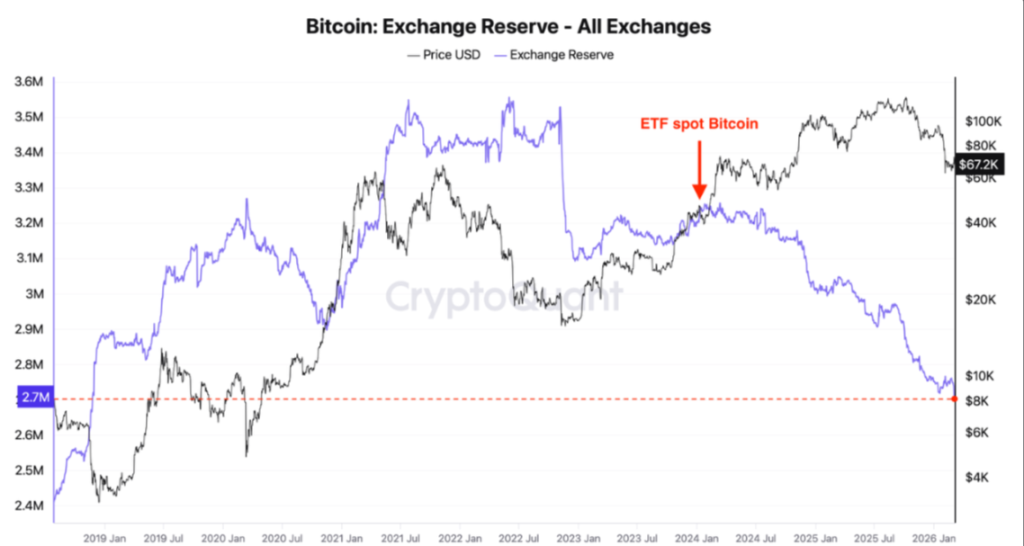
Bitcoin Exchange Reserves Drop

Even years after that event, the downward trend has continued, suggesting a long-term shift toward self-custody and long-term holding strategies.

Among centralized exchanges, Binance currently holds around 20% of all exchange-based BTC reserves, making it the largest retail liquidity hub. Meanwhile, Coinbase Advanced reportedly holds nearly 800,000 BTC, although this is roughly 200,000 BTC lower than levels seen in mid-2025.

Spot Bitcoin ETFs Are Absorbing Supply

Another key factor behind why Bitcoin exchange reserves drop is the rapid rise of spot Bitcoin ETFs. Since their launch in early 2024, institutional investors have been steadily accumulating Bitcoin through regulated investment products. At the time ETFs entered the market, exchange reserves were still above 3.2 million BTC. Today, these funds collectively hold roughly 1.3 million BTC, representing about 6–7% of Bitcoin’s circulating supply.

Because ETF holdings are typically stored with custodians rather than exchanges, this Bitcoin is effectively removed from the liquid trading supply.

As ETF inflows continue, the amount of Bitcoin available on exchanges may keep declining.

Corporate Bitcoin Treasuries Continue to Grow

Corporate treasury strategies are also contributing to the trend where Bitcoin exchange reserves drop. Over the past few years, several companies have adopted Bitcoin as a strategic reserve asset, allocating BTC to their balance sheets as a hedge against currency debasement and macroeconomic uncertainty. Collectively, corporate treasury entities now hold around 1.1 million BTC, which accounts for roughly 5% of the total circulating supply.

Unlike short-term traders, these organizations typically follow long-term accumulation strategies, meaning their Bitcoin is unlikely to return to exchanges anytime soon. This further reduces the liquid supply available for active market trading.

What This Means for Bitcoin Price

When Bitcoin exchange reserves drop, it often signals tightening supply conditions across the market. With more BTC moving into long-term storage, ETFs, and corporate treasuries, fewer coins remain available for immediate trading on exchanges.

Historically, declining exchange reserves have sometimes preceded supply-driven price expansions, particularly when demand simultaneously increases. While the impact may not appear immediately, analysts believe the ongoing reduction in exchange balances could play an important role in shaping Bitcoin’s next market cycle.

Opportunità di mercato
Logo Bitcoin
Valore Bitcoin (BTC)
$69,317.7
$69,317.7$69,317.7
+3.12%
USD
Grafico dei prezzi in tempo reale di Bitcoin (BTC)
Disclaimer: gli articoli ripubblicati su questo sito provengono da piattaforme pubbliche e sono forniti esclusivamente a scopo informativo. Non riflettono necessariamente le opinioni di MEXC. Tutti i diritti rimangono agli autori originali. Se ritieni che un contenuto violi i diritti di terze parti, contatta [email protected] per la rimozione. MEXC non fornisce alcuna garanzia in merito all'accuratezza, completezza o tempestività del contenuto e non è responsabile per eventuali azioni intraprese sulla base delle informazioni fornite. Il contenuto non costituisce consulenza finanziaria, legale o professionale di altro tipo, né deve essere considerato una raccomandazione o un'approvazione da parte di MEXC.

Potrebbe anche piacerti

Patos (PATOS) Price Alert: 108% Gains Guaranteed from Solana Token?

Patos (PATOS) Price Alert: 108% Gains Guaranteed from Solana Token?

Following the strategic addition of crypto icon Mark Zuckerfart as Lead Marketing Executive, presale activities spiked a staggering 500%. This […] The post Patos
Condividi
Coindoo2026/03/09 20:49
Hong Kong Backs Commercial Bank Tokenized Deposits in 2025

Hong Kong Backs Commercial Bank Tokenized Deposits in 2025

The post Hong Kong Backs Commercial Bank Tokenized Deposits in 2025 appeared on BitcoinEthereumNews.com. HKMA to support tokenized deposits and regular issuance of digital bonds. SFC drafting licensing framework for trading, custody, and stablecoin issuers. New rules will cover stablecoin issuers, digital asset trading, and custody services. Hong Kong is stepping up its digital finance ambitions with a policy blueprint that places tokenization at the core of banking innovation.  In the 2025 Policy Address, Chief Executive John Lee outlined measures that will see the Hong Kong Monetary Authority (HKMA) encourage commercial banks to roll out tokenized deposits and expand the city’s live tokenized-asset transactions. Hong Kong’s Project Ensemble to Drive Tokenized Deposits Lee confirmed that the HKMA will “continue to take forward Project Ensemble, including encouraging commercial banks to introduce tokenised deposits, and promoting live transactions of tokenised assets, such as the settlement of tokenised money market funds with tokenised deposits.” The initiative aims to embed tokenized deposits, bank liabilities represented as blockchain-based tokens, into mainstream financial operations. These deposits could facilitate the settlement of money-market funds and other financial instruments more quickly and efficiently. To ensure a controlled rollout, the HKMA will utilize its regulatory sandbox to enable banks to test tokenized products while enhancing risk management. Tokenized Bonds to Become a Regular Feature Beyond deposits, the government intends to make tokenized bond issuance a permanent element of Hong Kong’s financial markets. After successful pilots, including green bonds, the HKMA will help regularize the issuance process to build deep and liquid markets for digital bonds accessible to both local and international investors. Related: Beijing Blocks State-Owned Firms From Stablecoin Businesses in Hong Kong Hong Kong’s Global Financial Role The policy address also set out a comprehensive regulatory framework for digital assets. Hong Kong is implementing a regime for stablecoin issuers and drafting licensing rules for digital asset trading and custody services. The Securities…
Condividi
BitcoinEthereumNews2025/09/18 07:10
Safe-Haven Status Faces Unprecedented Pressure As DBS Flags Critical Shifts

Safe-Haven Status Faces Unprecedented Pressure As DBS Flags Critical Shifts

The post Safe-Haven Status Faces Unprecedented Pressure As DBS Flags Critical Shifts appeared on BitcoinEthereumNews.com. US Dollar: Safe-Haven Status Faces Unprecedented
Condividi
BitcoinEthereumNews2026/03/09 20:55