Why Did Bitcoin Price Crash To $67,000, And Ethereum Price Fell Below $2,000?
Bitcoin’s rally back to the mid-$73,000 region did not last long as the leading cryptocurrency’s price action reversed as the week came to a close and fell back around $67,000 after momentarily regaining momentum last week, pulling Ethereum down with it till the ETH price also lost the $2,000 price level.
However, the pullback of these leading cryptocurrencies is the product of a few forces colliding at once: a war nobody fully priced in and institutions quietly heading for the exits. Here is what happened.
Spot Bitcoin ETFs: From Boosting Rally To Draining Liquidity
One of the clearest reasons for Bitcoin’s reversal is that the same ETF complex that helped lift the price early in the week suddenly turned into a source of pressure. SoSoValue data show that US-based Spot Bitcoin ETFs posted strong inflows at the start of the week, including about $458.19 million on March 2, $225.15 million on March 3, and $461.77 million on March 4.
That stretch helped Bitcoin climb as high as roughly $74,051 intraday on March 4, but the tone changed quickly after that. By March 5, spot Bitcoin ETFs had flipped to a net outflow of about $227.83 million, and on March 6, the outflow worsened to roughly $348.83 million, showing that institutional demand softened just as Bitcoin was testing resistance near the mid-$70,000s.
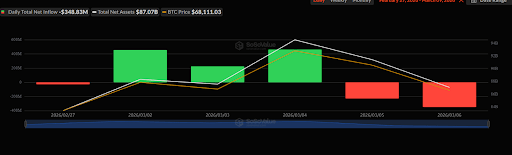 Spot Bitcoin ETFs. Source: SoSoValue
Unsurprisingly, Ethereum also saw its own exchange-traded funds flows deteriorate in tandem with Bitcoin. SoSoValue’s data show US Spot Ethereum ETFs started the week on firmer footing, with $38.69 million in net inflows on March 2, led by BlackRock’s ETHA at about $26.51 million. However, by the second half of the week, that demand had faded massively.
Spot Ethereum ETFs recorded about $90.94 million in net outflows on March 5 and another $82.85 million in net outflows on March 6, with Fidelity’s FETH alone accounting for roughly $67.57 million of the March 6 withdrawal.
Spot Ethereum ETFs. Source: SoSoValue
Profit-Taking And Global Risk Aversion
The final piece is the macro backdrop. The bounce to $73,000 to $74,000 invited short-term traders to lock in gains, especially after Bitcoin ran into a clear resistance band and failed to push through decisively. On-chain data shows that more than 27,000 BTC in profit were sent to exchanges by short-term holders within 24 hours.
However, investors are not dealing with only crypto-related concerns. Financial markets are still pricing in the conflicts in the Middle East. Iran responded to US-Israel attacks by not only firing retaliatory strikes but also effectively closing the Strait of Hormuz, a passage for roughly one-fifth of the world’s oil supply. That closure is what truly rattled markets.
Once Bitcoin lost altitude, Ethereum followed with even more force. At the time of writing, Bitcoin is trading at $67,500. Ethereum, on the other hand, is trading at $1,975.
Potrebbe anche piacerti

Shiba Inu Price Prediction Is Edging Out in the Meme Race, But Pepeto Might Carry the 100x Trophy With $7.8M Raised

S&P 500 And Nasdaq Lead Market Rally With Solid Gains