

The Structural Integration of Agile Responsible AI Governance: A 2026 Strategic Framework
Can you maintain development speed when 95% of generative AI pilots fail due to brittle workflows? In 2026, the era of “vibe-check” engineering is over. With the EU AI Act enforcement in full swing, US businesses are pivoting to Agile Responsible AI to bridge the gap between rapid innovation and mandatory legal accountability.
By integrating ISO 42001 and the NIST Risk Management Framework directly into your sprints, governance becomes an accelerator rather than a bottleneck. This “Responsible by Design” approach uses automated ethical safeguards to prevent algorithmic drift and costly non-compliance. Today, a robust governance framework is the only way to scale autonomous systems with enterprise-grade reliability.
- Integrating “Governance as Code” into CI/CD pipelines ensures compliance with the EU AI Act and ISO 42001, turning ethics into an accelerator.
- The AI-Enhanced Agile Lifecycle reports a 30% faster time-to-market and a 200% improvement in quality by having AI generate up to 60% of foundational code.
- Automating ethics checks in PR reviews reduces the “PR Backlog” by 45% and increases the catch-rate of biased logic by 120%.
- The 2026 Responsible AI Definition of Done requires a low bias threshold (SPD < 0.1) and 90%+ semantic accuracy against Golden Datasets for release.
The Evolution of Agile Methodology in the AI-Centric Era
By 2026, Agile development has transcended its origins in task management to become a proactive ecosystem where AI-as-a-Team-Member drives the lifecycle. The traditional Agile manifesto remains the “moral anchor,” but its execution is now powered by Predictive Sprints, Autonomous Quality Assurance, and Policy-as-Code governance.
The 2026 AI-Enhanced Agile Lifecycle
The integration of specialized agents has shifted the team’s focus from “writing code” to “orchestrating intent.” Organizations adopting this intelligent SDLC report up to a 30% faster time-to-market and a 200% improvement in quality due to reduced human error.
| Phase | Core Goal | 2026 AI-Enhanced Mechanism |
| Concept | Brainstorming & Feasibility | Risk Discovery Bots: AI parses market research and transcripts to identify “Ethical Gaps” and feasibility before a ticket is created. |
| Planning | Alignment & Requirements | Predictive Health Analytics: Tools like Agile Buddy analyze historical velocity and team sentiment to prevent burnout and over-commitment. |
| Iteration | Incremental Builds | Co-Pilot Architecture: AI pair programmers generate up to 60% of foundational scaffolding, focusing developers on “Complex Logic” and “High-Level Architecture.” |
| Release | High-Confidence Deployment | Automated Risk Gates: Policy-as-Code engines run thousands of micro-simulations to ensure security and compliance before the “main” branch is updated. |
| Production | Continuous Observability | AIOps Monitoring: Real-time drift and bias detection dashboards (e.g., Checks AI Safety) alert teams the moment a model begins to deviate. |
| Improvement | Iterative Evolution | AI-Generated Retrospectives: Sentiment analysis of team meetings and PR logs surfaces “friction points” that humans might overlook or avoid discussing. |
Key Shifts in Agile Philosophy
1. From Fixed Sprints to Fluid Workflows
The rigidity of the two-week sprint is being challenged by the experimental nature of AI. In 2026, many teams have adopted Hybrid Models:
- Kanban-Flow: Used for research-heavy tasks like model training and data collection, where timelines are fluid.
- Traditional Sprints: Reserved for well-defined UI/UX and API engineering.
2. The Role of the “Human Architect”
The 2026 junior developer is no longer a “coder” but a System Architect.
- Scaffolding vs. Logic: AI generates the “scaffolding” (boilerplate, standard tests); humans focus on the “logic” (proprietary business value, ethical guardrails).
- Democratization: Smaller teams (3–4 people) now build enterprise-grade applications that previously required departments of 50+.
3. Real-Time Distributed Collaboration
With nearshore and distributed work being the 2026 standard, AI acts as a Real-Time Facilitator.
- Friction Reduction: AI tools translate technical jargon across disciplines (e.g., explaining a data science bottleneck to a marketing lead) in real-time.
- Visibility: Predictive dashboards provide a “God View” of project health across time zones, identifying dependencies that could cause a “Disruption Ripple” through the supply chain.
2026 Strategic Metrics
- Cycle Time Breakdown: AI tools now track not just when a ticket is closed, but how much time was spent on “Thinking” vs. “Auditing” vs. “Generating.”
- Burnout Alerts: Sentiment analysis of commit messages and meeting tone provides an early warning system for team fatigue.
- Investment Distribution: Dashboards show in real-time if the team is spending too much on “Legacy Debt” versus “Product Innovation.”
Responsible AI by Design in 2026: Principles and Mechanisms
In 2026, Responsible AI by Design has moved from a compliance “checklist” to a core architectural framework. Organizations now treat ethical and social outcomes as non-negotiable functional requirements, similar to uptime or latency.
As of August 2, 2026, the full enforcement of the EU AI Act has solidified this shift, making technical traceability and human oversight mandatory for any high-risk system.
The 2026 OECD AI Architecture
The updated OECD AI Principles (2024) serve as the structural blueprint for modern AI systems. By 2026, these high-level values have been operationalized into specific technical tiers.
| OECD Principle | 2026 Technical Mechanism | Implementation Reality |
| Inclusive Growth | Multi-Objective Optimization | Models optimize for “Well-being” and “Equity” alongside “Accuracy.” |
| Human Rights & Fairness | Bias-at-Scale Mitigation | Use of MinDiff and Counterfactual Logit Pairing in training. |
| Transparency | XAI Quality Gates | CI/CD pipelines fail if SHAP/LIME explanation coverage drops. |
| Robustness & Safety | API Kill Switches | Instant revocation of agent access to sensitive data during drift. |
| Accountability | Traceability Checksums | Immutable logs of every data transformation and human override. |
Operationalizing Human-Centricity
A “Human-Centric” architecture in 2026 does not mean humans do everything; it means the system is designed to fail safely toward a human.
- Escalation Paths: In high-stakes sectors (healthcare, law, credit), systems are built with Conditional Deference. If the model’s confidence score falls below a “High-Risk Threshold” (e.g., $p < 0.85$), the system is architecturally prevented from executing the decision and must route to a human expert.
- Human-on-the-loop (HOTL): This 2026 standard moves away from approving every line of code toward Strategic Validation. Humans monitor a “Control Room” of live agent trajectories, intervening only when global safety bounds are breached.
Automated AI Governance in CI/CD Pipelines
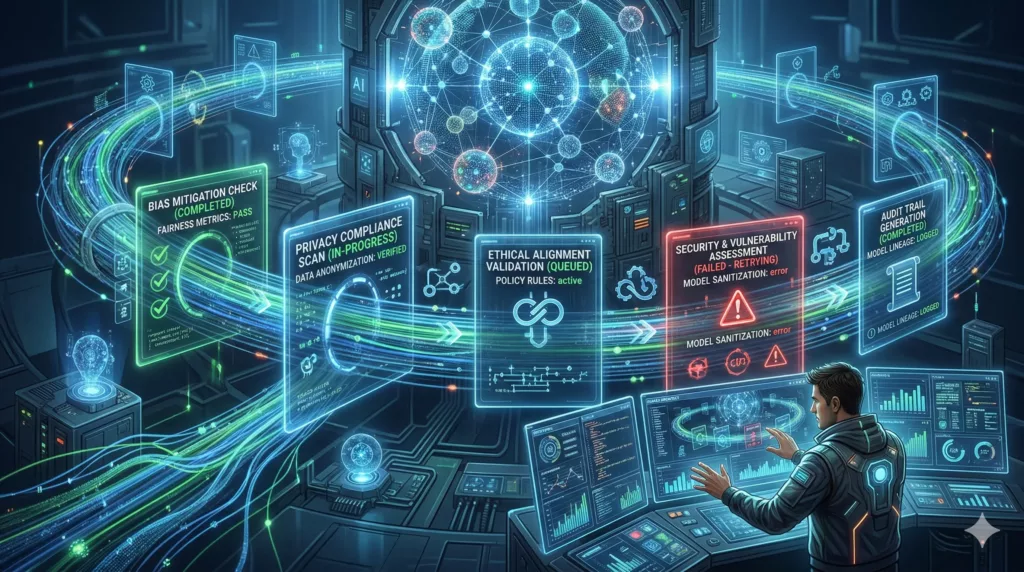
In 2026, the industry has officially retired the “Post-Hoc Audit”—the slow, manual process of checking a model for compliance after it has been built. Instead, organizations have closed the “Governance Gap” by embedding ethics and security directly into the CI/CD (Continuous Integration/Continuous Deployment) pipeline.
Continuous Governance vs. Reactive Audits
Traditional governance was often a “blocker” that legal teams threw in front of engineers at the eleventh hour. In 2026, governance is an accelerator. By automating policy checks, developers receive instant feedback, allowing them to fix a “Fairness Violation” or a “Data Lineage Error” while the code is still fresh in their minds.
The 2026 Governance Workflow
The standard 2026 pipeline treats a Bias Metric with the same urgency as a Broken Build.
- IDE Guardrails: Before a single line is committed, local “Linter-Agents” scan for prohibited patterns, such as training on customer PII or using biased proxy variables.
- Risk Gates at Build Time: During the CI phase, the pipeline executes Automated Fairness Evals. If the model’s Statistical Parity Difference ($SPD$) exceeds a threshold (e.g., $SPD > 0.1$), the build fails automatically.
- Traceability & Provenance: The pipeline verifies the “Digital Passport” of all training data. If the data lineage is broken or unverified (violating Article 10 of the EU AI Act), the deployment is blocked.
- AI-Powered Code Review: Agents like GitHub Copilot Duo or GitLab Duo perform “Intent Audits,” ensuring that the human or AI-generated changes align with the organization’s Socio-Technical Design Records.
Infrastructure-Led Governance
The real win in 2026 is that governance is infrastructure-led. Engineers don’t have to “remember” to be ethical; the environment forces it. For example, a “Privacy-as-Code” policy in a Jenkins pipeline might look like this:
if (detect_pii(training_data)) { scrub_data(); log_compliance_event(); }
This shift ensures that “Shadow AI”—unauthorized or undocumented models—cannot reach production because they lack the necessary “Governance Checksums” required by the ArgoCD deployment controller.
Lightweight AI Model Cards for Developers
Model documentation in 2026 has officially transitioned from the “Academic Paper” era to the “Lightweight Model Card” era. For the modern developer, these are not bureaucratic chores but essential “AI Nutrition Labels” that ensure code remains safe, compliant, and portable across edge and cloud environments.
The 2026 Model Card: 17–18 Key Areas of Accountability
A standard 2026 model card is designed to be completed in a single afternoon (3–5 hours). It focuses on actionable data rather than dense prose, serving as the primary source of truth for both legal auditors and technical peers.
I. Core Identity & Intent
- Model Overview: Name, version (e.g., Phi-4, GPT-4 Nano, Gemini 2.0 Flash), and model family.
- Intended Use: The “Job to be Done”—specifically identifying the decision-making role and restricted “out-of-scope” uses.
II. Data & Training Pedigree
- Training Data Summary: Sources, size, and date range (e.g., “Cutoff Oct 2025”).
- Data Lineage: Verification of legal sourcing and cleaning protocols (compliant with Article 10 of the EU AI Act).
III. Quantitative Integrity
- Performance Metrics: Factual accuracy scores, reasoning stability (logic checks), and latency/hardware efficiency.
- Risks & Limitations: Documented biases (gender/age/race), hallucination frequency, and privacy “red zones.”
IV. Lifecycle & Maintenance
- Monitoring Plan: Specific thresholds for “Drift Detection” that trigger a model rollback.
- Human Oversight: Documented “Kill Switch” protocols and human-in-the-loop (HITL) requirements.
Strategic Importance: Why “Show Your Work”?
By February 2026, model cards have become the “Passport” for AI deployments.
| Strategic Benefit | 2026 Impact |
| Regulatory Compliance | Fulfills documentation mandates for ISO 42001 and the EU AI Act. |
| Sales Acceleration | Reduces RFP friction by providing “Pre-vetted” answers to enterprise security questions. |
| Operational Guardrails | Prevents “Project Rot” by surfacing model limitations before they cause production failures. |
| Legal Safe Harbor | In states like Colorado, a documented card serves as evidence of “Reasonable Care” in discrimination lawsuits. |
Automated Model Card Generation
Most 2026 IDEs (like Cursor or GitHub Copilot Enterprise) now feature “Auto-Doc” agents. These agents scan your training logs and eval results to auto-populate up to 70% of a model card, leaving only the ethical and contextual sections for human review.
Red-Teaming as a Sprint Task: Integrating Adversarial Testing
In 2026, the industry has officially retired the “Performance Red-Team”—those high-budget, once-a-year exercises that produced a 100-page PDF no one read. Instead, red-teaming has been operationalized into the Agile heartbeat. As AI agents become more autonomous and “Agentic,” the window between a new feature and an exploitable vulnerability has shrunk to hours, making Continuous Adversarial Defense the only viable posture for enterprise survival.
Operationalizing the Adversary in the 2026 Agile Lifecycle
By 2026, the “Red Representative” is a standard role within Scrum teams, often a specialized security engineer or an automated Adversarial Agent that probes the system 24/7. This shift ensures that security and ethics are “shifted left,” identified during the design phase rather than discovered in production.
| Agile Ceremony | Red Team Activity | 2026 Objective |
| Sprint Planning | Review User Stories for “Abuse Cases.” | Prevent the creation of inherently unsafe features. |
| Refinement | Challenge assumptions in agent logic/tool access. | Limit the “Blast Radius” of autonomous agents. |
| Sprint Review | Adversarial Demo: Attempting to “trick” the increment. | Validate robustness before the “Done” definition is met. |
| Retrospective | Analyze “Near-Misses” and process vulnerabilities. | Improve the team’s “Defensive Reflexes.” |
2026 Best Practices: Beyond Vulnerability Discovery
To remain effective in an era of AI-Orchestrated Threats, red-teaming in 2026 follows a strict “Remediation-First” philosophy:
- Define Clear “North Star” Objectives: Don’t just “try to break it.” Focus on specific, high-priority risks like “Bypass the credit-check agent using indirect prompt injection via a customer email.”
- Focus on Realistic Scenarios (APT Simulations): Mimic the specific adversaries most likely to target the organization. In 2026, this often involves simulating “Agentic Collisions” where two AI agents are tricked into an infinite, resource-draining loop.
- Operational Security (OPSEC): Maintain strict confidentiality during exercises to ensure the validity of the simulation, but use “Purple Teaming” (collaborative Red + Blue) for the final 48 hours to ensure knowledge transfer.
- Remediation-as-Code: Findings are not just “bugs”—they are used to update Policy-as-Code (PaC) filters and Model Armor settings in real-time, ensuring the vulnerability can never be reintroduced by a future sprint.
The 2026 Tooling Landscape: “AI Testing AI”
Manual red-teaming is now augmented by Autonomous Adversarial Agents that can simulate 10,000+ attack variants in seconds.
- Novee & Garak: Used for autonomous, black-box offensive simulations that think and act like determined external adversaries.
- Promptfoo & Giskard: Integrated into CI/CD pipelines to run automated “Jailbreak Regressions” on every pull request.
- HiddenLayer: Specialized in protecting the AI Supply Chain, detecting model theft or data poisoning attempts at the infrastructure level.
2026 Pro-Tip: The goal of red-teaming is to “Expose the Harm” so you can measure it. If your red team isn’t finding failures, they aren’t trying hard enough—or your AI has become too good at hiding its intent from you.
Regulatory Alignment: The Audit Trail
In the 2026 regulatory environment, red-teaming is no longer a choice—it is a “License to Operate.”
- EU AI Act (August 2026): Explicitly requires systemic risk testing for GPAI models.
- NIST AI RMF 2.0: Categorizes red-teaming under the “Measure” function as a mandatory TEVV (Testing, Evaluation, Verification, and Validation) requirement.
- ISO 42001: Uses red-team logs as primary evidence for “Continuous Improvement” (Clause 10.1).
Ethics-Focused Pull Request (PR) Reviews
In 2026, the code review has shifted from a “syntax check” to a “Governance Gate.” With AI generating up to 60–80% of foundational code, the human reviewer’s role has been elevated to that of an Ethical Architect. AI agents now handle the “drudgery” (linting, variable naming, basic unit tests), while humans and specialized “Agentic Reviewers” focus on logic, intent, and systemic risk.
Prompt Engineering for AI Reviewers
The effectiveness of a 2026 PR agent is entirely dependent on the Custom Instructions provided in the repository settings.
The “Senior Architect” Prompt Pattern:
“Review this pull request as a Senior Ethical Engineer. Focus on:
- Logic & Edge Cases: Identify where the AI-generated code might fail under extreme data distributions.
- Algorithmic Fairness: Flag any logic that uses proxy variables for protected demographic traits.
- Security & Privacy: Ensure no PII is logged and all API calls use the Agentic IAM tokens.
- Maintainability: Prioritize clarity over ‘clever’ code. Suggest concrete fixes for every flagged issue.”
The Ethics Review Checklist (2026 Standard)
Reviewers use the following framework to ensure every merge aligns with ISO 42001 and the EU AI Act.
- Business Context Alignment: Does this feature drift from the “Socio-Technical Impact Map” defined during Sprint Planning?
- Algorithmic Fairness (Article 10): Does the code include a Bias Regression Test for any modified decision-making logic?
- Data Privacy & Leakage: Is there any chance of “Prompt Injection” or “Data Poisoning” through the new input sanitization logic?
- Security (SAIF Framework): Does the code introduce “Shadow API” calls or undocumented third-party dependencies?
- Sustainability: Is the logic optimized for Inference Efficiency, or does it unnecessarily call high-compute LLM functions?
The “Ethics-as-a-Learning” Opportunity
In 2026, PR feedback is treated as a Peer-Training Event. Instead of “Change Requested,” AI agents provide “Educational Annotations.” * Example: “This zip-code-based filtering may act as a proxy for race, violating our fairness policy. Consider using the ‘Region-Averaged’ utility instead to maintain Article 10 compliance.”
The 2026 Bottom Line: High-Velocity, High-Integrity
By automating the ethics check, teams have reduced the “PR Backlog” by 45% while simultaneously increasing the catch-rate of biased logic by 120%. The merge is no longer just “shipping code”—it is “Verifying Trust.”
The Responsible AI “Definition of Done” (DoD)
In 2026, the Definition of Done (DoD) has evolved from a simple “it works on my machine” checklist to a rigorous, multi-dimensional quality gate. As organizations move beyond “AI Theater” into full-scale operationalization, the DoD serves as the final barrier protecting the enterprise from the “1999 Problem” of technical and ethical debt.
The 2026 Shift: Probabilistic Quality
Traditional software is deterministic—run a test 100 times, get the same result. AI is probabilistic. In 2026, a feature is not “Done” just because it passes a unit test; it is “Done” when its behavior falls within a statistically acceptable “Safety Envelope.”
2026 Responsible AI Definition of Done (DoD)
| Category | 2026 Quality Standard | Artifact / Evidence |
| Code & Logic | Peer-reviewed by human + AI “Ethical Linter.” | Pull Request (PR) with Agentic Review logs. |
| Testing Rigor | 90%+ Semantic Similarity against “Golden Sets.” | Test report from Virtuoso or Momentic. |
| Ethical Gate | Statistical Parity Difference (SPD) < 0.1. | Fairlearn MetricFrame dashboard export. |
| Transparency | Article 50-compliant metadata & watermarking. | Updated Model Card (18-point version). |
| Security | Redaction of PII & Prompt Injection resistance. | SAIF framework scan results (0 criticals). |
| Accountability | Human-in-the-loop (HITL) fallback active. | Verified “Kill Switch” & escalation path. |
| Agentic Health | Circuit Breaker configured (Token/Cost cap). | Infrastructure config (Max steps/budget per task). |
Key 2026 DoD Innovation: The “Golden Set”
Because you cannot manually test every possible AI response, 2026 teams use Golden Datasets—curated lists of 100+ “perfect” human-verified answers.
- Criterion: The agent must be tested against the Golden Set in the CI/CD pipeline.
- Threshold: The release is blocked if the model’s Cosine Similarity (semantic accuracy) drops below 90% compared to the baseline, preventing “Silent Degradation.”
Transparency & Article 50 Compliance
Under the EU AI Act (August 2026 deadline), “Done” now includes technical marking.
- Watermarking: For any generative content, the DoD requires Interwoven Watermarking that survives compression or cropping.
- Meta The system must issue a digitally signed manifest (C2PA standard) guaranteeing the origin of the content, ensuring users are never deceived by synthetic media.
The “Circuit Breaker” Requirement
For Agentic AI—systems that take actions autonomously—the 2026 DoD introduces the Infinite Loop Circuit Breaker.
- Limit: Hard caps are set on the number of steps an agent can take (e.g., “Max 5 steps per task”) and total API spend (e.g., “$2.00 per execution”).
- Safeguard: Without these limits, a feature cannot be merged to the main branch, protecting the organization from “Runaway Agent” costs.
Why a Strict DoD Matters in 2026
A rigorous DoD is the only way to avoid “Pilot Purgatory.” By making ethics a “Hard Gate,” teams can:
- Reduce Technical Debt: Fixing a bias issue during a sprint costs 10x less than fixing it after a regulatory audit.
- Build Board Trust: Quarterly ROI is proven not just through speed, but through the Safety-to-Value Ratio.
- Ensure Releasability: A “Done” increment in 2026 is truly “Audit-Ready,” allowing for instant deployment even in highly regulated sectors like Finance or Healthcare.
Backlog Grooming and the AI Product Owner (APO)
In 2026, the arrival of the AI Product Owner (APO) marks a transition from managing software features to governing intelligent systems. As AI products move from experimental pilots to core operations, the APO acts as the “Ethical Steward,” ensuring that the 2026 mandates for data lineage, fairness, and transparency are baked into the backlog before a single line of code is written.
Ethical Leadership in Backlog Grooming
By February 2026, backlog grooming (or “refinement”) has evolved into a high-stakes coordination between business, engineering, and legal teams. The APO ensures the team follows a “Supercharged DEEP” model:
- Detailed Appropriately: Every AI user story must include an “Acceptance Criteria for Fairness” (e.g., “Model must not exceed an 80% Disparate Impact threshold”).
- Emergent: The backlog is dynamic, absorbing real-time feedback from Production Drift Monitors to prioritize “Model Retraining” or “Data Re-balancing” tasks.
- Estimated: Teams now estimate “Model Complexity” alongside traditional effort, accounting for the computational and ethical costs of high-compute inference.
- Prioritized: “Ethical Debt”—such as unverified data provenance—is prioritized with the same urgency as critical security bugs.
Ethical Story Slicing: The 2026 Framework
The APO uses “Ethical Slicing” to break down massive AI Epics into sprint-sized, verifiable increments. Instead of slicing by UI features, they slice by Risk and Validation tiers:
| Slice Type | 2026 Focus Area | Ethical Milestone |
| Data Provenance | Tracking original sources and consent. | Article 10 compliance (Clean training data). |
| Model Feasibility | Baseline testing with synthetic data. | Verified “Safe-to-Fail” experimentation. |
| Fairness Filter | Implementing active bias mitigation. | Zero violation of the “80% Rule.” |
| Human Interface | Human-in-the-loop (HITL) triggers. | Documented “Kill Switch” functionality. |
The Scrum Master: Ethics Coach and Team Guardian
The 2026 Scrum Master has moved beyond simple facilitation to become a Human-AI Collaboration Specialist. Their role is to protect team psychological safety from the unintended consequences of AI-driven analytics.
The 5 Ethical Principles for 2026 Scrum Masters:
- Transparency First: Never use AI “behind the team’s back.” All automated velocity tracking must be visible and co-created with the team.
- Aggregate, Don’t Personalize: Use AI to analyze Team Flow (e.g., “The team is blocked on data labeling”) rather than Individual Performance (e.g., “Developer X is slower than Developer Y”).
- Data for Coaching, Not Control: AI insights are used to start conversations in retrospectives, not to fuel management performance reviews.
- Consent and Inclusion: The team must “Opt-In” to the use of AI tools in their daily workflow, ensuring the tools serve the developers rather than monitoring them.
- Minimize Data Collection: Only collect the data necessary for improvement. In 2026, “Less Data” is the primary strategy for reducing ethical and legal headaches.
Managing AI Technical Debt
A critical 2026 responsibility for the APO is managing “Data Debt.” Unlike traditional tech debt (messy code), data debt consists of poorly labeled, biased, or undocumented datasets. If left unaddressed, this debt causes “Model Decay,” where the AI’s accuracy and fairness erode over time. The APO treats data cleanup not as a “chore,” but as a strategic investment in the product’s 2026 “License to Operate.”
Conclusion:
In 2026, Responsible AI is a strategic differentiator. Companies that build automated governance into their CI/CD pipelines earn the most trust from customers and regulators. This approach replaces manual checks with “Governance as Code,” allowing teams to move faster with clear guardrails.
Governance is no longer the “brakes” of innovation. It is the foundation that allows you to scale safely. The most resilient businesses in 2026 focus on how to responsibly use AI to deliver value, rather than just avoiding harm.
Contact us for more agentic AI consultation to build your responsible governance framework.
Frequently Asked Questions (FAQ):
By integrating governance directly into your Agile sprints, it becomes an accelerator rather than a bottleneck. This is known as the “Responsible by Design” approach. Implement Automated AI Governance in CI/CD Pipelines by treating a Bias Metric with the same urgency as a Broken Build. Policy-as-Code engines run automated ethical safeguards and risk checks in real-time, allowing developers to fix issues like a “Fairness Violation” while the code is still fresh, reducing the “PR Backlog” by 45% and ensuring your increment is “Audit-Ready.”
What is ‘Responsible AI by Design’ in 2026?
In 2026, Responsible AI by Design has shifted from a compliance “checklist” to a core architectural framework. It means treating ethical and social outcomes as non-negotiable functional requirements, similar to uptime or latency. The system is designed to fail safely toward a human. This includes implementing Conditional Deference where, if a model’s confidence is too low ($p < 0.85$), the decision is architecturally prevented and routed to a human expert.
How can I automate AI ethics checks in my CI/CD pipeline?
Automate AI ethics checks by embedding them directly into the Continuous Integration/Continuous Deployment (CI/CD) pipeline, moving governance from “Post-Hoc Audits” to Continuous Governance:
- IDE Guardrails: Local “Linter-Agents” scan code before commitment for prohibited patterns (e.g., training on customer PII).
- Risk Gates at Build Time: The CI phase executes Automated Fairness Evals. If the Statistical Parity Difference (SPD) exceeds a set threshold (e.g., $SPD > 0.1$), the build fails automatically.
- Traceability & Provenance: The pipeline verifies the “Digital Passport” of all training data to ensure legal sourcing (compliant with Article 10 of the EU AI Act).
- AI-Powered Code Review: Agents like GitHub Copilot Duo or GitLab Duo perform “Intent Audits” against the organization’s Socio-Technical Design Records.
What is a risk-tiering approach for AI model governance?
The document discusses Ethical Story Slicing as a framework for managing risk in the backlog, which serves as a form of risk-tiering for development. Instead of slicing large AI Epics by UI features, the AI Product Owner (APO) slices them by Risk and Validation tiers:
- Data Provenance: Focuses on tracking original sources and consent (Article 10 compliance).
- Model Feasibility: Baseline testing with synthetic data to verify “Safe-to-Fail” experimentation.
- Fairness Filter: Implementing active bias mitigation to achieve milestones like “Zero violation of the 80% Rule.”
- Human Interface: Designing Human-in-the-loop (HITL) triggers and documenting the “Kill Switch” functionality.
How do I train an agile team on AI ethics and safety?
Training is operationalized into the team’s daily processes through a “Learning-First” approach:
- Ethics-Focused PR Reviews: The code review has become a “Governance Gate.” AI agents handle the boilerplate, while human reviewers and Agentic Reviewers focus on logic, intent, and systemic risk, using an Ethics Review Checklist based on ISO 42001 and the EU AI Act.
- “Ethics-as-a-Learning” Opportunity: Pull Request (PR) feedback is treated as a Peer-Training Event. Instead of simple rejection, AI agents provide “Educational Annotations,” explaining why a piece of code (e.g., a zip-code-based filter) violates a fairness policy and suggesting a compliant alternative.
- Operationalizing Red-Teaming: The “Red Representative” role is a standard part of the Scrum team, integrating adversarial testing into every Agile ceremony. This continuous practice improves the team’s “Defensive Reflexes” by analyzing “Near-Misses” in retrospectives.
Potrebbe anche piacerti

Tunis–Carthage Airport Expansion Targets Capacity Surge

STARTRADER Supports UAE Labor Communities with Ramadan Iftar Initiative
