Parametric Insurance Industry Statistics 2026: Payout Trends Now

Imagine you’re a farmer in Iowa, preparing for the year’s harvest season. Everything from corn to soybeans is growing well until an unexpected storm hits, resulting in devastating losses. Traditional insurance policies could take months to assess the damages and settle claims, often with a significant shortfall from the expected payout. Now, consider an insurance model where payouts are triggered automatically based on preset conditions, like a specific level of rainfall or wind speed. This is the promise of parametric insurance, a solution increasingly favored in industries vulnerable to unpredictable natural events. Today, parametric insurance is rapidly gaining traction worldwide, promising faster, more transparent, and effective coverage.
With parametric insurance, policies rely on data-driven parameters rather than lengthy claims assessments, creating efficient, scalable risk solutions. In this article, we’ll dive into the statistics that define this emerging industry, exploring key trends, market drivers, and recent advancements shaping parametric insurance.
Editor’s Choice
- North America holds about 38% market share, generating roughly $9.1 billion in revenue in 2026.
- Natural catastrophe-related covers account for around 70% of total parametric premiums in 2026.
- The agriculture segment generates about 32% of global parametric insurance revenue in 2026.
- The construction and infrastructure segment contributes an estimated 25% share of the market with growth above 9% CAGR through 2030.
- Asia-Pacific is the fastest-growing region, expanding at roughly 13% CAGR and steadily increasing its global share.
Recent Developments
- Corporate and large commercial buyers account for roughly 50% of global parametric insurance demand as data-driven risk tools scale.
- African Risk Capacity now counts 39 African Union member states, collectively protecting over 26.4 million people with climate-risk coverage.
- CCRIF members maintained about $1.44 billion in aggregate parametric coverage, supporting disaster resilience across 24 Caribbean and Central American countries.
- Asia-Pacific remains the fastest-growing parametric market, helping drive a projected 12.6% CAGR globally through 2034.
- Smart contracts for parametric insurance are projected to grow from $9.5 billion in 2024 to $25.6 billion by 2034 at about 10% CAGR.
Parametric Insurance Market Growth Forecast
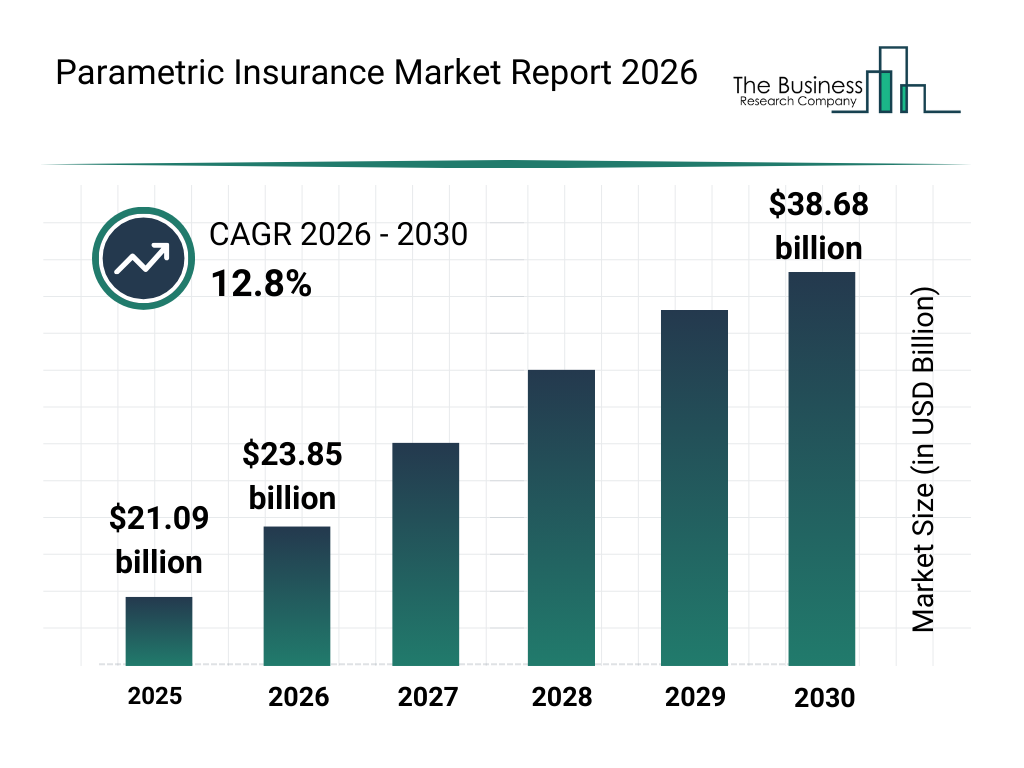
- The global parametric insurance market is expected to grow to $23.85 billion in 2026, reflecting rising demand for faster automated insurance payouts.
- With continued expansion, the industry could reach about $26.90 billion in 2027 as insurers increase the use of weather and event-based coverage models.
- By 2028, the parametric insurance market may grow to roughly $30.34 billion, supported by stronger use in agriculture, disaster coverage, and climate risk protection.
- The market could climb to nearly $34.23 billion in 2029, as businesses adopt data-triggered insurance solutions for faster claims processing.
- By 2030, the global parametric insurance market is projected to reach $38.68 billion, highlighting rapid expansion across insurance, reinsurance, and climate risk sectors.
- Overall, the market is expected to grow at a 12.8% CAGR from 2026 to 2030, showing strong long-term growth in automated and data-based insurance products.
 (Reference: The Business Research Company)
Parametric Insurance Market Drivers
- The increasing frequency of natural disasters has led to a 30% rise in demand for parametric policies across vulnerable regions.
- Climate change legislation worldwide encourages businesses to adopt parametric insurance, leading to a 15% annual growth in climate-related parametric policies.
- Data accuracy improvements through satellite and IoT technology are enhancing policy reliability, with 60% of insurers now integrating advanced data sources to define triggers.
- Customer demand for faster claim payouts remains strong, with 88% of policyholders citing immediate payouts as a primary reason for choosing parametric over traditional insurance.
- Rising insurance premiums in traditional markets make parametric insurance more attractive, with average savings of 20% on premium costs driving adoption.
- Increased government support and partnerships, particularly in climate-vulnerable countries, contribute to a 25% growth in public-private parametric insurance collaborations.
- Expansion of digital platforms enables easier access and customization, with online sales accounting for 60% of all parametric insurance purchases.
Biggest Drivers of Profitability for Insurance Organizations
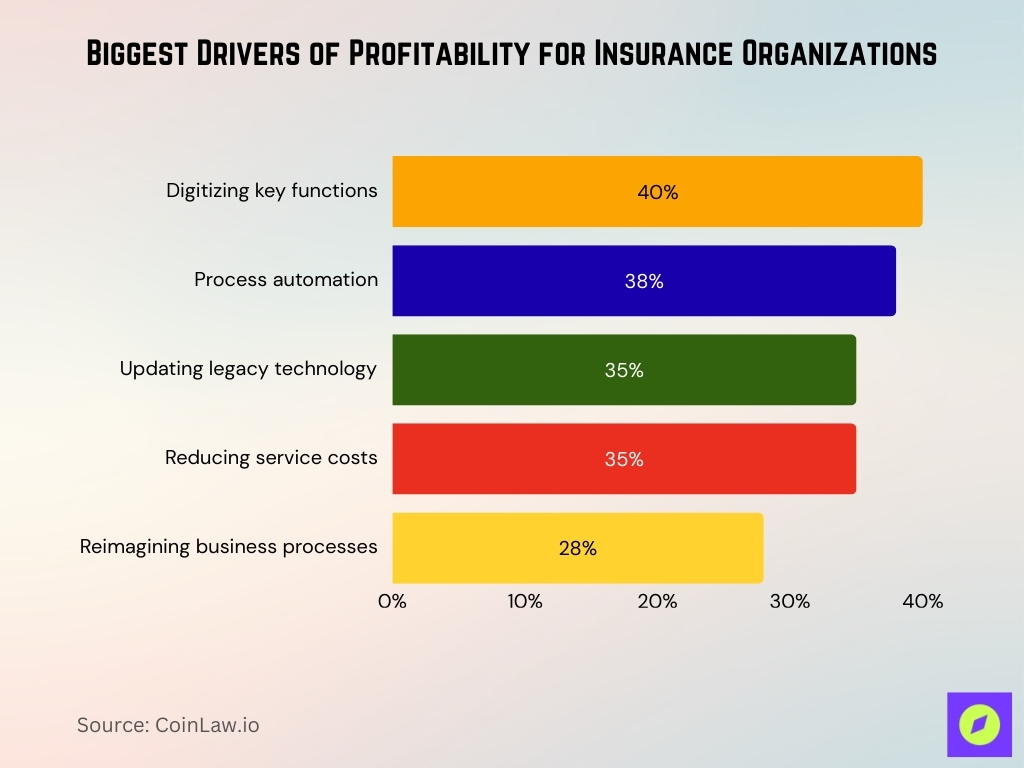
- Digitizing key functions ranks as the top driver, with 40% of insurance organizations expecting it to deliver the largest profitability gains over the next two years.
- Greater process automation follows closely, as 38% of insurers believe automation technologies will improve operational efficiency and boost profits.
- Updating legacy technology architecture is also critical, with 35% of insurance companies planning to modernize outdated systems to improve performance and reduce delays.
- Reducing service costs per customer remains a major focus, as 35% of organizations aim to improve profitability by cutting operational expenses and improving service efficiency.
- Reimagining business processes is another strategy, with 28% of insurers looking to redesign workflows and operations to drive better financial results.
 (Reference: DICEUS)
The Power of Technology in Parametric Insurance
- Satellite data usage in parametric insurance grew by 38% in 2025, enabling faster, more accurate event validation for floods, droughts, and hurricanes.
- AI adoption surged, with 53% of parametric insurers using AI-driven models for real-time trigger calibration and dynamic pricing.
- Blockchain-based policies now make up 44% of new parametric offerings, improving data integrity and speeding up claims resolution.
- Geolocation and GPS tech are used by 72% of insurers to track event precision and optimize risk zones.
- Automated claims systems processed over 85% of parametric claims within 24–48 hours, outperforming traditional models.
- Big Data analytics improved risk modeling accuracy by 17%, refining parametric thresholds and reducing false triggers.
- Mobile-first access is rising, with 37% of customers managing parametric policies via dedicated mobile apps.
- Blockchain adoption rose to 48% among parametric insurers for secure and automated payouts.
- IoT-driven parametric policies increased 33% annually, thanks to real-time risk monitoring.
Parametric Insurance Market by End Use
- The corporate segment dominates with a 50% revenue share.
- Government use ranks second largest at 40% market share.
- Individual end users account for the remaining 10% share.
- Corporate adoption grew 12% YoY, driven by supply chain risks.
- Governments expanded parametric use by 18% for disaster funds.
- Individual policies surged 25% with microinsurance programs.
Parametric Insurance Segmentation
- Climate-based parametric insurance dominates with a 47% market share.
- The agriculture segment comprises 31% of policies.
- The energy sector accounts for 21% of the parametric market.
- Travel and hospitality represent 6% of policies.
- Event-triggered policies hold 16% of the global market.
- Healthcare coverage exceeds $1.4 billion in value.
- Marine and aviation sectors claim a combined 5% share.
Barriers to Parametric Insurance Adoption
- 65% of brokers cite basis risk concerns.
- 61% of MGAs note data/trigger issues.
- 58% of (re)insurers highlight adoption barriers.
- 26% of MGAs report basis risk worries.
- 10% of (re)insurers face bad data concerns.
- 28% of brokers mention the cost of capacity.
- 17% of (re)insurers note distribution costs.
- 15% of (re)insurers flag regulation concerns.
Competitive Landscape and Key Companies
- Swiss Re leads with $1.8 billion invested in parametric solutions.
- AXA Climate holds 37% of parametric policies in agri-coverage.
- Munich Re saw a 24% increase in natural disaster parametric policies.
- Global Parametrics manages over $240 million in disaster recovery coverage.
- Jumpstart Insurance is active in 12+ US states for earthquake payouts.
- Nephila Capital oversees $620 million in weather and cat-risk policies.
- Lloyd’s of London focuses on flood and cyclone solutions in emerging markets.
Frequently Asked Questions (FAQs)
Natural catastrophe coverage accounts for about 70% of the parametric insurance market globally.
Corporate applications represent roughly 50% of end-use adoption in the parametric insurance market.
In 2024, the global protection gap reached about 60%, with $368 billion in economic losses but only $145 billion insured, fueling demand for parametric solutions.
Conclusion
Parametric insurance is reshaping the insurance landscape, offering rapid, data-driven solutions that address the growing need for protection against climate and catastrophic risks. The industry’s expansion highlights a broader shift towards innovative, tech-driven insurance models that provide faster payouts, greater transparency, and cost-effective alternatives to traditional insurance. With advancements in AI, blockchain, and IoT, the scope of parametric insurance is widening, and its applications are expected to grow in both high-risk and emerging markets.
As climate volatility continues to impact global economies and daily lives, parametric insurance represents a proactive, flexible option that can adapt to various sectors’ unique challenges. From agriculture to travel, and energy to finance, this insurance model’s potential is vast and transformative. The next decade is likely to see parametric insurance become a cornerstone in climate resilience and economic stability, providing peace of mind to businesses and individuals alike.
The post Parametric Insurance Industry Statistics 2026: Payout Trends Now appeared first on CoinLaw.
Potrebbe anche piacerti

Midnight is Predicted to Drop to $0.042605 By Mar 15, 2026

Whale Already Holding Long Position Buys ETH, Price Spike?