The dominant force in this cycle comes from institutions. The four major cryptocurrencies, BTC, ETH, SOL, and BNB, have all hit new highs, but only BTC and BNB have continued to rise by over 40% since breaking through their all-time highs. SOL achieved a breakout earlier this year thanks to Trump's coin launch, while ETH experienced a revaluation mid-year driven by DAT buying, but neither has yet reached a new high. The Federal Reserve cut interest rates last night. How far can this round of institutional-led market trends go? 1. The institutional configuration logic of the three major currencies The positioning of crypto assets directly determines their long-term value, and different positioning corresponds to different institutional configuration logic. Bitcoin: The anti-inflation property of digital gold Positioned as "digital gold," its long-term logic is strongly tied to the fiat currency inflation cycle. Data shows that its market capitalization growth is synchronized with Global M2 and negatively correlated with the US dollar index. Its core value lies in its "inflation resistance" and value preservation and appreciation, making it a fundamental target for institutional investment. Ethereum: The Institutional Narrative Dividend of the World Computer Positioned as the "World Computer," although the foundation's "Layer 2 scaling" narrative has failed to gain traction in the capital market, its stable system, with 10 years of zero downtime, has capitalized on the development of institutional narratives such as US dollar stablecoins, RWAs, and the tokenization of US stocks. It has shrugged off the collapse of the Web3 narrative, and with the crucial push from DAT, has achieved a revaluation of its market capitalization. Ethereum, with its stability and security, will become the settlement network for institutional applications. Solana: The Active Advantage of Online Capital Markets Positioned as an "Internet Capital Market," Solana (ICM) stands for on-chain asset issuance, trading, and clearing. It has experienced a resurgence following the collapse of FTX. Year-to-date, it accounts for 46% of on-chain trading volume, with over 3 million daily active users year-round, making it the most active blockchain network. Solana, with its superior performance and high liquidity, will be the catalyst for the crypto-native on-chain trading ecosystem. The three platforms have distinct positioning, leading to different institutional investment logic. Traditional financial institutions first understand the value of Bitcoin, then consider developing their institutional business based on Ethereum, and finally, perhaps recognize the value of on-chain transactions. This is a typical path: question, understand, and become a part of it. Second, institutional holdings of the three major currencies show gradient differences The institutional holdings data of BTC, ETH, and SOL show obvious gradient differences, which also reflects the degree and rhythm of institutions' recognition of these three projects. Chart by: IOBC Capital From the comparison, we can see that institutional holdings of BTC and ETH account for > 18% of the circulating supply; SOL currently only accounts for 9.5%, and there may be room for replenishment. 3. SOL DAT: New Trends in Crypto Concept Stocks In the past month or so, 18 SOL DAT companies have come onto the scene, directly pushing SOL up by more than 50% from its August low. The louder SOL DAT company: Chart by: IOBC Capital Among the existing SOL DAT companies, Forward Industries, led by Multicoin Capital founder Kyle Samani, may become the SOL DAT leader. Unlike BTC DAT, which simply hoards coins, many SOL DAT companies will build their own Solana Validators, so that this is not limited to the "NAV game". Instead of simply waiting for token appreciation, they will continue to obtain cash flow income through the Validator business. This strategy is equivalent to "hoarding coins + mining", which is both long-term and profitable in the short term. 4. Crypto Concept Stocks: A Mapping of Capital Market Betting Crypto concept stocks are a new bridge between traditional capital and the crypto market. The degree of recognition of various Crypto businesses by the traditional financial market is also reflected in the stock price performance of crypto concept stocks. Chart by: IOBC Capital Looking back at the crypto stocks that have seen significant gains this round, we can see two common characteristics: 1. Only by betting big can a valuation reassessment be achieved. There are 189 publicly listed companies holding BTC, but only 30 hold 70% of their stock market capitalization, and only 12 hold more than 10,000 BTC—and these 12 have seen significant gains. A similar pattern is observed among listed ETH DATs. A superficial DAT strategy can only cause short-term stock price fluctuations and cannot substantially boost stock market capitalization or liquidity. 2. Business synergy can amplify commercial value. Transforming a single-point business into a multifaceted industry chain layout can amplify commercial value. For example, Robinhood, through its expansion into cryptocurrency trading, real-world asset trading (RRE), and participation in the USDG stablecoin, has formed a closed-loop business cycle for capital flow, leading to record highs in its stock price. Conversely, while Trump Media has also invested heavily in crypto (holding BTC, applying for an ETH ETF, and issuing tokens like Trump, Melania, and WLFI), the lack of synergy between its businesses has ultimately led to a lackluster market response to both its stock and its token. Ending The project philosophies of Bitcoin, Ethereum, and Solana correspond to three instincts of human beings when facing the future: survival, order, and flow.The dominant force in this cycle comes from institutions. The four major cryptocurrencies, BTC, ETH, SOL, and BNB, have all hit new highs, but only BTC and BNB have continued to rise by over 40% since breaking through their all-time highs. SOL achieved a breakout earlier this year thanks to Trump's coin launch, while ETH experienced a revaluation mid-year driven by DAT buying, but neither has yet reached a new high. The Federal Reserve cut interest rates last night. How far can this round of institutional-led market trends go? 1. The institutional configuration logic of the three major currencies The positioning of crypto assets directly determines their long-term value, and different positioning corresponds to different institutional configuration logic. Bitcoin: The anti-inflation property of digital gold Positioned as "digital gold," its long-term logic is strongly tied to the fiat currency inflation cycle. Data shows that its market capitalization growth is synchronized with Global M2 and negatively correlated with the US dollar index. Its core value lies in its "inflation resistance" and value preservation and appreciation, making it a fundamental target for institutional investment. Ethereum: The Institutional Narrative Dividend of the World Computer Positioned as the "World Computer," although the foundation's "Layer 2 scaling" narrative has failed to gain traction in the capital market, its stable system, with 10 years of zero downtime, has capitalized on the development of institutional narratives such as US dollar stablecoins, RWAs, and the tokenization of US stocks. It has shrugged off the collapse of the Web3 narrative, and with the crucial push from DAT, has achieved a revaluation of its market capitalization. Ethereum, with its stability and security, will become the settlement network for institutional applications. Solana: The Active Advantage of Online Capital Markets Positioned as an "Internet Capital Market," Solana (ICM) stands for on-chain asset issuance, trading, and clearing. It has experienced a resurgence following the collapse of FTX. Year-to-date, it accounts for 46% of on-chain trading volume, with over 3 million daily active users year-round, making it the most active blockchain network. Solana, with its superior performance and high liquidity, will be the catalyst for the crypto-native on-chain trading ecosystem. The three platforms have distinct positioning, leading to different institutional investment logic. Traditional financial institutions first understand the value of Bitcoin, then consider developing their institutional business based on Ethereum, and finally, perhaps recognize the value of on-chain transactions. This is a typical path: question, understand, and become a part of it. Second, institutional holdings of the three major currencies show gradient differences The institutional holdings data of BTC, ETH, and SOL show obvious gradient differences, which also reflects the degree and rhythm of institutions' recognition of these three projects. Chart by: IOBC Capital From the comparison, we can see that institutional holdings of BTC and ETH account for > 18% of the circulating supply; SOL currently only accounts for 9.5%, and there may be room for replenishment. 3. SOL DAT: New Trends in Crypto Concept Stocks In the past month or so, 18 SOL DAT companies have come onto the scene, directly pushing SOL up by more than 50% from its August low. The louder SOL DAT company: Chart by: IOBC Capital Among the existing SOL DAT companies, Forward Industries, led by Multicoin Capital founder Kyle Samani, may become the SOL DAT leader. Unlike BTC DAT, which simply hoards coins, many SOL DAT companies will build their own Solana Validators, so that this is not limited to the "NAV game". Instead of simply waiting for token appreciation, they will continue to obtain cash flow income through the Validator business. This strategy is equivalent to "hoarding coins + mining", which is both long-term and profitable in the short term. 4. Crypto Concept Stocks: A Mapping of Capital Market Betting Crypto concept stocks are a new bridge between traditional capital and the crypto market. The degree of recognition of various Crypto businesses by the traditional financial market is also reflected in the stock price performance of crypto concept stocks. Chart by: IOBC Capital Looking back at the crypto stocks that have seen significant gains this round, we can see two common characteristics: 1. Only by betting big can a valuation reassessment be achieved. There are 189 publicly listed companies holding BTC, but only 30 hold 70% of their stock market capitalization, and only 12 hold more than 10,000 BTC—and these 12 have seen significant gains. A similar pattern is observed among listed ETH DATs. A superficial DAT strategy can only cause short-term stock price fluctuations and cannot substantially boost stock market capitalization or liquidity. 2. Business synergy can amplify commercial value. Transforming a single-point business into a multifaceted industry chain layout can amplify commercial value. For example, Robinhood, through its expansion into cryptocurrency trading, real-world asset trading (RRE), and participation in the USDG stablecoin, has formed a closed-loop business cycle for capital flow, leading to record highs in its stock price. Conversely, while Trump Media has also invested heavily in crypto (holding BTC, applying for an ETH ETF, and issuing tokens like Trump, Melania, and WLFI), the lack of synergy between its businesses has ultimately led to a lackluster market response to both its stock and its token. Ending The project philosophies of Bitcoin, Ethereum, and Solana correspond to three instincts of human beings when facing the future: survival, order, and flow.

After the interest rate cut, how far can the institutional bull market go?

2025/09/18 19:00

The dominant force in this cycle comes from institutions.

The four major cryptocurrencies, BTC, ETH, SOL, and BNB, have all hit new highs, but only BTC and BNB have continued to rise by over 40% since breaking through their all-time highs. SOL achieved a breakout earlier this year thanks to Trump's coin launch, while ETH experienced a revaluation mid-year driven by DAT buying, but neither has yet reached a new high.

The Federal Reserve cut interest rates last night. How far can this round of institutional-led market trends go?

1. The institutional configuration logic of the three major currencies

The positioning of crypto assets directly determines their long-term value, and different positioning corresponds to different institutional configuration logic.

Bitcoin: The anti-inflation property of digital gold

Positioned as "digital gold," its long-term logic is strongly tied to the fiat currency inflation cycle. Data shows that its market capitalization growth is synchronized with Global M2 and negatively correlated with the US dollar index. Its core value lies in its "inflation resistance" and value preservation and appreciation, making it a fundamental target for institutional investment.

Ethereum: The Institutional Narrative Dividend of the World Computer

Positioned as the "World Computer," although the foundation's "Layer 2 scaling" narrative has failed to gain traction in the capital market, its stable system, with 10 years of zero downtime, has capitalized on the development of institutional narratives such as US dollar stablecoins, RWAs, and the tokenization of US stocks. It has shrugged off the collapse of the Web3 narrative, and with the crucial push from DAT, has achieved a revaluation of its market capitalization. Ethereum, with its stability and security, will become the settlement network for institutional applications.

Solana: The Active Advantage of Online Capital Markets

Positioned as an "Internet Capital Market," Solana (ICM) stands for on-chain asset issuance, trading, and clearing. It has experienced a resurgence following the collapse of FTX. Year-to-date, it accounts for 46% of on-chain trading volume, with over 3 million daily active users year-round, making it the most active blockchain network. Solana, with its superior performance and high liquidity, will be the catalyst for the crypto-native on-chain trading ecosystem.

The three platforms have distinct positioning, leading to different institutional investment logic. Traditional financial institutions first understand the value of Bitcoin, then consider developing their institutional business based on Ethereum, and finally, perhaps recognize the value of on-chain transactions. This is a typical path: question, understand, and become a part of it.

Second, institutional holdings of the three major currencies show gradient differences

The institutional holdings data of BTC, ETH, and SOL show obvious gradient differences, which also reflects the degree and rhythm of institutions' recognition of these three projects.
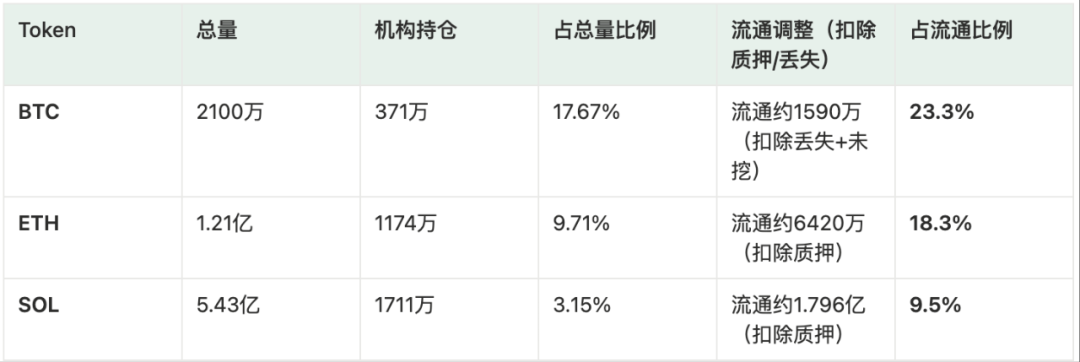
 Chart by: IOBC Capital

From the comparison, we can see that institutional holdings of BTC and ETH account for > 18% of the circulating supply; SOL currently only accounts for 9.5%, and there may be room for replenishment.

In the past month or so, 18 SOL DAT companies have come onto the scene, directly pushing SOL up by more than 50% from its August low.

The louder SOL DAT company:
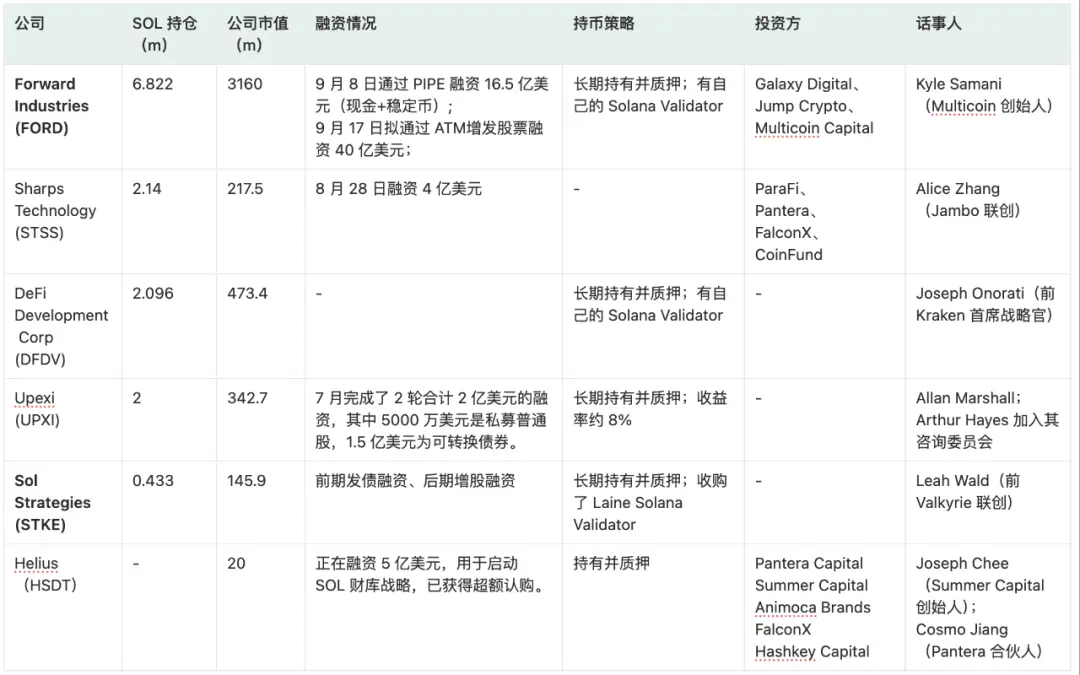
 Chart by: IOBC Capital

Among the existing SOL DAT companies, Forward Industries, led by Multicoin Capital founder Kyle Samani, may become the SOL DAT leader.

Unlike BTC DAT, which simply hoards coins, many SOL DAT companies will build their own Solana Validators, so that this is not limited to the "NAV game". Instead of simply waiting for token appreciation, they will continue to obtain cash flow income through the Validator business. This strategy is equivalent to "hoarding coins + mining", which is both long-term and profitable in the short term.

4. Crypto Concept Stocks: A Mapping of Capital Market Betting

Crypto concept stocks are a new bridge between traditional capital and the crypto market. The degree of recognition of various Crypto businesses by the traditional financial market is also reflected in the stock price performance of crypto concept stocks.
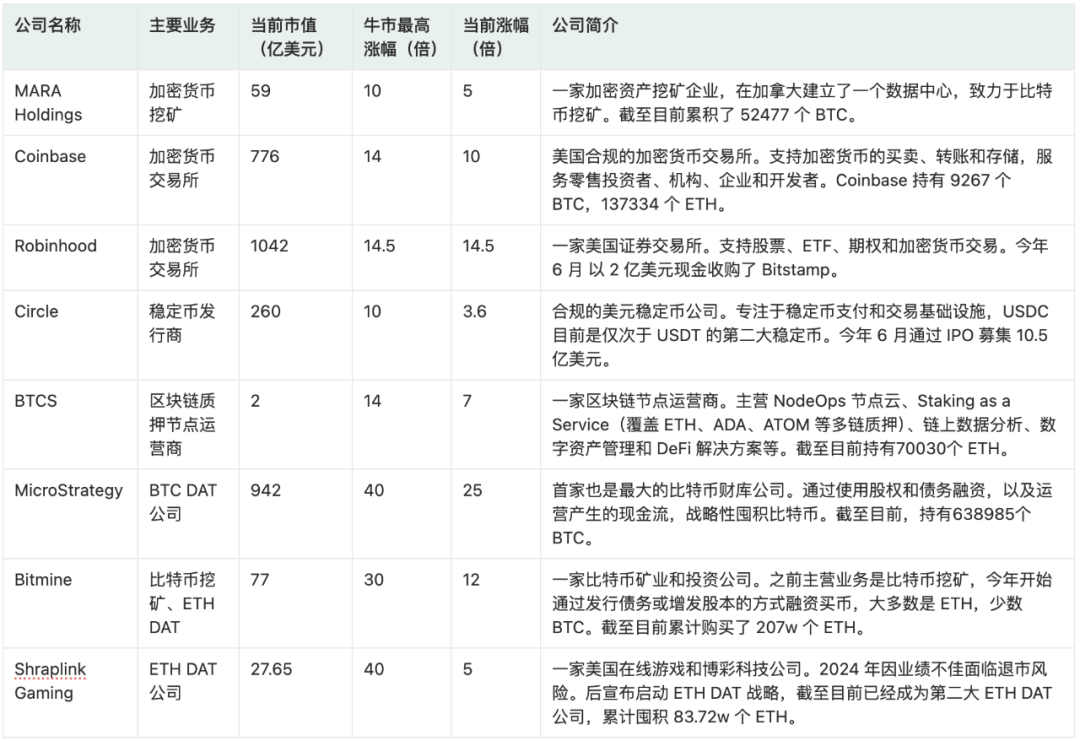
 Chart by: IOBC Capital

Looking back at the crypto stocks that have seen significant gains this round, we can see two common characteristics:

1. Only by betting big can a valuation reassessment be achieved. There are 189 publicly listed companies holding BTC, but only 30 hold 70% of their stock market capitalization, and only 12 hold more than 10,000 BTC—and these 12 have seen significant gains. A similar pattern is observed among listed ETH DATs. A superficial DAT strategy can only cause short-term stock price fluctuations and cannot substantially boost stock market capitalization or liquidity.

2. Business synergy can amplify commercial value. Transforming a single-point business into a multifaceted industry chain layout can amplify commercial value. For example, Robinhood, through its expansion into cryptocurrency trading, real-world asset trading (RRE), and participation in the USDG stablecoin, has formed a closed-loop business cycle for capital flow, leading to record highs in its stock price. Conversely, while Trump Media has also invested heavily in crypto (holding BTC, applying for an ETH ETF, and issuing tokens like Trump, Melania, and WLFI), the lack of synergy between its businesses has ultimately led to a lackluster market response to both its stock and its token.

Ending

The project philosophies of Bitcoin, Ethereum, and Solana correspond to three instincts of human beings when facing the future: survival, order, and flow.

시장 기회
솔라나 로고
솔라나 가격(SOL)
$144,26
$144,26$144,26
+%0,54
USD
솔라나 (SOL) 실시간 가격 차트
면책 조항: 본 사이트에 재게시된 글들은 공개 플랫폼에서 가져온 것으로 정보 제공 목적으로만 제공됩니다. 이는 반드시 MEXC의 견해를 반영하는 것은 아닙니다. 모든 권리는 원저자에게 있습니다. 제3자의 권리를 침해하는 콘텐츠가 있다고 판단될 경우, [email protected]으로 연락하여 삭제 요청을 해주시기 바랍니다. MEXC는 콘텐츠의 정확성, 완전성 또는 시의적절성에 대해 어떠한 보증도 하지 않으며, 제공된 정보에 기반하여 취해진 어떠한 조치에 대해서도 책임을 지지 않습니다. 본 콘텐츠는 금융, 법률 또는 기타 전문적인 조언을 구성하지 않으며, MEXC의 추천이나 보증으로 간주되어서는 안 됩니다.

추천 콘텐츠

How to earn from cloud mining: IeByte’s upgraded auto-cloud mining platform unlocks genuine passive earnings

How to earn from cloud mining: IeByte’s upgraded auto-cloud mining platform unlocks genuine passive earnings

The post How to earn from cloud mining: IeByte’s upgraded auto-cloud mining platform unlocks genuine passive earnings appeared on BitcoinEthereumNews.com. contributor Posted: September 17, 2025 As digital assets continue to reshape global finance, cloud mining has become one of the most effective ways for investors to generate stable passive income. Addressing the growing demand for simplicity, security, and profitability, IeByte has officially upgraded its fully automated cloud mining platform, empowering both beginners and experienced investors to earn Bitcoin, Dogecoin, and other mainstream cryptocurrencies without the need for hardware or technical expertise. Why cloud mining in 2025? Traditional crypto mining requires expensive hardware, high electricity costs, and constant maintenance. In 2025, with blockchain networks becoming more competitive, these barriers have grown even higher. Cloud mining solves this by allowing users to lease professional mining power remotely, eliminating the upfront costs and complexity. IeByte stands at the forefront of this transformation, offering investors a transparent and seamless path to daily earnings. IeByte’s upgraded auto-cloud mining platform With its latest upgrade, IeByte introduces: Full Automation: Mining contracts can be activated in just one click, with all processes handled by IeByte’s servers. Enhanced Security: Bank-grade encryption, cold wallets, and real-time monitoring protect every transaction. Scalable Options: From starter packages to high-level investment contracts, investors can choose the plan that matches their goals. Global Reach: Already trusted by users in over 100 countries. Mining contracts for 2025 IeByte offers a wide range of contracts tailored for every investor level. From entry-level plans with daily returns to premium high-yield packages, the platform ensures maximum accessibility. Contract Type Duration Price Daily Reward Total Earnings (Principal + Profit) Starter Contract 1 Day $200 $6 $200 + $6 + $10 bonus Bronze Basic Contract 2 Days $500 $13.5 $500 + $27 Bronze Basic Contract 3 Days $1,200 $36 $1,200 + $108 Silver Advanced Contract 1 Day $5,000 $175 $5,000 + $175 Silver Advanced Contract 2 Days $8,000 $320 $8,000 + $640 Silver…
공유하기
BitcoinEthereumNews2025/09/17 23:48
China Blocks Nvidia’s RTX Pro 6000D as Local Chips Rise

China Blocks Nvidia’s RTX Pro 6000D as Local Chips Rise

The post China Blocks Nvidia’s RTX Pro 6000D as Local Chips Rise appeared on BitcoinEthereumNews.com. China Blocks Nvidia’s RTX Pro 6000D as Local Chips Rise China’s internet regulator has ordered the country’s biggest technology firms, including Alibaba and ByteDance, to stop purchasing Nvidia’s RTX Pro 6000D GPUs. According to the Financial Times, the move shuts down the last major channel for mass supplies of American chips to the Chinese market. Why Beijing Halted Nvidia Purchases Chinese companies had planned to buy tens of thousands of RTX Pro 6000D accelerators and had already begun testing them in servers. But regulators intervened, halting the purchases and signaling stricter controls than earlier measures placed on Nvidia’s H20 chip. Image: Nvidia An audit compared Huawei and Cambricon processors, along with chips developed by Alibaba and Baidu, against Nvidia’s export-approved products. Regulators concluded that Chinese chips had reached performance levels comparable to the restricted U.S. models. This assessment pushed authorities to advise firms to rely more heavily on domestic processors, further tightening Nvidia’s already limited position in China. China’s Drive Toward Tech Independence The decision highlights Beijing’s focus on import substitution — developing self-sufficient chip production to reduce reliance on U.S. supplies. “The signal is now clear: all attention is focused on building a domestic ecosystem,” said a representative of a leading Chinese tech company. Nvidia had unveiled the RTX Pro 6000D in July 2025 during CEO Jensen Huang’s visit to Beijing, in an attempt to keep a foothold in China after Washington restricted exports of its most advanced chips. But momentum is shifting. Industry sources told the Financial Times that Chinese manufacturers plan to triple AI chip production next year to meet growing demand. They believe “domestic supply will now be sufficient without Nvidia.” What It Means for the Future With Huawei, Cambricon, Alibaba, and Baidu stepping up, China is positioning itself for long-term technological independence. Nvidia, meanwhile, faces…
공유하기
BitcoinEthereumNews2025/09/18 01:37
Stablecoin rewards provisions face industry test in Senate crypto bill

Stablecoin rewards provisions face industry test in Senate crypto bill

With the CLARITY Act scheduled for a markup on Thursday, some lawmakers could still be at odds over decentralized finance, stablecoins and ethical concerns.As US
공유하기
Coinstats2026/01/14 01:52