Nigeria’s innovation flywheel: Turning early AI uptake into economic acceleration
By Deen Yusuf, Managing Director, Microsoft Nigeria
Nigeria has never struggled with ingenuity. It is a place where innovation grows from necessity, and where developers, entrepreneurs, and problem solvers consistently push past limitations to build what does not yet exist.
But in the era of artificial intelligence, ingenuity alone is no longer enough. The nations that will lead are those that not only innovate, but also ensure AI reaches workers at every level of the economy, because innovation without diffusion is simply potential left on the shelf.
See also: Artificial Intelligence to add $1 trillion to Africa’s GDP by 2035- AfDB report
Yet research shows this diffusion is far from guaranteed. While global generative AI usage continues to rise, the adoption gap between the Global North and Global South is widening at almost twice the rate.
Even the United States, despite leading in frontier AI, has fallen behind smaller, highly digitized economies in workforce adoption.
 Deen Yusuf, Managing Director, Microsoft Nigeria
It’s clear that access constraints, not a lack of creativity or ambition, pose the greatest threat to equitable AI progress. For Africa, and for Nigeria in particular, this risk cannot be ignored.
The barriers slowing Nigeria’s AI acceleration
Microsoft’s Global AI Adoption in 2025: A Widening Digital Divide report shows that though Nigeria’s appetite for innovation remains strong, the underlying systems required to translate that energy into mainstream adoption are underdeveloped. While startups, government institutions, researchers, and investors are actively exploring AI applications across multiple sectors, national adoption has risen only marginally, up just 0.6 percentage points, from 8.7 percent in the first half of 2025 to 9.3 percent in the second half of the year.
Access remains the most immediate constraint. Connectivity gaps, inconsistent speeds, and high data costs limit the everyday use of AI tools. With median mobile speeds of 46.78 Mbps and fixed broadband at 27.54 Mbps, Nigeria ranks below the global benchmarks needed for reliable, cloud-based AI services.
Skills shortages create a second barrier. While momentum is building, Nigeria still requires the specialized talent required to build, integrate, and manage advanced AI systems. Talent emigration further widens the gap.
Language and localization gaps compound the challenge. Most large language models leverage English-language training data, excluding many Nigerian languages and limiting the cultural relevance of AI tools in a country with rich linguistic diversity.
Finally, fragmented regulation slows progress. Overlapping mandates across agencies create uncertainty around governance, privacy, and security, fueling public hesitation and reinforcing fears around job displacement.
Learning from global AI leaders
The fastest-accelerating countries, including the UAE, Singapore, Norway, Ireland, France and Spain, share a clear blueprint: early investment in digital infrastructure, robust skilling ecosystems, and decisive government leadership.
The impact of this approach is evident in the UAE, where the AI Diffusion Report shows national adoption rising from 59.4 percent in the first half of 2025 to 64 percent in the latter half, a 4.6-percentage-point increase.
See also: The hidden risks of our love affair with Artificial Intelligence
The Emirates’ AI advantage didn’t materialize overnight. It was built deliberately and with years of foresight. In October 2017, five full years before ChatGPT captured global attention, the UAE appointed the world’s first Minister of State for Artificial Intelligence. That same year, the country launched a national AI strategy covering nine priority sectors and establishing governance frameworks.
This sequencing proved consequential. When the current generative AI wave arrived, UAE residents encountered a familiar technology, one their government had been deploying in public services and discussing in national conversations for half a decade. The foundation was already in place.
Regulatory pragmatism has been a key driver of the UAE’s rise as a global AI leader. Early on, the country established sandbox environments that allowed controlled experimentation and learning. It then introduced targeted visa programs to attract and retain AI talent, ensuring the ecosystem could scale.
This was reinforced by principle-based guidelines that offered clear direction without stifling innovation or creating compliance paralysis.
Over time, this approach built trust in the most durable way possible: through proven outcomes and AI systems that deliver value in everyday transactions.
For Nigeria, a similar path begins with deliberate government action through initiatives such as 3MTT and Project Bridge.
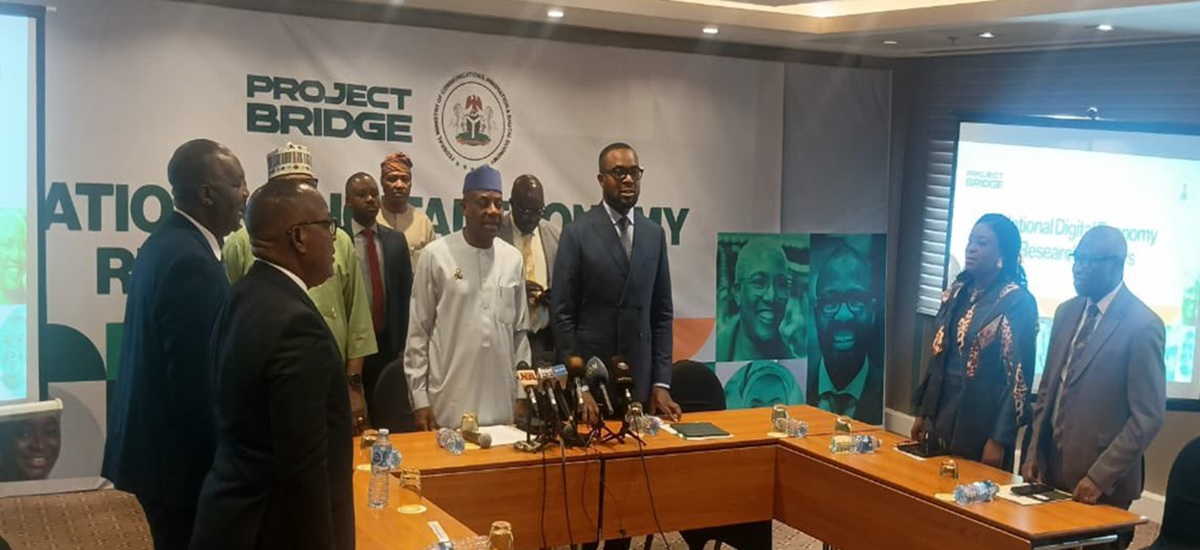 A Project Bridge discussion session featuring the Minister of Communications, Bosun Tijani
These programs lay the groundwork for strengthening talent and infrastructure, expanding access and connectivity, and accelerating digitization across ministries, departments and agencies.
Professional bodies also have a critical role to play. Through training, workshops, and sector-specific guidance, they can demystify AI, correct misconceptions, and help workers understand its benefits.
Early adopters already show what is possible. Through its advanced analytics-driven marketing platform, Terragon Group is helping its clients achieve returns of up to 900 percent, while financial services group Access Holdings has significantly accelerated product development cycles using AI-driven tools.
Local language relevance is equally essential. South Korea’s surge in AI adoption, for example, rising from 25th to 18th in the global rankings, only accelerated once AI models became highly effective in Korean. Nigeria can follow this path by investing in indigenous language AI.
Initiatives such as Awarri and Paza, a recent collaboration with Microsoft Research, are starting to show how culturally rooted AI tools can expand access and inclusion.
 Artificial Intelligence (AI) in Africa
Nigeria stands at a pivotal moment. The ingenuity is here; the ambition is here, and now the pathway is clear.
With focused investment in infrastructure, talent, localization, and forward-leaning governance, the country can move from early promise to broad-based AI participation, ensuring AI becomes a driver of inclusive growth and opportunity for every Nigerian.


추천 콘텐츠

USD/JPY Analysis: The Currency Pair’s Critical Rebound Above 159.00 Faces Intense Scrutiny

Philippines SEC Warns Against dYdX and 6 Crypto Platforms