

OCC Approves Augustus AI-Stablecoin Bank Charter, Sets Precedent
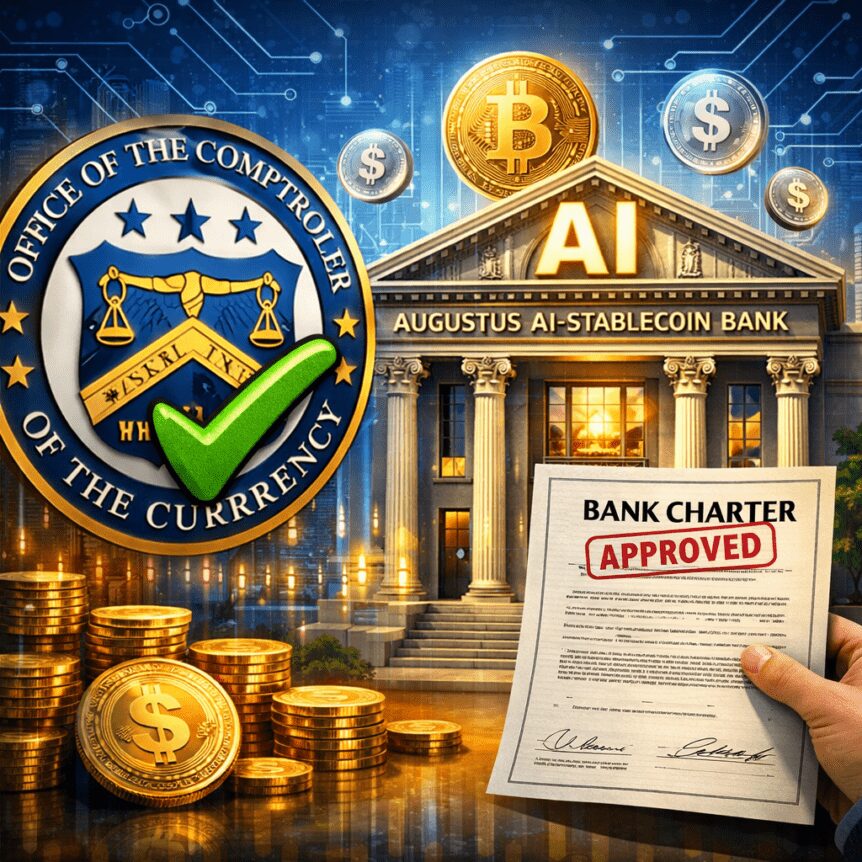
Augustus, a payments group backed by Peter Thiel’s Valar Ventures, has received conditional approval from the U.S. Office of the Comptroller of the Currency (OCC) to charter a U.S. national bank focused on artificial intelligence and stablecoin-based payments. The decision marks a notable step in the ongoing push to modernize cross-border settlement infrastructure through tokenized dollars and blockchain-enabled rails, expanding Augustus’ European operations into the United States.
The approval, announced recently, would allow Augustus National Bank to proceed toward a fully chartered U.S. national bank, but only after meeting the OCC’s pre-opening requirements. The company describes the institution as “the first clearing bank for the AI era,” built on an AI- and stablecoin-native core intended to interface with machine agents at “the speed of compute,” reducing reliance on traditional batch processes and manual clerical work. This characterization comes from Augustus’ own materials accompanying the regulatory filing.
Founded in 2022, Augustus operates under European banking licenses and has reported serving institutional clients with significant flows, including cryptocurrency exchange Kraken. While the proposed U.S. national bank charter represents a major milestone, the OCC approval remains conditional until the pre-opening criteria are satisfied. In line with the OCC’s evolving approach to digital assets, the path to a federally chartered bank remains selective and tightly regulated.
Augustus secures OCC conditional approval. Source: PR Newswire
Related: Stablecoin issuer Circle faces lawsuit over Drift Protocol hack
Notably, Augustus joins a small cohort of digital-asset firms that have advanced to the more stringent federal chartering process. Other players, such as Ripple and Circle, have pursued national charter options under OCC oversight, but only a subset have reached advanced stages in the formal chartering process. The OCC’s conditional approval underscores a broader, ongoing debate about how digital-asset firms should be integrated into the U.S. banking system and supervised under traditional bank regulatory frameworks.
Key takeaways
- The OCC issued conditional approval for Augustus National Bank to pursue a U.S. national bank charter, contingent on meeting pre-opening requirements.
- Augustus aims to extend its European banking operations into the United States, framed around AI-enabled clearing and stablecoin-based settlement.
- The bank’s framework is described as “the first clearing bank for the AI era,” leveraging AI- and stablecoin-native core technology to interface with machine agents.
- Augustus operates with European licenses and reports institutional client activity, including services for Kraken; this U.S. charter would place it among a select group of firms progressing toward federally chartered status.
- Regulatory and policy context emphasizes a shift toward tokenized-dollar rails within regulated banking, intersecting with GENIUS Act provisions and ongoing cross-border settlement innovations (Circle–Finastra, Citi/HSBC tokenized deposits).
Regulatory milestone and charter dynamics
The OCC’s conditional green light reflects a deliberate approach to digital-asset and tokenized-payment initiatives within the U.S. banking system. While the OCC has signaled openness to “fintech-friendly” approaches and national-charter pathways for select firms, chartering remains contingent on robust compliance, capital, liquidity, and governance standards, as well as careful scrutiny of risk management, cyber resilience, and customer protection frameworks.
Industry observers note that, despite the broader trend toward modernization, only a handful of firms have progressed to advanced stages of federal chartering in recent years. The OCC has previously authorized banking charters or similar umbrellas for digital-asset firms and crypto-related ventures, but the process remains deliberately cautious and capability-driven. Augustus’ conditional status aligns with the OCC’s pattern of staged approvals that allow firms to demonstrate risk controls, integrations with existing operations, and compliance readiness before a full charter is granted.
From a regulatory policy perspective, the Augusts development sits at the intersection of traditional supervisory oversight and a rapidly evolving tokenized-payments ecosystem. In the U.S., the GENIUS Act framework for stablecoins and payments contributes to a regulatory backdrop that envisions fully reserved-dollar token issuance within insured banking rails. This regulatory context informs how Augustus’ proposed charter might be evaluated in relation to liquidity provisioning, reserve management, and consumer protections. For cross-border market participants and financial institutions, the act creates a pathway for stablecoin settlement to be integrated with conventional bank infrastructure, subject to rigorous supervision and compliance requirements. More on GENIUS Act guidance
AI-era clearing bank and tokenized payments infrastructure
The strategic concept behind Augustus National Bank centers on an AI-native payments core that operates in concert with stablecoins to fulfill real-time settlement objectives. The proposed model emphasizes direct interaction with machine agents at high speed, reducing latency and operational friction that characterize legacy payment rails. This architectural shift aligns with a broader industry push to industrialize cross-border settlements, minimize settlement risk, and improve transparency in tokenized-dollar flows.
Within the broader policy and market landscape, there has been steady progress in enabling tokenized-dollar settlements inside regulated banking rails. Circle’s collaboration with core banking provider Finastra aims to streamline stablecoin settlement through the Global PAYplus hub, enabling cross-border settlements in USDC. Separately, major banks such as Citi and HSBC have started to roll out live tokenized-deposit capabilities to support near real-time, 24/7 cross-border and interbank payments. These developments, highlighted in industry coverage, illustrate a tangible trend toward integrating tokenized-dollar mechanisms into traditional banking operations. Circle–Finastra collaboration, Citi and HSBC tokenized deposits
From a compliance and supervisory standpoint, the prospect of AI-assisted clearing raises questions about governance, data integrity, and model risk management. Regulators would likely evaluate how AI systems influence settlement decisions, the controls around algorithmic decision-making, and the safeguards ensuring that tokenized assets remain fully backed and auditable. The ASC (anti-money-laundering) and KYC (know-your-customer) frameworks will remain central to supervisory judgments as custody, settlement, and liquidity management move closer to automated, real-time processes.
Industry context and regulatory landscape
Augustus’ filing arrives amid a broader strategic push to modernize U.S. settlement layers and to situate stablecoins within formal banking rails. The GENIUS Act regime is cited as a key enabling framework for issuing fully reserved-dollar tokens by banks and trust companies, with market participants actively exploring cross-border settlement opportunities under compliant standards. In parallel, the U.S. regulatory environment remains vigilant about the separation between traditional banking and digital-asset activities, reinforcing the need for robust licensing, oversight, and risk management to mitigate potential financial crime and consumer protection issues.
Comparative regulatory dynamics abroad add depth to the discussion. In Europe, MiCA (Markets in Crypto-Assets Regulation) represents a broad attempt to harmonize crypto licensing and oversight, while the U.S. approach tends to emphasize bank-charter status and prudent supervision under the OCC and related agencies. The intersection of U.S. banking supervision and crypto innovation continues to shape how firms structure settlements, custody, and asset issuance across borders, with Augustus’ case illustrating a potential template for enterprise-scale, AI-driven, tokenized-payments operations within a federally chartered framework.
Augustus’ backers—Valar Ventures, Creandum, and founders of Ramp and Deel—have positioned the group at the intersection of fintech, institutional custody, and regulated payments. With the company reporting several billion dollars in processed flows for institutional clients, the U.S. charter path could influence fiduciary, liquidity, and risk-management standards for similarly situated firms seeking to operate at scale within U.S. banking rails. The broader regulatory narrative remains uncertain, but the convergence of artificial intelligence, stablecoins, and bank charters is increasingly plausible within a structured, compliant framework.
Closing perspective
As Augustus advances through the pre-opening phase toward a fully authorized U.S. national bank, observers will be watching closely how the institution navigates the intersection of AI-enabled settlement, stablecoin governance, and the evolving U.S. regulatory regime. The outcome could have meaningful implications for banks, exchanges, and institutional users seeking compliant, real-time cross-border settlement capabilities in a digitized dollar economy.
This article was originally published as OCC Approves Augustus AI-Stablecoin Bank Charter, Sets Precedent on Crypto Breaking News – your trusted source for crypto news, Bitcoin news, and blockchain updates.


추천 콘텐츠

CryptoQuant Analyst Reveals Bitcoin Whales’ Next Move as BTC Holds Near $78K
Trump just 'nuked' his Senate majority: journalist
Former FTX Engineer Nishad Singh Pays $3.7M CFTC Fine


인기 뉴스
더보기
