Ethics Key Hurdle as Crypto Market Structure Bill Heads to Senate Markup
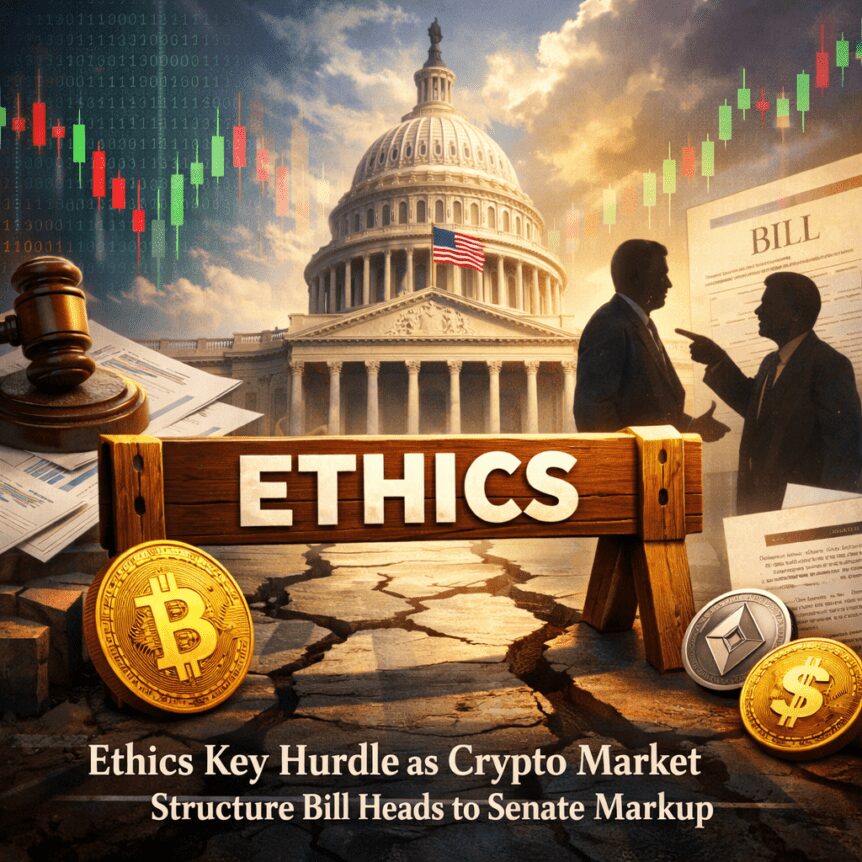
The U.S. Senate Banking Committee is poised to take up a markup on the Digital Asset Market Clarity Act (CLARITY) this week, with Democratic lawmakers signaling they may withhold support if ethics provisions remain unresolved. The bill, which the House passed in July 2025, has faced months of delay as negotiators work through language on stablecoin yields, tokenized equities, and other industry-specific concerns. According to Cointelegraph, the committee’s action comes as policymakers seek a clearer framework for crypto markets without compromising ethical standards for public officials.
Although the Senate Agriculture Committee moved its own version of CLARITY forward in January, the legislation still must clear both panels to align securities and commodities authorities and to address jurisdictional differences. “Negotiations continue to be positive, and I remain confident we can get a bipartisan bill over the finish line this Congress,” Senate Democrat Kirsten Gillibrand told Cointelegraph. “Americans deserve a well-regulated market with strong consumer protections and real ethics reforms so politicians can’t cash in on their insider status for personal gain.”
Key takeaways
- House-passed CLARITY Act dates back to July 2025, setting a bipartisan framework for a regulated crypto market.
- Senate Agriculture Committee advanced its version in January, signaling continued momentum across chambers.
- The Banking Committee markup is scheduled this week, with ethics provisions and stablecoin yield language identified as critical sticking points.
- Political dynamics show divergent views on ethics and conflicts of interest, potentially shaping whether the bill can reach the floor for a full vote.
- Any path to law requires reconciliation between House and Senate outputs and presidential action; timing remains uncertain.
Policy dynamics and the path forward
From a regulatory architecture standpoint, CLARITY represents a concerted effort to codify a market structure for digital assets that aligns with existing securities and commodities regimes. The contrast between committee positions underscores ongoing tensions between innovation, investor protection, and public accountability. As negotiations unfold, many lawmakers view ethics provisions as the gatekeeper that could determine the bill’s ultimate fate, even if other provisions enjoy broad bipartisan support. In this context, the intersection of crypto policy with congressional ethics rules is increasingly in focus, with industry stakeholders watching closely for any precedent-setting language that could influence future oversight and enforcement actions.
Democrats have pressed for robust ethics safeguards to curb conflicts of interest among members of Congress and top executive branch officials. Gillibrand’s remarks reflect a broader aim to ensure that policy debates on digital assets are insulated from personal financial considerations. Republicans, including Senate Banking Chair Tim Scott, have emphasized the need for a timely, bipartisan deal but indicate that ethics language must ultimately be resolved on the floor rather than within committee confines. Wyoming Senator Cynthia Lummis, a leading advocate for CLARITY in the Senate, has encouraged colleagues to move forward, signaling continued support for a functional regulatory framework while acknowledging the ethics concerns that lawmakers have raised.
Industry voices have framed the ethics debate as a practical hurdle that could stall otherwise constructive policy progress. Cody Carbone, CEO of the Digital Chamber, argued that while ethics matters, it should be tackled on the Senate floor and not become a fatal obstruction to markup. “Ethics has to be tackled on the floor; it’s not within the jurisdiction of the Senate Banking Committee, so I don’t expect it to hold up the markup,” he told Cointelegraph.
Stablecoins, yield, and regulatory nuance
A central flashpoint remains the treatment of stablecoins and yield mechanics within the CLARITY framework. Earlier this month, Senators Thom Tillis and Angela Alsobrooks announced a compromise on stablecoin yield that could unlock movement on the bill after months of delay. Nevertheless, Democratic leadership has signaled that even with progress on yield, ethics provisions could derail prospects for a floor vote. Gillibrand’s position underscores a broader condition: any final package must address governance integrity to satisfy lawmakers who have prioritized anti-corruption safeguards alongside market structure clarity.
Beyond ethics and yield language, the bill’s broader aim is to reconcile differences between securities and commodities laws as they apply to digital assets, including questions around tokenized equities and other complex instruments. The Senate Agriculture Committee’s earlier action indicates a willingness to pursue a comprehensive approach, but the Banking Committee’s markup will test whether a unified, bipartisan compromise can be achieved in a manner compatible with the regulatory aspirations of both chambers.
Broader implications for institutions and oversight
For crypto firms, exchanges, and financial institutions, the CLARITY process signals a tightening of regulatory expectations around market structure, disclosures, and governance. A clarified framework could influence licensing trajectories, compliance costs, and the scope of permissible activities within crypto markets. From an enforcement perspective, alignment with established prudential standards—while preserving innovation—would likely intersect with ongoing oversight by the SEC, CFTC, and DOJ, as well as corresponding AML/KYC regimes. Observers also note potential interactions with international standards, such as the European Union’s MiCA, as policymakers compare approaches to cross-border compliance and transfer of risk across jurisdictions.
As the legislative effort unfolds, market participants must remain alert to evolving guidance on tokenized assets, stablecoins, and digital yield strategies. The path to law will depend not only on the content of ethics provisions but also on the administration’s priorities and the ability of lawmakers to secure a reconciled, floor-ready bill that can withstand potential veto or political headwinds.
Closing perspective
With the markup advancing and ethics debates unresolved, CLARITY’s fate rests on a delicate balance between bipartisan agreement and robust governance safeguards. Stakeholders should monitor committee proceedings for signs of a workable compromise and assess how any final text could reshape regulatory expectations for the crypto industry, compliance programs, and cross-border policy alignment.
This article was originally published as Ethics Key Hurdle as Crypto Market Structure Bill Heads to Senate Markup on Crypto Breaking News – your trusted source for crypto news, Bitcoin news, and blockchain updates.


추천 콘텐츠

Beyond Cleaning: What Else You Must Check Before Moving Out
Justice Department has 'gone off the rails' for Trump's 'pretzel logic': analysis