

Strategy Says Its Software Business Is Quietly Powering Its Bitcoin Machine
Strategy’s Phong Le pushed back against the idea that the company’s Bitcoin identity can be separated from its legacy software business, arguing that the two sides now reinforce each other operationally, financially, and culturally.
In a post on X, Le said Strategy’s success is “rooted in more than Bitcoin on our balance sheet,” framing the company’s enterprise software unit as a key part of the infrastructure behind its Bitcoin Treasury Company model. The comments come as the firm continues to be viewed primarily through the lens of its Bitcoin holdings, even as management seeks to highlight the operating business that predates its digital asset strategy.
“I’m sometimes asked why a Bitcoin Treasury Company should also operate a software business,” Le wrote. “The two create powerful and unique synergies. I plan to provide more regular updates on Strategy Software, and will start here with a foundational overview.”
Why Strategy Thinks Software Gives Its Bitcoin Treasury Model An Edge
Le said Q1 2026 was the software division’s strongest financial quarter in a decade. According to his post, software revenue rose 12%, led by 59% growth in cloud revenue, while controllable margin increased 27%. He said that margin expansion helped fund Strategy’s Bitcoin operating expenses, positioning the software business as more than a legacy asset sitting alongside the treasury strategy.
“Over the last six years, we transformed the software business while simultaneously becoming a Bitcoin Treasury Company,” Le wrote.
The scale of that business was central to his argument. Le said Strategy has 1,500 employees serving more than 3,000 customers, over 500,000 active users, and nearly half of the Fortune 500. Its customer base includes major banks, healthcare companies, retailers, and government agencies. He also pointed to the company’s operating history, noting that it has been in business since 1989, public since 1998, and active in more than 25 countries.
For Le, that history matters because it gives Strategy a level of institutional infrastructure that most digital asset firms do not have. He cited the company’s NASDAQ listing, WKSI status, quarterly 10-Q and annual 10-K filings, KPMG audits, and compliance with SOC 2 Type 2, ISO 27001, FedRAMP, PCI DSS, HIPAA, DPF, and GDPR standards.
“This directly benefits our Bitcoin Treasury Company,” Le said. “We have world-class software engineers, product managers, customer success teams, cloud and security experts, enterprise sales and consulting professionals, and experienced leaders in operations, finance, legal, and HR. Many employees have been with the company for more than 25 years.”
Le added that “no company in the digital asset ecosystem has this depth of institutional experience,” describing Strategy’s organizational maturity as intentional and differentiated in an industry often associated with faster-moving, less established corporate structures.
He also argued that the relationship works in the other direction: Bitcoin has helped accelerate the software business. Le said employees have been energized by Strategy’s mission, equity performance, and global community, while customers have moved “from skeptical to curious to supportive” and are increasingly engaged with the company’s digital asset strategy.
A large part of the next phase, according to Le, is AI. He said Strategy has built an AI data foundation called “Mosaic,” which integrates LLMs, hyperscalers, and data warehouses into a “trusted, secure, open platform.” The system is designed to provide an AI-driven semantic layer for enterprise data, with AI agents as end users.
Le said Strategy is also rebuilding internal systems using multiple AI models. “Over the next year, I expect we will automate many core workflows and replace much of our internal enterprise software,” he wrote. “Our systems and software will become increasingly autonomous, adaptive, self-healing, and self-improving.”
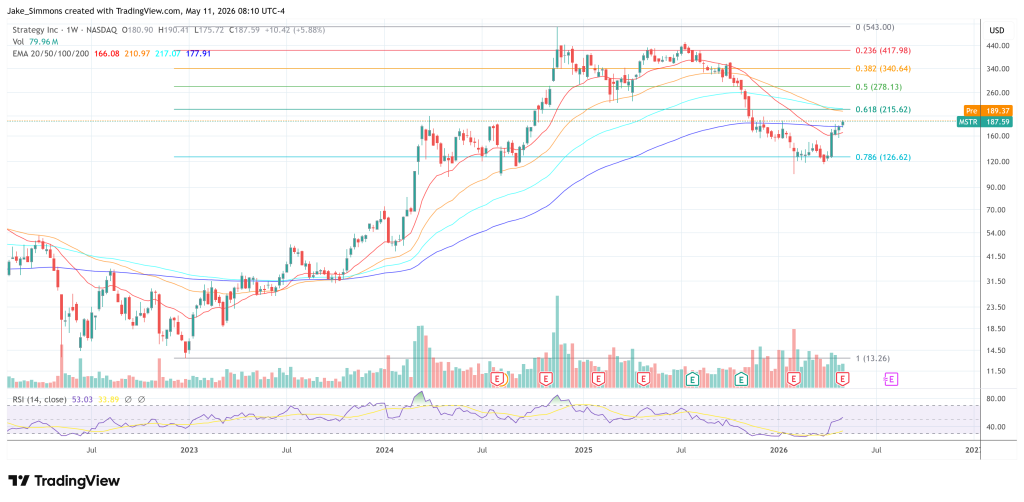
At press time, MSTR traded at $187.59


추천 콘텐츠

Beyond Cleaning: What Else You Must Check Before Moving Out

Justice Department has 'gone off the rails' for Trump's 'pretzel logic': analysis




