Circle Introduces Agent Stack, Building Financial Layer For AI Agents And Machine-Driven Payments

Financial technology company Circle has introduced the Circle Agent Stack, a new suite of chain- and protocol-agnostic infrastructure designed to support what it describes as the emerging “agentic economy,” where software agents can operate as autonomous economic participants. The launch expands Circle’s broader effort to position programmable USDC as a foundational settlement layer for machine-driven transactions across digital systems.
The Agent Stack initially comprises five integrated products aimed at enabling agents to hold funds, discover services, and execute transactions within defined constraints. Three of these components are newly released: Agent Wallets, Agent Marketplace, and Circle CLI, while Nanopayments powered by Circle Gateway and Circle Skills were previously announced. Together, the suite is intended to create a full financial loop in which agents can access capital, identify services, and complete payments programmatically using USDC and ERC-20 tokens, subject to policy-based controls.
According to Circle, the development of a dedicated financial layer for autonomous agents is becoming increasingly relevant as early real-world usage begins to scale. The company pointed to data from the x402 protocol, which processed $24.24 million in transaction volume over a recent 30-day period as of April 29, with nearly all value settled in USDC. While still early in scale, this activity is presented as evidence of growing demand for real-time, machine-executable payment systems capable of handling high-frequency and low-value transactions without requiring manual intervention or traditional payment workflows.
In the absence of such infrastructure, agent-based systems have typically relied on fragmented approaches, including hard-coded private keys, human-centric accounts, or manual approval processes. Similarly, service discovery and integration have required developers to stitch together APIs, SDKs, documentation, and multichain payment logic, limiting scalability and increasing operational complexity. Circle’s Agent Stack is positioned as an attempt to standardize these functions within a single programmable framework.
Agent Wallets are designed to provide controlled financial access for software agents, allowing them to hold and transfer USDC under user-defined governance rules. These include configurable spending limits, address allowlists and blocklists, and time-based restrictions. Transactions are evaluated against these policies before execution, with enforcement occurring at the wallet layer to ensure that agent behavior remains aligned with predefined intent and permissions.
Agent Marketplace introduces a structured environment for discovering and integrating agent-compatible services. The system is intended to shift interactions away from static subscriptions and manual integrations toward programmable, usage-based access models, where services can be evaluated and paid for dynamically as part of automated workflows.
Circle CLI functions as an operational control interface, enabling developers and systems to manage agent behavior through command-line execution. It allows for wallet creation, policy configuration, service discovery, and transaction execution through structured commands. The tool is designed to improve determinism in agent execution by reducing reliance on inconsistent documentation or fragmented API interactions, effectively acting as a control plane for agent-based financial operations.
Expanding USDC Infrastructure To Power Cross-Chain, Machine-To-Machine Payments
Supporting these components, Circle emphasizes its broader infrastructure layer built around USDC. Nanopayments powered by Circle Gateway are designed to facilitate extremely small, high-frequency transactions with minimal friction, including sub-cent payments that could enable machine-to-machine economic activity at scale. Cross-chain functionality is supported through the Cross-Chain Transfer Protocol (CCTP), which allows USDC to move across supported blockchains, while Circle Skills provide standardized implementation templates for developers using AI-assisted coding tools.
The company describes its approach as open and composable, with infrastructure designed to be chain- and protocol-agnostic. Rather than enforcing rigid application structures, Circle provides tools and financial primitives while leaving application logic, service selection, and policy design to developers and users.
With the introduction of Agent Stack, Circle is positioning programmable digital dollars as a core settlement mechanism for emerging autonomous systems, where software agents may increasingly participate in discovery, negotiation, and execution of economic activity across the internet.
The post Circle Introduces Agent Stack, Building Financial Layer For AI Agents And Machine-Driven Payments appeared first on Metaverse Post.


추천 콘텐츠

PMI-ACP Exam Preparation: How to Use a Simulator and Practice Questions Effectively
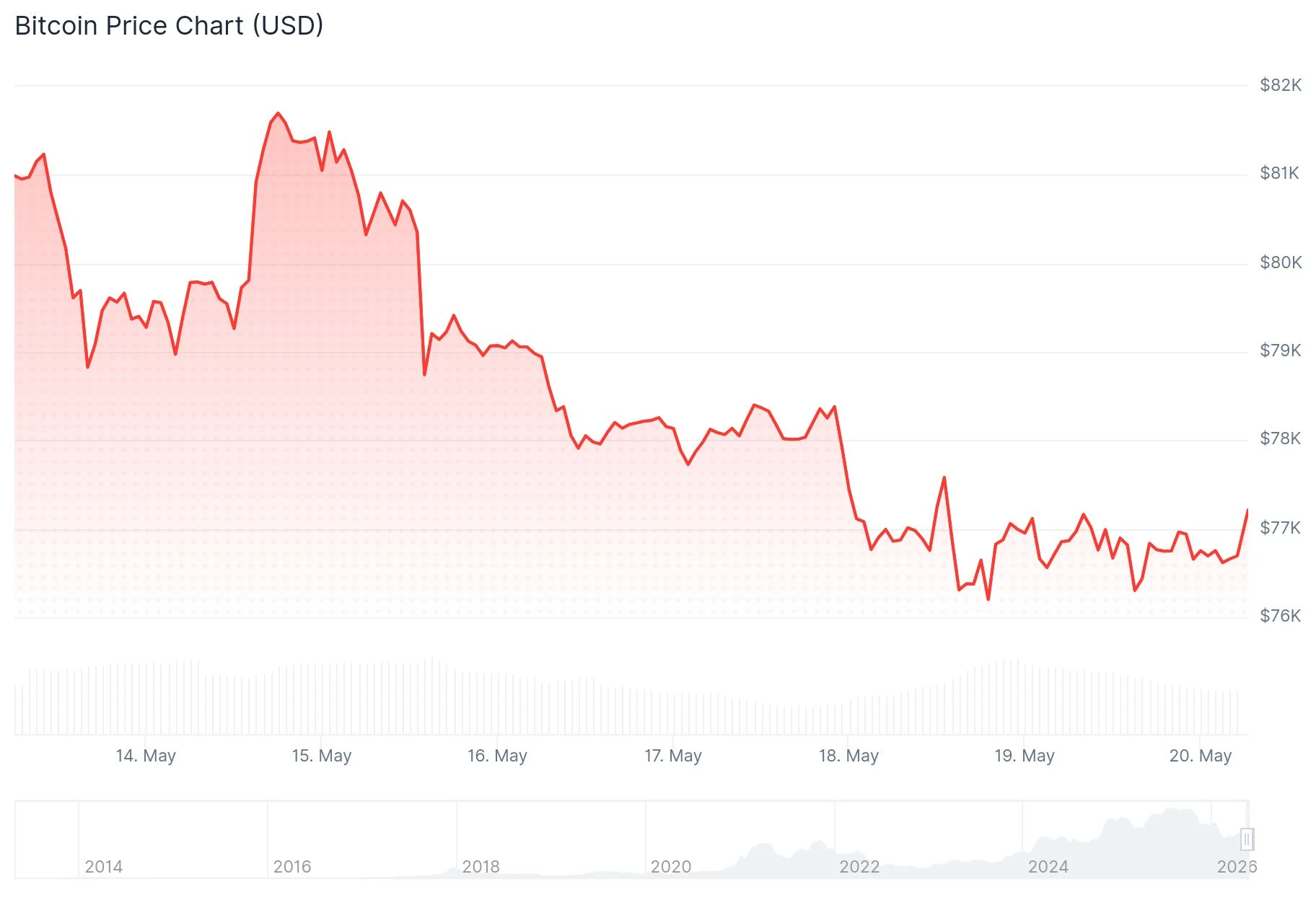
Bitcoin (BTC) Hovers Above $77K Amid Iran Diplomacy and Rising Treasury Yields