Here’s When Bitcoin Could Reach $10 Million Under Power Law Model
Physicist Giovanni Santostasi says Bitcoin’s long-term price trajectory is not best understood as an S-curve, speculative bubble, or simple exponential trend, but as a power law similar to patterns found in cities, biology and other natural systems. Speaking with Nathalie Brunell on the May 12 episode of the Coin Stories podcast, the director of the Scientific Bitcoin Institute argued that Bitcoin’s historical data points to roughly $1 million per coin in about eight years and $10 million in roughly 20 years.
Santostasi explained his Bitcoin Power Law thesis in detail. His core claim is that Bitcoin’s price has followed a nonlinear mathematical relationship with time since the network’s early trading history. In his formulation, Bitcoin’s price is proportional to time raised to a power of roughly 5.8 to 5.9, often rounded to six. That exponent, he said, is not just a curve-fitting artifact but a “fingerprint” of the system.
“With bitcoin we found a similar relationship where the price is proportional to the time,” Santostasi said. “So the age of bitcoin, how many years, you can measure it in days, you can measure it in years. And then you take the power and that power is 5.8.”
Bitcoin Is Growing Like A City
He acknowledged that Bitcoin remains volatile in the short term, with wars, crises and liquidity shocks producing large deviations. But he argued those moves are oscillations around a deeper trajectory.
According to Santostasi, Bitcoin’s power law currently implies a central price level around $120,000, while the market has recently traded below that level. He said the lower statistical band, which he described as a kind of floor, is currently near $56,000 to $57,000. He also cited a correlation coefficient of 0.97 for the power law fit, arguing that only around 3% of Bitcoin’s long-term price variation is not described by the model.
A key part of Santostasi’s thesis is that Bitcoin behaves more like a networked organism than a corporate asset. He compared Bitcoin to cities, which he said grow through bottom-up interaction and tend to endure far longer than corporations. Cities, in his telling, follow power laws because their value emerges from networks of people freely interacting, building and exchanging information.
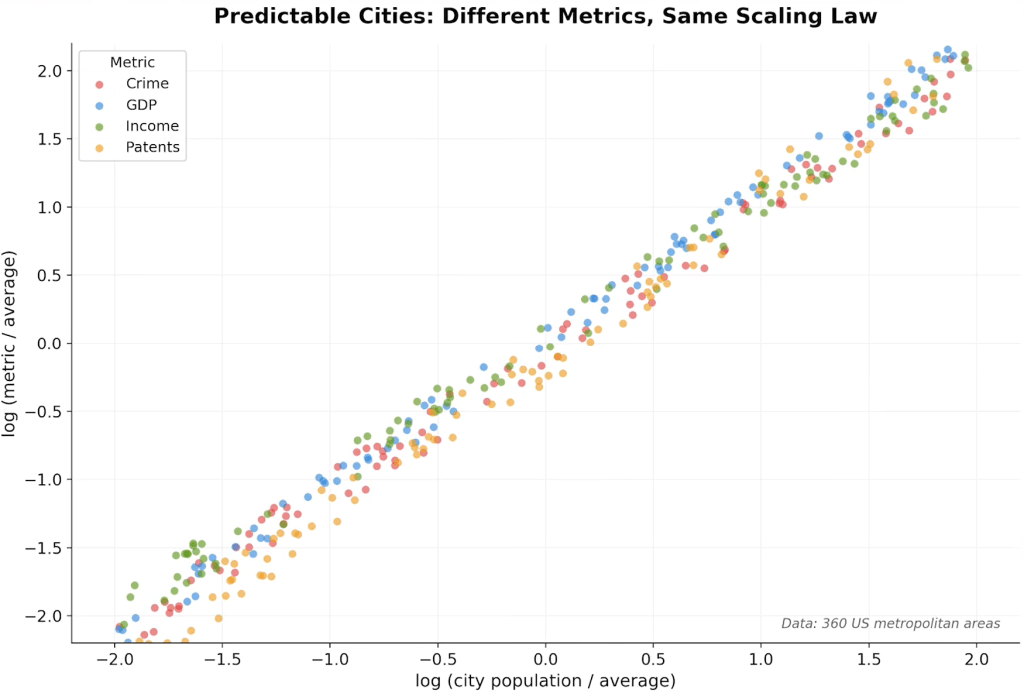
“Bitcoin is like a city,” Santostasi said. “Bitcoin is like tooth and nails and thorns and shells, these natural forms. To me, if you can simplify this message — and because it’s not poetry, it’s science actually, it’s based on data — it is one of the most convincing orange-pilling arguments that you can make.”
The physicist contrasted that with exponential growth, which he associated with systems that expand quickly but eventually hit resource limits. He cited corporations as an example, saying most die within 150 years, while cities such as Rome can persist for millennia. That distinction led to one of the more provocative implications of the discussion: corporations backed by Bitcoin, Santostasi suggested, could theoretically become more city-like in their durability.
“This is one of the reasons why I want Saylor to start adopting this language of a power law,” he said, referring to Strategy executive chairman Michael Saylor. “He could say exactly that. We are turning corporations into cities.”
Santostasi also argued that Bitcoin’s address growth supports the thesis. He said Bitcoin addresses have grown as a power law with time cubed, while price reacts to address growth roughly according to a square relationship, similar to Metcalfe’s Law. Combining those two relationships, he said, produces the observed price relationship of time to the sixth power.
“If you double the number of addresses, the price goes up to four,” Santostasi said. “If you triple it, it goes to nine. So it’s a power law with the square.”
That framework also leads Santostasi to reject the common view that Bitcoin adoption should be modeled primarily as an S-curve, like refrigerators, televisions or other consumer technologies. Those products, he argued, are not networks in the same way Bitcoin is. Bitcoin’s social, monetary and technical layers make it closer to the internet or a city than to a household appliance.
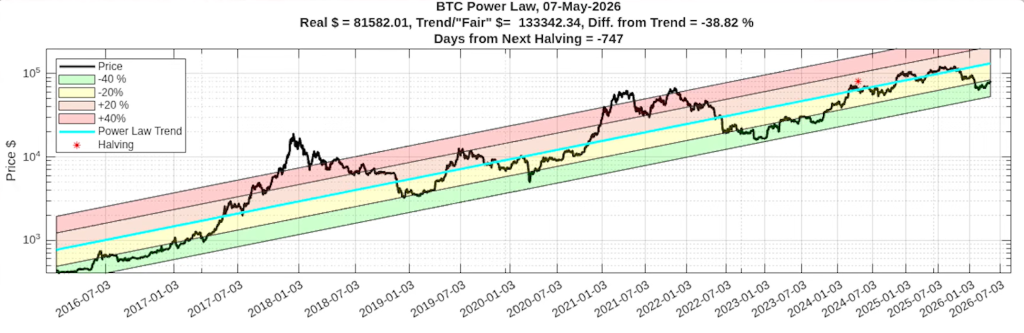
Still, Santostasi stopped short of presenting the forecast as certainty. Asked how confident he is that Bitcoin will reach roughly $1 million per coin in about eight years and $10 million in roughly 20 years, he put the probability near 90%, while leaving room for failure conditions. He said continued capital inflows, larger institutional participation and new pools of capital are necessary for the path to remain intact.
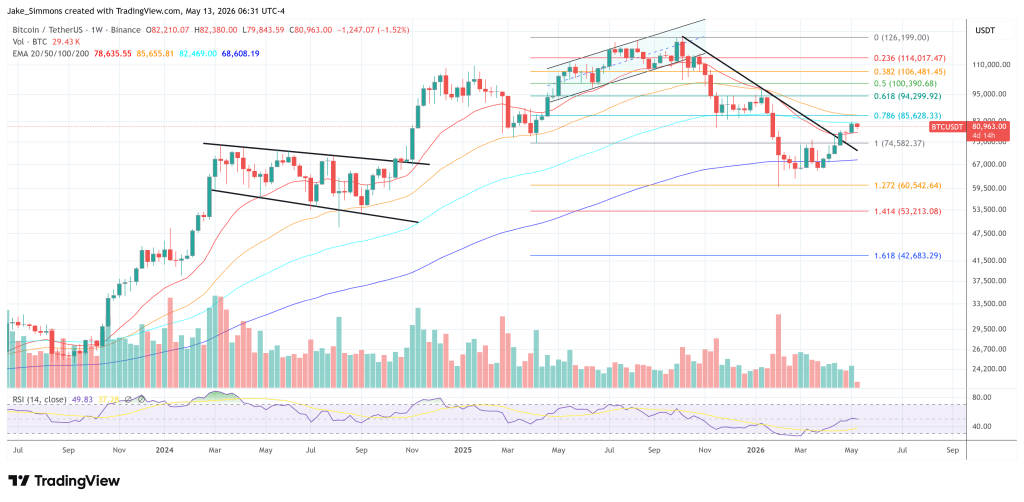
At press time, BTC traded at $80,963.


추천 콘텐츠

Crypto mining stocks suffer brutal quarterly slump

Southwestern National Bank Introduces New Brand and Trade Name