Fidelity builds Moody’s-rated tokenized fund on Chainlink
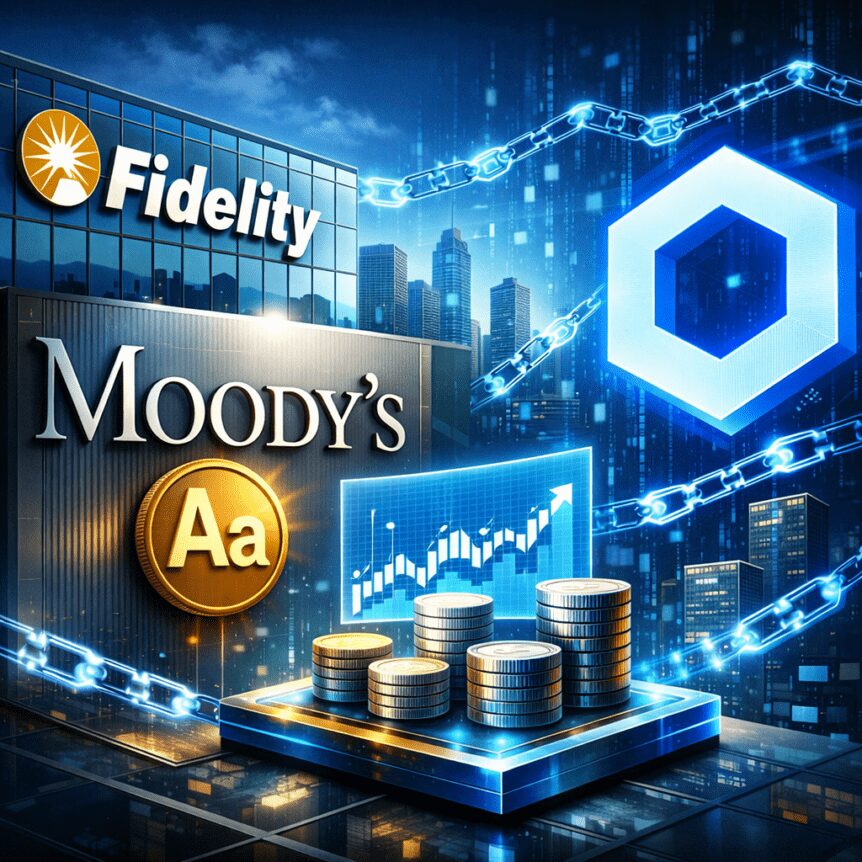
Fidelity International is expanding the tokenization frontier in public markets with the launch of the Fidelity USD Digital Liquidity Fund (FILQ). The fund, described as a tokenized liquidity vehicle, has been rated AAA-mf by Moody’s Ratings—a designation that signals high credit quality and robust liquidity for money-market-like assets. FILQ is issued on blockchain infrastructure connected to Chainlink and rolled out via Sygnum Bank’s tokenization platform, with transfer agency support from Apex Group, illustrating how traditional cash-equivalent instruments can move on-chain within a regulated framework.
According to Sygnum, the fund’s AAA-mf rating from Moody’s Ratings marks an important milestone for the on-chain money-market space. The rating distinguishes FILQ as a highly liquid, credit-worthy option suitable for institutional investors seeking yield-bearing liquidity while maintaining risk controls associated with regulated money-market products. Fatmire Bekiri, Sygnum’s head of tokenization, described the development as a meaningful step in bringing regulated, high-quality liquidity onto the blockchain. Apex Group said it is supporting the fund as transfer agent, handling digital investor onboarding, wallet whitelisting, and transaction processing.
Fidelity International did not immediately respond to requests for comment at publication, while Fidelity Investments and Fidelity International operate as separate entities in different jurisdictions. The move sits within a broader push by large asset managers to tokenize cash and near-cash products, offering traditional yields with on-chain settlement and visibility. Apex Group’s role highlights the operational layer needed to extend traditional fund transfer agency into a 24/7 tokenised model while maintaining regulatory standards.
Chainlink expands role in tokenized real-world assets
FILQ’s architecture relies on Chainlink’s data network to deliver on-chain net asset value (NAV) and distribution metrics. By providing verifiable, real-time NAV and payout data on-chain, the fund aims to give international investors a transparent, auditable view of value and income—addressing one of the core challenges in tokenized real-world assets: ensuring data integrity and timely information for fund investors. Fernando Vazquez, president of capital markets at Chainlink Labs, framed the approach as a crucial bridge between traditional finance and the on-chain economy, emphasizing tamper-proof transparency as a foundation for digital liquidity products. Apex Group complements this setup on the operational side, supporting fund transfers, onboarding, and transaction handling in a tokenised workflow.
In addition to Chainlink’s data feeds, JPMorgan is slated to contribute approved daily NAV data for FILQ, reinforcing the model of established market players supplying regulated inputs to a tokenized funds structure. The collaboration between Fidelity International, Sygnum, Chainlink, and Apex Group builds on prior production use cases that align NAV and distribution data with on-chain fund representations, including earlier deployments involving Fidelity International and Sygnum for NAV data integration in 2024.
Chainlink’s involvement underscores a broader industry trend: real-world assets are increasingly being connected to blockchains through standardized data feeds and governance models that aim to preserve regulatory compliance while enabling on-chain liquidity and settlement. This approach addresses one of the most persistent barriers to mainstream adoption of tokenized funds: ensuring data verifiability, accuracy, and timeliness in a decentralized environment.
Tokenized funds: a broader industry shift
The FILQ launch adds momentum to a wave of tokenized money-market and liquidity products emerging from major asset managers. In recent years, venerable players such as BlackRock and Franklin Templeton have introduced tokenized money-market offerings aimed at converting cash-like assets into on-chain formats that still route through traditional risk controls and counterparties. The trend is driven by the desire to provide stable yields with greater liquidity, while leveraging blockchain rails for settlement efficiency and transparency.
Industry watchers note that the growing interest in tokenized liquidity comes with a set of practical considerations. For one, real-time NAV data and transparent payout scheduling can improve governance and investor confidence, but participants must navigate custodial arrangements, regulated disclosure requirements, and the interplay between on-chain activity and existing financial-market infrastructure. The involvement of Moody’s Ratings, Chainlink, JPMorgan, and Apex Group signals a collective effort to embed credible, regulated data streams and operational support into tokenized funds, rather than relying on unvetted on-chain information alone.
Within Fidelity’s broader ecosystem, the firm has previously explored tokenized money-market constructs, including Fidelity Digital Interest Token (FDIT) and related initiatives anchored by traditional cash-management strategies. The on-chain fund model seeks to keep reserves aligned with fiat currency exposure while offering near real-time visibility to investors and managers. As the market tests these approaches, observers will be watching how regulators respond to tokenized money-market products, particularly with respect to liquidity buffers, reserve backing, and disclosure standards.
What this means for investors and the on-chain promise
For investors, FILQ represents a concrete instance of how regulated, high-quality liquidity can be tokenized without sacrificing the governance and credit safeguards associated with traditional money-market funds. Apex Group’s 24/7 digital transfer agency model is designed to remove traditional business-hour constraints, enabling real-time access to liquidity and continuous automated processing. The AAA-mf rating provides a signal of credit quality and liquidity that may appeal to institutions exploring on-chain cash equivalents as part of liquidity management, treasury operations, or cross-border funding programs.
For builders and developers in the on-chain finance space, the FILQ case highlights two enduring requirements: robust data integrity and interoperable market infrastructure. On-chain NAV data, verified by established market participants, helps reduce information asymmetry between on-chain and off-chain counterparts. At the same time, the collaboration among Fidelity International, Sygnum, Chainlink, and JPMorgan demonstrates a practical model for multi-party governance around tokenized assets—one that leverages regulated involvement to raise on-chain legitimacy and scalability.
Still, the emergence of tokenized liquidity products also invites scrutiny of regulatory boundaries and operational risk. While the involvement of Moody’s, a trusted rating agency, and JPMorgan’s data inputs provides guardrails, the on-chain settlement of money-market instruments must align with applicable securities, banking, and cross-border rules. Market participants will likely watch how supervisory approaches evolve as more large asset managers bring tokenized liquidity funds to market, and how custody, settlement, and disclosure standards adapt to a hybrid asset class that sits between traditional finance and blockchain networks.
Closing perspective
FILQ marks a notable inflection point in the ongoing experiment of tokenized liquidity. As more traditional managers pilot on-chain cash products with formal ratings, standardized data feeds, and reputable custodial partners, the industry gains a clearer template for combining regulatory discipline with the efficiency and transparency of blockchain rails. The coming months will reveal how scalable this model proves to be, how regulators respond to broader adoption, and which other fund families may follow suit into tokenized money-market instruments.
Watch for further details on how FILQ performs relative to its on-chain NAV feeds, and for additional updates on how JPMorgan’s daily NAV inputs integrate with the fund’s distribution schedule. The collaboration among Fidelity International, Sygnum, Chainlink, and JPMorgan may well set a precedent for next-generation tokenized liquidity offerings across the sector.
This article was originally published as Fidelity builds Moody’s-rated tokenized fund on Chainlink on Crypto Breaking News – your trusted source for crypto news, Bitcoin news, and blockchain updates.


추천 콘텐츠

The Chart Nobody Wants to See: ADA Tests 88.7% Fib With $0.10 in the Distance
Western Digital (WDC) Stock: Quantum-Resistant Storage Technology Drives Long-Term Security Strategy