

Claude AI didn’t hack Bitcoin: The truth behind the viral crypto wallet recovery
The internet loves a digital ghost story, particularly when it marries the two most feverish technology trends of the decade: artificial intelligence and cryptocurrency. On Wednesday, 13 May, X was abuzz with a sensational narrative. Anthropic’s Claude, one of the leading large language models, had allegedly ‘cracked’ a Bitcoin wallet, recovering 5 BTC, valued at roughly $395,000 at current market price, that had been trapped on a dusty hard drive for several years.
The implication spreading across the timeline was as thrilling as it was terrifying to the Web3 community. If an AI can autonomously shatter cryptographic security, the foundational premise of blockchain technology is entirely compromised. The viral panic suggested an imminent reality where language models could simply brute-force or exploit a zero-day vulnerability in any digital vault, rendering modern encryption obsolete overnight. Mainstream discourse quickly amplified this, trading accuracy for the cheap clicks generated by the phrase “AI hacks crypto”.
Yet, as is customary with algorithmic hysteria, the truth is far less cinematic and infinitely more practical. A careful examination of the incident reveals that the underlying cryptography of Bitcoin remains utterly unbreached. Claude did not break Bitcoin; it merely acted as a highly competent, infinitely patient IT support desk.
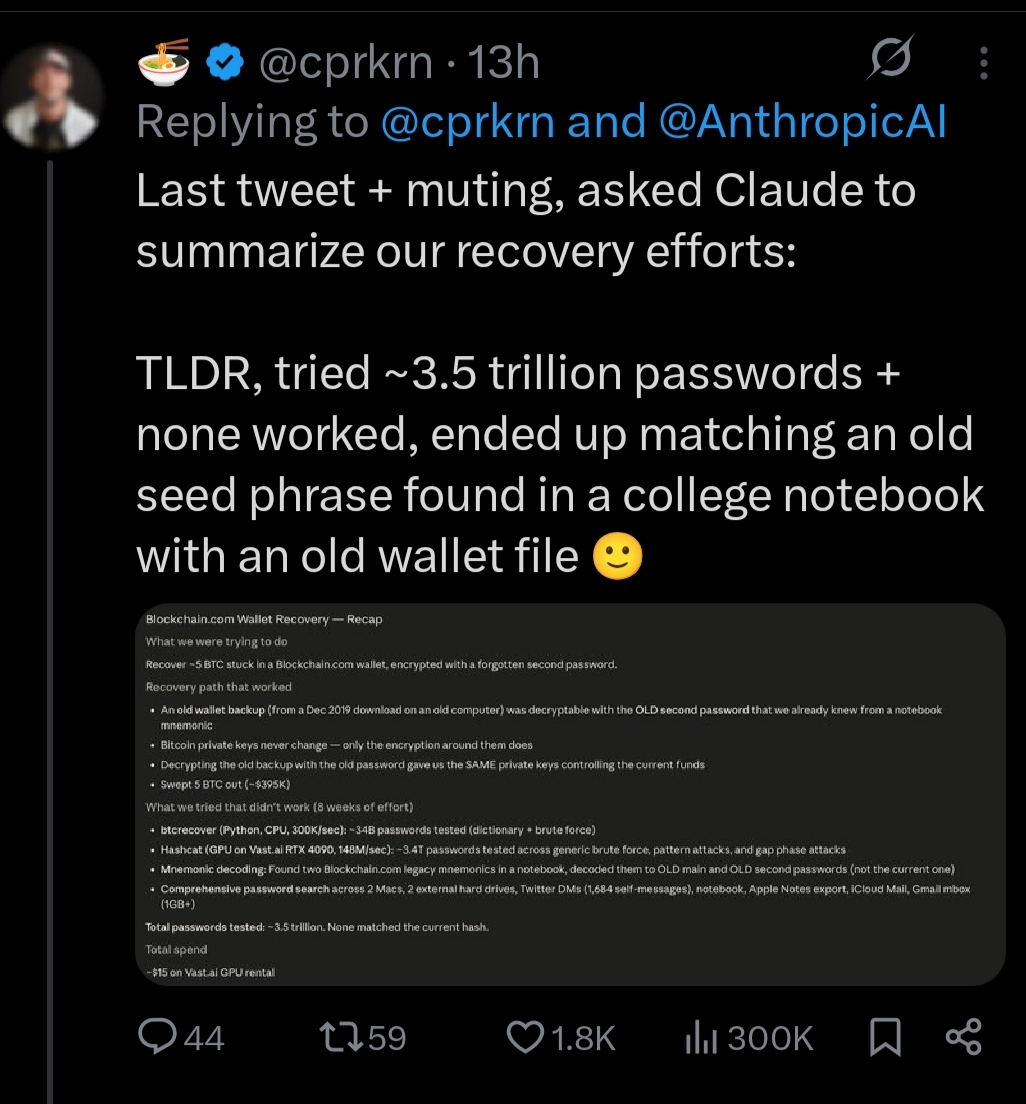
To understand the reality, we have to look at the precise mechanics of this particular crypto wallet recovery. The user, simply known as @cprkrn, possessed an old, disorganised local hard drive, vaguely aware that a cryptocurrency backup existed somewhere within its sprawling directory tree. Crucially, he also held a physical record bearing the wallet’s original password. What he lacked was the technical know-how to locate the specific hidden file, often buried in obscure system folders like AppData/Roaming.
What Claude provided was conversational, step-by-step diagnostic instructions. The AI guided the owner through his own operating system’s directory structure, helping him run the correct search parameters to locate the specific wallet backup file that had been lost to time. Once the file was finally located, the unlocking step relied entirely on human memory and analogue security: the wallet was opened using the physical password the owner had already written down.
Claude AI didn’t hack Bitcoin: Cryptographic foundations remain intact
The recovered backup contained the same private keys as the user’s current wallet setup. This explicitly means the underlying cryptography was entirely untouched. The Elliptic Curve Digital Signature Algorithm (ECDSA) and SHA-256, the cryptographic pillars of the Bitcoin network, remain as robust today as they were years ago. Claude did not guess a 256-bit integer, nor did it reverse-engineer a seed phrase from thin air. It simply showed a user how to use the search function on their hard drive effectively.
Labelling this a cryptographic breach is akin to claiming a locksmith hacked a bank vault because they helped the manager find the key dropped under the carpet. It conflates administrative assistance with malicious exploitation, doing a substantial disservice to public understanding of both artificial intelligence and blockchain security.
Stripping away the hacker mystique actually reveals a far more compelling, grounded narrative regarding the future of artificial intelligence in the Web3 ecosystem.

Crypto has long suffered from a brutal user experience problem. The strict ethos of self-custody, often summarised by the maxim ‘not your keys, not your coins’, places a formidable, unforgiving cognitive load on the average crypto holder. Misplaced seed phrases, forgotten hardware wallet PINs, and corrupted local files have permanently locked billions of dollars’ worth of digital assets away from their rightful owners. Until now, recovering these assets required immense technical proficiency, complex command-line wrestling, or the costly, high-risk services of specialist data recovery firms.
What the Claude incident demonstrates is not a systemic vulnerability, but a profound democratisation of digital asset recovery. Large language models excel at pattern recognition, data synthesis, and translating opaque technical processes into plain, actionable everyday language. For the non-technical holder, an AI assistant acts as a bridge over the intimidating interfaces that still dominate early blockchain architecture. It transforms panic-inducing technical hurdles into navigable, step-by-step diagnostic conversations.
The implications for the broader Web3 space are distinctly positive. Rather than threatening blockchain integrity, AI assistants can help bridge the terrifying user-experience gap that currently limits the mass adoption of self-custody solutions. They act as a digital safety net, empowering users to audit their own devices and recover digital assets without the need to surrender sensitive hardware to expensive and potentially malicious third parties.

Also read: How Binance deployed AI-powered security to prevent $10.5 billion losses to hackers in 15 months
As the blockchain technology continues to mature, we can anticipate AI being integrated directly into wallet software to prevent these losses proactively. Systems could automatically verify backups, help troubleshoot failed transactions without requiring users to scour hostile developer forums, and guide frantic users through hardware recovery protocols safely.
Bitcoin’s cryptographic fortress remains intact. The real story here is not that code was broken, but that the friction of self-custody was temporarily lifted. Artificial intelligence has finally given the average user a fighting chance at navigating the historically unforgiving crypto space. The coming together of these two technologies should not be defined by shattered encryption but by rescued files, empowered individuals, and a significantly lower barrier to entry.


추천 콘텐츠

Why Businesses Need Professional Machine Design and Development Services

Bitcoin ETFs Shed $649M in a Day While Ethereum Fund Outflows Hit a Six-Day Streak




