

KOSPI Breaks 8,000 for the First Time: A Historic Milestone for South Korea’s Stock Market
BitcoinWorld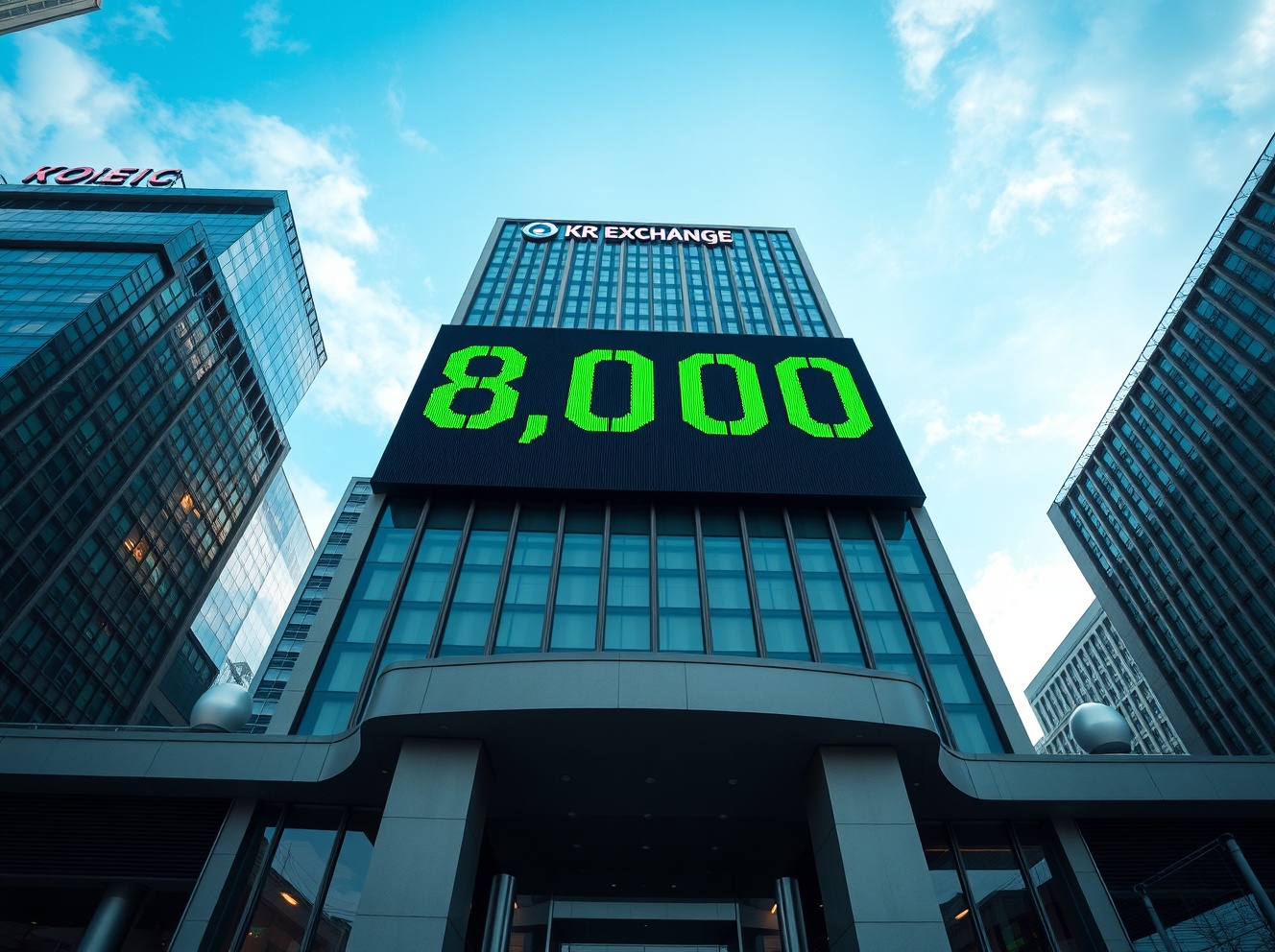
KOSPI Breaks 8,000 for the First Time: A Historic Milestone for South Korea’s Stock Market
Seoul, South Korea — The KOSPI index crossed the 8,000 mark for the first time in its history during intraday trading on [insert date], setting a new all-time high and marking a significant milestone for the South Korean stock market. The benchmark index, which tracks the performance of all common stocks listed on the Korea Exchange, has been on a sustained upward trajectory driven by strong corporate earnings, robust export growth, and increased foreign investor inflows.
What Drove the Rally to 8,000?
The surge past 8,000 reflects a confluence of factors. South Korea’s export-driven economy has benefited from a global semiconductor recovery, with major companies like Samsung Electronics and SK Hynix reporting record quarterly profits. Additionally, the Korean won’s relative stability against the U.S. dollar has attracted foreign portfolio investment. The government’s policy support for the ‘Korean New Deal’ — focusing on digital and green infrastructure — has also boosted investor confidence in domestic equities.
Market analysts note that the rally is not purely speculative. The KOSPI’s price-to-earnings ratio remains within reasonable historical ranges, suggesting that earnings growth, rather than excessive valuation expansion, has been the primary driver. Institutional investors, including pension funds and sovereign wealth funds, have increased their domestic equity allocations, providing a stable base of demand.
Historical Context and Market Implications
The KOSPI’s journey to 8,000 has taken decades. The index first surpassed 1,000 in the late 1980s, broke 2,000 in 2007, and crossed 3,000 in early 2021. Each milestone has reflected the maturation of South Korea’s economy and its capital markets. The 8,000 level represents a roughly 160% gain from the pandemic-era lows of March 2020.
For retail investors, the milestone carries psychological significance. South Korea has one of the highest rates of individual stock market participation among developed economies, with millions of ordinary citizens holding KOSPI-listed shares. The rally has generated substantial household wealth, though it also raises concerns about market concentration and potential overheating in certain sectors.
What This Means for Global Investors
The KOSPI’s record high reinforces South Korea’s position as a key emerging market benchmark. For global portfolio managers, the index offers exposure to technology, automotive, and financial sectors that are deeply integrated into global supply chains. However, the market remains sensitive to geopolitical risks on the Korean peninsula and global trade tensions, which could introduce volatility at these elevated levels.
Foreign ownership of KOSPI stocks has risen steadily, now accounting for approximately 30% of market capitalization. The index’s inclusion in major global indices such as MSCI Emerging Markets and FTSE Russell has further boosted its visibility among international investors.
Conclusion
The KOSPI’s breach of 8,000 is a landmark event for South Korea’s financial markets, reflecting sustained economic growth, corporate profitability, and investor confidence. While the index may experience pullbacks as profit-taking occurs, the underlying fundamentals suggest that the market’s long-term trajectory remains positive. Investors should monitor earnings reports, monetary policy signals from the Bank of Korea, and global macroeconomic conditions for cues on whether the rally can sustain itself above this historic level.
FAQs
Q1: What is the KOSPI index?
The KOSPI (Korea Composite Stock Price Index) is the benchmark stock market index for the Korea Exchange, representing the performance of all common stocks listed on the exchange. It is the primary indicator of the South Korean stock market’s overall health.
Q2: What sectors contributed most to the KOSPI reaching 8,000?
The technology and semiconductor sectors have been the primary drivers, led by Samsung Electronics and SK Hynix. The automotive and battery sectors, including Hyundai Motor and LG Energy Solution, have also contributed significantly. Financial stocks and industrial companies have provided additional support.
Q3: Is the KOSPI overvalued at 8,000?
While valuations have risen, the KOSPI’s forward price-to-earnings ratio remains in line with its five-year average, suggesting that earnings growth has largely justified the price increase. However, certain high-growth sectors may be trading at elevated multiples, and investors should exercise caution with individual stock selection.
This post KOSPI Breaks 8,000 for the First Time: A Historic Milestone for South Korea’s Stock Market first appeared on BitcoinWorld.


추천 콘텐츠

Cango Inc. Completes $65M Investment and Secures $10M Convertible Note Financing

Chainlink Price Steadies as Market Watches Macro Breakout Case




