XRP falls to $1.93 after rejecting $2, while weekly MACD tightens. Analysts watch $1.90 support and $2.05 reclaim.XRP falls to $1.93 after rejecting $2, while weekly MACD tightens. Analysts watch $1.90 support and $2.05 reclaim.

XRP Below $2: Why Ripple Is Crashing and What Happens Next

2026/01/20 19:14

Ripple’s native cross-border token has dropped to $1.93 after failing to hold above the $2. In the short term, the price action is moving to the downside, but some technical indicators could change the trend in the future.

XRP Stalls Below $2 as Support Shifts

XRP lost momentum after a brief move above $2. Sellers stepped in quickly, pushing the asset down and clearing recent gains. Former support at $2 has turned into resistance, now capping upside moves.

XRP is holding around $1.93, with $1.90 acting as a nearby support level. Failure in that area could lead to additional losses. Bulls would consider a stable movement past $ 2.05 as an important milestone to recover.

Meanwhile, the MACD on the weekly chart is showing signs of compression. Histogram bars are fading, and the two lines are drawing closer. This pattern often appears before a crossover. Traders view this as a signal that momentum could shift in the coming weeks. A technical analyst known as ChartNerd shared,
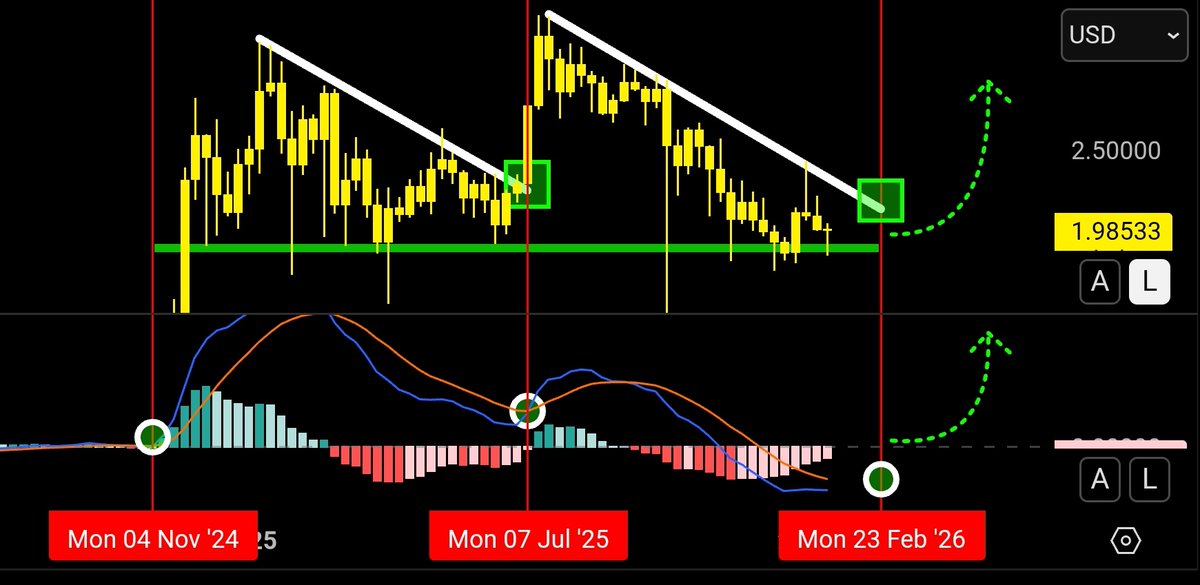
XRP Price ChartXRP Price Chart 1.20. Source: ChartNerd/X

Historical data shows that similar crossovers have led to strong upward moves. Despite this, XRP continues to trade below its long-term descending trendline. The line has been respected for months, and the price has yet to close above it. A confirmed breakout above this trendline would be needed for any push toward the $2.50 zone.

Analysts Warn of Weak Buyer Support

Earlier this month, XRP reached a two-month high of $2.41. The move represented a 30% gain from the start of the year but did not hold. Market analyst Dom said the rise lacked strong buyer activity.

Since then, XRP has dropped 18% from that peak. Dom also noted that XRP has tested the $1.80 area three times, which he described as a final possible support structure. A move below this zone may trigger deeper losses. To stabilize, the asset must rise and remain above $2.05.

Other crypto assets have also been affected by growing tension between the US and the EU. After military activity involving EU countries in Greenland, the US responded with tariffs. This development has added pressure to risk assets, including digital currencies.

The post XRP Below $2: Why Ripple Is Crashing and What Happens Next appeared first on CryptoPotato.

시장 기회
리플 로고
리플 가격(XRP)
$1.8973
$1.8973$1.8973
-1.04%
USD
리플 (XRP) 실시간 가격 차트
면책 조항: 본 사이트에 재게시된 글들은 공개 플랫폼에서 가져온 것으로 정보 제공 목적으로만 제공됩니다. 이는 반드시 MEXC의 견해를 반영하는 것은 아닙니다. 모든 권리는 원저자에게 있습니다. 제3자의 권리를 침해하는 콘텐츠가 있다고 판단될 경우, [email protected]으로 연락하여 삭제 요청을 해주시기 바랍니다. MEXC는 콘텐츠의 정확성, 완전성 또는 시의적절성에 대해 어떠한 보증도 하지 않으며, 제공된 정보에 기반하여 취해진 어떠한 조치에 대해서도 책임을 지지 않습니다. 본 콘텐츠는 금융, 법률 또는 기타 전문적인 조언을 구성하지 않으며, MEXC의 추천이나 보증으로 간주되어서는 안 됩니다.

추천 콘텐츠

The Channel Factories We’ve Been Waiting For

The Channel Factories We’ve Been Waiting For

The post The Channel Factories We’ve Been Waiting For appeared on BitcoinEthereumNews.com. Visions of future technology are often prescient about the broad strokes while flubbing the details. The tablets in “2001: A Space Odyssey” do indeed look like iPads, but you never see the astronauts paying for subscriptions or wasting hours on Candy Crush.  Channel factories are one vision that arose early in the history of the Lightning Network to address some challenges that Lightning has faced from the beginning. Despite having grown to become Bitcoin’s most successful layer-2 scaling solution, with instant and low-fee payments, Lightning’s scale is limited by its reliance on payment channels. Although Lightning shifts most transactions off-chain, each payment channel still requires an on-chain transaction to open and (usually) another to close. As adoption grows, pressure on the blockchain grows with it. The need for a more scalable approach to managing channels is clear. Channel factories were supposed to meet this need, but where are they? In 2025, subnetworks are emerging that revive the impetus of channel factories with some new details that vastly increase their potential. They are natively interoperable with Lightning and achieve greater scale by allowing a group of participants to open a shared multisig UTXO and create multiple bilateral channels, which reduces the number of on-chain transactions and improves capital efficiency. Achieving greater scale by reducing complexity, Ark and Spark perform the same function as traditional channel factories with new designs and additional capabilities based on shared UTXOs.  Channel Factories 101 Channel factories have been around since the inception of Lightning. A factory is a multiparty contract where multiple users (not just two, as in a Dryja-Poon channel) cooperatively lock funds in a single multisig UTXO. They can open, close and update channels off-chain without updating the blockchain for each operation. Only when participants leave or the factory dissolves is an on-chain transaction…
공유하기
BitcoinEthereumNews2025/09/18 00:09
Will XRP Price Increase In September 2025?

Will XRP Price Increase In September 2025?

Ripple XRP is a cryptocurrency that primarily focuses on building a decentralised payments network to facilitate low-cost and cross-border transactions. It’s a native digital currency of the Ripple network, which works as a blockchain called the XRP Ledger (XRPL). It utilised a shared, distributed ledger to track account balances and transactions. What Do XRP Charts Reveal? […]
공유하기
Tronweekly2025/09/18 00:00
China Blocks Nvidia’s RTX Pro 6000D as Local Chips Rise

China Blocks Nvidia’s RTX Pro 6000D as Local Chips Rise

The post China Blocks Nvidia’s RTX Pro 6000D as Local Chips Rise appeared on BitcoinEthereumNews.com. China Blocks Nvidia’s RTX Pro 6000D as Local Chips Rise China’s internet regulator has ordered the country’s biggest technology firms, including Alibaba and ByteDance, to stop purchasing Nvidia’s RTX Pro 6000D GPUs. According to the Financial Times, the move shuts down the last major channel for mass supplies of American chips to the Chinese market. Why Beijing Halted Nvidia Purchases Chinese companies had planned to buy tens of thousands of RTX Pro 6000D accelerators and had already begun testing them in servers. But regulators intervened, halting the purchases and signaling stricter controls than earlier measures placed on Nvidia’s H20 chip. Image: Nvidia An audit compared Huawei and Cambricon processors, along with chips developed by Alibaba and Baidu, against Nvidia’s export-approved products. Regulators concluded that Chinese chips had reached performance levels comparable to the restricted U.S. models. This assessment pushed authorities to advise firms to rely more heavily on domestic processors, further tightening Nvidia’s already limited position in China. China’s Drive Toward Tech Independence The decision highlights Beijing’s focus on import substitution — developing self-sufficient chip production to reduce reliance on U.S. supplies. “The signal is now clear: all attention is focused on building a domestic ecosystem,” said a representative of a leading Chinese tech company. Nvidia had unveiled the RTX Pro 6000D in July 2025 during CEO Jensen Huang’s visit to Beijing, in an attempt to keep a foothold in China after Washington restricted exports of its most advanced chips. But momentum is shifting. Industry sources told the Financial Times that Chinese manufacturers plan to triple AI chip production next year to meet growing demand. They believe “domestic supply will now be sufficient without Nvidia.” What It Means for the Future With Huawei, Cambricon, Alibaba, and Baidu stepping up, China is positioning itself for long-term technological independence. Nvidia, meanwhile, faces…
공유하기
BitcoinEthereumNews2025/09/18 01:37