

VanEck: Deflationary Mechanisms May Help Ethereum Overtake Bitcoin in Value Storage
Source: Cryptoslate
Compiled by: Blockchain Knight
Analysts at VanEck say Ethereum is steadily becoming a stronger rival to Bitcoin in the race for store-of-value dominance.
The driving force behind this shift is the growing popularity of digital asset treasuries (DATs), with global businesses increasingly favoring Ethereum and Bitcoin as options for digital asset vaults.
Initially, Bitcoin was the preferred digital asset for treasuries due to its fixed supply and perceived stability, but recent developments have sparked increased interest in Ethereum.
Regulatory changes in the United States have highlighted the need for stablecoins and tokenization, which are core functions of the Ethereum ecosystem.
This has allowed ETH to be used for purposes beyond its original design, with several large brokerages and exchanges already launching tokenized stocks on the Ethereum blockchain.
Furthermore, Ethereum’s increasing flexibility is seen as a significant advantage over Bitcoin.
VanEck analysts pointed out that Ethereum provides more possibilities for complex financial strategies, allowing institutions to increase their holdings of ETH more efficiently than accumulating BTC.
With Ethereum’s staking functionality, the Treasury can earn additional ETH by participating in the network, a source of income that Bitcoin cannot provide in a similar way.
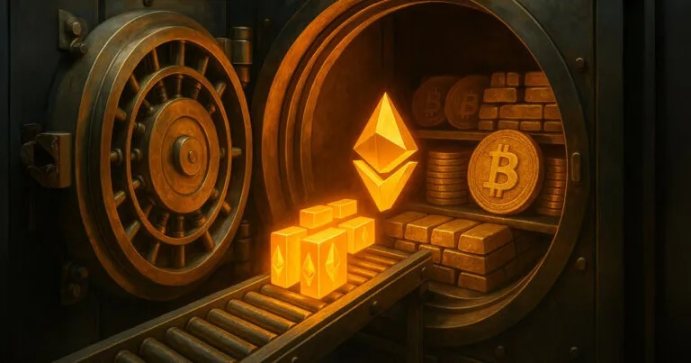
Ethereum’s transition from Proof-of-Work (PoW) to Proof-of-Stake (PoS) has had a significant impact on its inflation rate.
According to VanEck data, this shift caused ETH's supply growth to drop significantly: from approximately 120.6 million ETH in October 2022 to 120.1 million ETH in April 2024, resulting in a negative inflation rate of -0.25%.
In comparison, Bitcoin’s supply grew by 1.1% during the same period, making Ethereum’s inflation policy more attractive to ETH holders.
Bitcoin’s inflation rate decreases by 50% after each halving, making it more predictable. But the problem is that the top cryptocurrency has long relied on inflationary issuance to incentivize miners.
Last year, Bitcoin miners earned huge revenue from inflation rewards, totaling over $14 billion.
Therefore, as Bitcoin's inflation rate continues to decline in subsequent halvings, its security model will face increasing pressure and may need to rely on transaction fees or price increases to maintain it. Without these supports, the security of the blockchain network may be at risk, which may force a major shift in economic structure.
On the other hand, Ethereum’s PoS model gives token holders more control over network governance, ensuring that network upgrades and economic policy decisions are more directly in line with their interests.
This contrasts with Bitcoin’s miner-centric governance model, where miners’ economic incentives often influence decision-making.
Therefore, VanEck analysts believe that as Ethereum continues to develop with a more flexible governance structure, it may become a better long-term store of value than Bitcoin.


추천 콘텐츠

South Korean Banking Giant Enters Stablecoin Race with Kaia Pilot

Latest Trump nominee has botched prosecutions 'slam dunk' murder cases




