Table of Links Abstract and 1. Introduction 2. Experiment Definition 3. Experiment Design and Conduct 3.1 Latin Square Designs 3.2 Subjects, Tasks and Objects 3.3 Conduct 3.4 Measures 4. Data Analysis 4.1 Model Assumptions 4.2 Analysis of Variance (ANOVA) 4.3 Treatment Comparisons 4.4 Effect Size and Power Analysis 5. Experiment Limitations and 5.1 Threats to the Conclusion Validity 5.2 Threats to Internal Validity 5.3 Threats to Construct Validity 5.4 Threats to External Validity 6. Discussion and 6.1 Duration 6.2 Effort 7. Conclusions and Further Work, and References 3.4 Measures We used the time records of subjects to define the following measures: \ Duration: It is the elapsed time in minutes to write the program. Before starting the program assignment, subjects wrote down the current time. When they completed the program, they registered the finish time; then we calculate the difference in minutes between start and finish time. \ Effort: It measures the amount of labor spent to perform a task. It is the total programming effort in person-minutes to write a program. Total effort for a pair is the duration multiplied by two. Tables 3 and 4 show the measures (in minutes) collected for the experiment. \ \ \ :::info Authors: (1) Omar S. Gómez, full time professor of Software Engineering at Mathematics Faculty of the Autonomous University of Yucatan (UADY); (2) José L. Batún, full time professor of Statistics at Mathematics Faculty of the Autonomous University of Yucatan (UADY); (3) Raúl A. Aguilar, Faculty of Mathematics, Autonomous University of Yucatan Merida, Yucatan 97119, Mexico. ::: :::info This paper is available on arxiv under CC BY-NC-ND 4.0 DEED license. ::: \Table of Links Abstract and 1. Introduction 2. Experiment Definition 3. Experiment Design and Conduct 3.1 Latin Square Designs 3.2 Subjects, Tasks and Objects 3.3 Conduct 3.4 Measures 4. Data Analysis 4.1 Model Assumptions 4.2 Analysis of Variance (ANOVA) 4.3 Treatment Comparisons 4.4 Effect Size and Power Analysis 5. Experiment Limitations and 5.1 Threats to the Conclusion Validity 5.2 Threats to Internal Validity 5.3 Threats to Construct Validity 5.4 Threats to External Validity 6. Discussion and 6.1 Duration 6.2 Effort 7. Conclusions and Further Work, and References 3.4 Measures We used the time records of subjects to define the following measures: \ Duration: It is the elapsed time in minutes to write the program. Before starting the program assignment, subjects wrote down the current time. When they completed the program, they registered the finish time; then we calculate the difference in minutes between start and finish time. \ Effort: It measures the amount of labor spent to perform a task. It is the total programming effort in person-minutes to write a program. Total effort for a pair is the duration multiplied by two. Tables 3 and 4 show the measures (in minutes) collected for the experiment. \ \ \ :::info Authors: (1) Omar S. Gómez, full time professor of Software Engineering at Mathematics Faculty of the Autonomous University of Yucatan (UADY); (2) José L. Batún, full time professor of Statistics at Mathematics Faculty of the Autonomous University of Yucatan (UADY); (3) Raúl A. Aguilar, Faculty of Mathematics, Autonomous University of Yucatan Merida, Yucatan 97119, Mexico. ::: :::info This paper is available on arxiv under CC BY-NC-ND 4.0 DEED license. ::: \

A Simple Guide to Measuring Time and Labor in Programming

2025/08/19 09:56
2분 읽기
이 콘텐츠에 대한 의견이나 우려 사항이 있으시면 [email protected]으로 연락주시기 바랍니다

Abstract and 1. Introduction

2. Experiment Definition

3. Experiment Design and Conduct

3.1 Latin Square Designs

3.2 Subjects, Tasks and Objects

3.3 Conduct

3.4 Measures

4. Data Analysis

4.1 Model Assumptions

4.2 Analysis of Variance (ANOVA)

4.3 Treatment Comparisons

4.4 Effect Size and Power Analysis

5. Experiment Limitations and 5.1 Threats to the Conclusion Validity

5.2 Threats to Internal Validity

5.3 Threats to Construct Validity

5.4 Threats to External Validity

6. Discussion and 6.1 Duration

6.2 Effort

7. Conclusions and Further Work, and References

3.4 Measures

We used the time records of subjects to define the following measures:

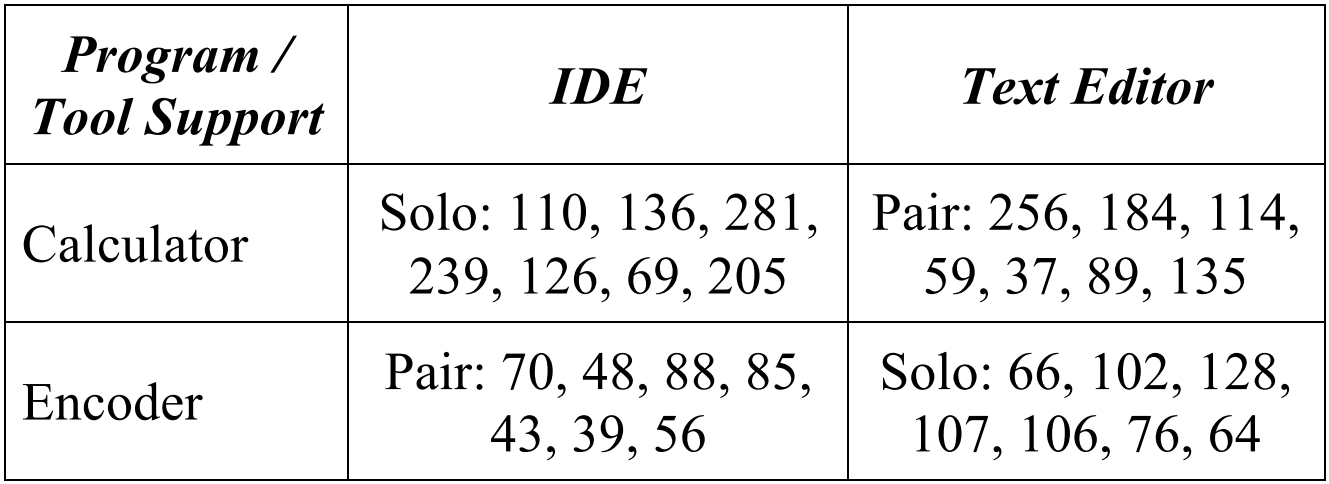
\ Duration: It is the elapsed time in minutes to write the program. Before starting the program assignment, subjects wrote down the current time. When they completed the program, they registered the finish time; then we calculate the difference in minutes between start and finish time.

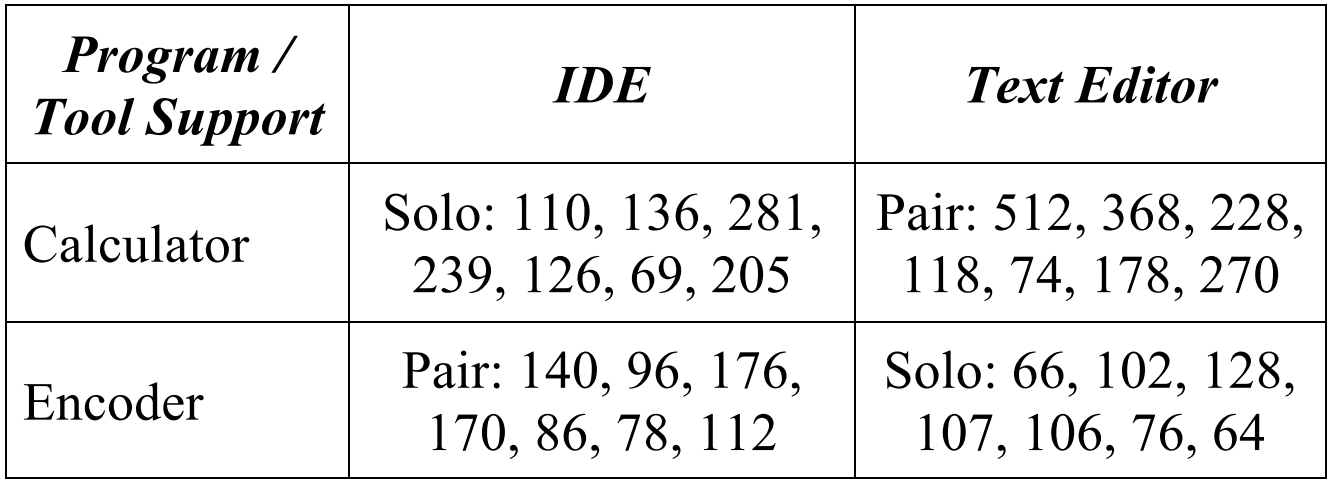
\ Effort: It measures the amount of labor spent to perform a task. It is the total programming effort in person-minutes to write a program. Total effort for a pair is the duration multiplied by two. Tables 3 and 4 show the measures (in minutes) collected for the experiment.

\ Table 3: Measures collected for duration

\ Table 4: Measures collected for effort

\

:::info Authors:

(1) Omar S. Gómez, full time professor of Software Engineering at Mathematics Faculty of the Autonomous University of Yucatan (UADY);

(2) José L. Batún, full time professor of Statistics at Mathematics Faculty of the Autonomous University of Yucatan (UADY);

(3) Raúl A. Aguilar, Faculty of Mathematics, Autonomous University of Yucatan Merida, Yucatan 97119, Mexico.

:::


:::info This paper is available on arxiv under CC BY-NC-ND 4.0 DEED license.

:::

\

시장 기회
Effect AI 로고
Effect AI 가격(EFFECT)
$0.00197
$0.00197$0.00197
+0.10%
USD
Effect AI (EFFECT) 실시간 가격 차트
면책 조항: 본 사이트에 재게시된 글들은 공개 플랫폼에서 가져온 것으로 정보 제공 목적으로만 제공됩니다. 이는 반드시 MEXC의 견해를 반영하는 것은 아닙니다. 모든 권리는 원저자에게 있습니다. 제3자의 권리를 침해하는 콘텐츠가 있다고 판단될 경우, [email protected]으로 연락하여 삭제 요청을 해주시기 바랍니다. MEXC는 콘텐츠의 정확성, 완전성 또는 시의적절성에 대해 어떠한 보증도 하지 않으며, 제공된 정보에 기반하여 취해진 어떠한 조치에 대해서도 책임을 지지 않습니다. 본 콘텐츠는 금융, 법률 또는 기타 전문적인 조언을 구성하지 않으며, MEXC의 추천이나 보증으로 간주되어서는 안 됩니다.

No Chart Skills? Still Profit

No Chart Skills? Still ProfitNo Chart Skills? Still Profit

Copy top traders in 3s with auto trading!