

How to Conduct a Controlled Experiment in Software Engineering
Table of Links
Abstract and 1. Introduction
2. Experiment Definition
3. Experiment Design and Conduct
3.1 Latin Square Designs
3.2 Subjects, Tasks and Objects
3.3 Conduct
3.4 Measures
4. Data Analysis
4.1 Model Assumptions
4.2 Analysis of Variance (ANOVA)
4.3 Treatment Comparisons
4.4 Effect Size and Power Analysis
5. Experiment Limitations and 5.1 Threats to the Conclusion Validity
5.2 Threats to Internal Validity
5.3 Threats to Construct Validity
5.4 Threats to External Validity
6. Discussion and 6.1 Duration
6.2 Effort
7. Conclusions and Further Work, and References
3.1 Latin Square Designs
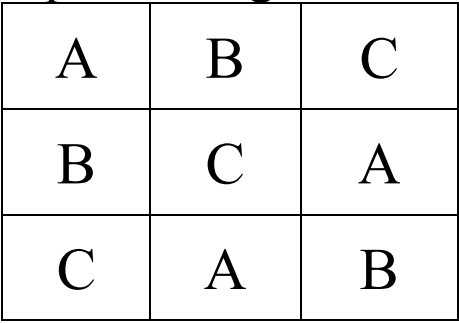
The main features of Latin square designs are that there are two blocking factors. Each treatment is present at each level of the first blocking factor and is also present at each level of the second blocking factor. This design is arranged with an equal number of rows (factor one) and columns (factor two). Treatments are represented by Latin characters symbols where each symbol is present exactly once in each row, and exactly once in each column. An example of the arrangement of this design is shown in Table 1.
\ 
\ In a Latin square design, blocking is used to systematically isolate the undesired source of variation in the comparison among treatments. In this case, pair versus solo programming. As a teaching purpose, we decided to block treatments by program and by tool support. Table 2 shows the arrangement used for the experiment.
\ 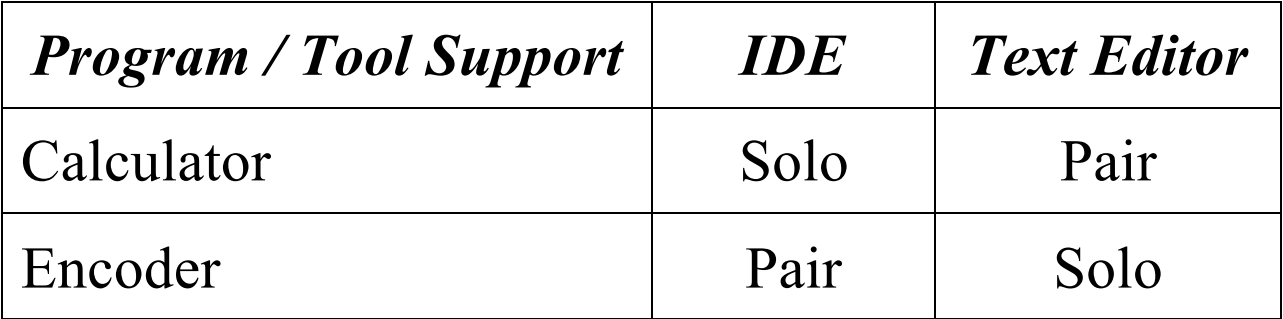
\ The program block has two levels: Calculator an encoder whereas tool support block has the levels: IDE (Integrated Development Environment) and text editor. The treatments to examine are: Pair and solo programming.
\
:::info Authors:
(1) Omar S. Gómez, full time professor of Software Engineering at Mathematics Faculty of the Autonomous University of Yucatan (UADY);
(2) José L. Batún, full time professor of Statistics at Mathematics Faculty of the Autonomous University of Yucatan (UADY);
(3) Raúl A. Aguilar, Faculty of Mathematics, Autonomous University of Yucatan Merida, Yucatan 97119, Mexico.
:::
:::info This paper is available on arxiv under CC BY-NC-ND 4.0 DEED license.
:::
\


추천 콘텐츠

Trafigura in Talks With Tether to Pilot USDT Payments at El Salvador Gas Stations

CNN's Anderson Cooper amazed pardoned J6 rioter may have predicted his own payoff




