Bitcoin’s near-term path, argues macro commentator Bruce Florian–founder of the Bitcoin Self-Custody Company Schwarzberg and a bestselling author–is being set far from crypto order books and deep inside the US money markets, where a once-enormous pool of excess cash has finally run dry. In a thread on X, Florian frames the Federal Reserve’s overnight reverse repo facility (RRP) as the “surplus pot” that quietly powered asset prices for two years—and now, with that pot empty, he believes markets are about to feel the unfiltered weight of tighter liquidity. Why This Means Pain For Bitcoin Florian starts by locating the inflection point: “The reverse repo facility (RRP) is at its lowest level in four years.” He then walks through the basic plumbing. During the pandemic response, “so much money was printed… there were fewer assets than excess cash,” so banks and money funds “parked [it] with the Fed in the RRP. Safe and earning interest.” As that pool drained, it didn’t disappear—it “was continuously pumped into the market over the last few years. Mainly into government bonds.” In his accounting, “around $2 trillion in excess liquidity from 2020/21 flowed into the market over the last 24 months,” keeping valuations buoyant despite higher policy rates and formal quantitative tightening. Related Reading: Is The Bitcoin Treasury Bubble Popping? Expert Answers The metaphor he uses is deliberate and evocative: “It’s like a tanker traveling at full speed. Even if you turn off the engine, it will continue to drift for many kilometers, solely due to the speed it has built up.” For Florian, that drift—the lagged effect of past liquidity—is ending. “Now the propulsion is gone. The surplus pot is empty, and the tanker comes to a standstill.” He connects that mechanical turn to the looming supply calendar: “There are still trillions in government bonds that need to be purchased in the coming months and years.” With the RRP no longer acting as a buyer of first resort, “we will feel the full brunt of the reduced liquidity since 2022.” The near-term cross-asset message is unambiguous. “This is bad for stocks, bonds, and Bitcoin in the short term,” he writes, adding that “stocks and Bitcoin can afford short respites… bonds cannot.” The constraint, in his view, is structural: “The US bond market is the most important market in the world.” If the RRP isn’t there to absorb cash and recycle it into Treasuries, “bond yields will continue to rise to attract investors.” Related Reading: Bitcoin Bull Run Hinges On Trump’s Pick For Fed Chair: Analyst That dynamic, he warns, collides with political and macro limits: “interest rates are already far too high for the current administration.” His base case is that the central bank ultimately has to step in: “The Fed will likely intervene and rescue the bond market by providing new liquidity.” The path from here is “unclear… in the short term,” but the contours of the pressure are, in his telling, set by the plumbing. Florian repeatedly stresses that any turbulence should not be misread as a Bitcoin-native failure. “The turmoil is once again coming from the fiat system, not from Bitcoin. Bitcoin merely reflects this development with its volatility.” That framing places Bitcoin downstream of dollar liquidity rather than in opposition to it. The market, he cautions, will “do everything it can to drive you out of your position.” His counsel for positioning is psychological as much as financial: “If you know what you own, you can stay relaxed.” The long-term thesis remains intact in his mind—“Remember where Bitcoin is headed as an ideal store of value”—but navigating the next phase requires horizon discipline: “Because if you keep your eyes on the horizon, you won’t get seasick.” At press time, BTC traded at $113,736. Featured image created with DALL.E, chart from TradingView.comBitcoin’s near-term path, argues macro commentator Bruce Florian–founder of the Bitcoin Self-Custody Company Schwarzberg and a bestselling author–is being set far from crypto order books and deep inside the US money markets, where a once-enormous pool of excess cash has finally run dry. In a thread on X, Florian frames the Federal Reserve’s overnight reverse repo facility (RRP) as the “surplus pot” that quietly powered asset prices for two years—and now, with that pot empty, he believes markets are about to feel the unfiltered weight of tighter liquidity. Why This Means Pain For Bitcoin Florian starts by locating the inflection point: “The reverse repo facility (RRP) is at its lowest level in four years.” He then walks through the basic plumbing. During the pandemic response, “so much money was printed… there were fewer assets than excess cash,” so banks and money funds “parked [it] with the Fed in the RRP. Safe and earning interest.” As that pool drained, it didn’t disappear—it “was continuously pumped into the market over the last few years. Mainly into government bonds.” In his accounting, “around $2 trillion in excess liquidity from 2020/21 flowed into the market over the last 24 months,” keeping valuations buoyant despite higher policy rates and formal quantitative tightening. Related Reading: Is The Bitcoin Treasury Bubble Popping? Expert Answers The metaphor he uses is deliberate and evocative: “It’s like a tanker traveling at full speed. Even if you turn off the engine, it will continue to drift for many kilometers, solely due to the speed it has built up.” For Florian, that drift—the lagged effect of past liquidity—is ending. “Now the propulsion is gone. The surplus pot is empty, and the tanker comes to a standstill.” He connects that mechanical turn to the looming supply calendar: “There are still trillions in government bonds that need to be purchased in the coming months and years.” With the RRP no longer acting as a buyer of first resort, “we will feel the full brunt of the reduced liquidity since 2022.” The near-term cross-asset message is unambiguous. “This is bad for stocks, bonds, and Bitcoin in the short term,” he writes, adding that “stocks and Bitcoin can afford short respites… bonds cannot.” The constraint, in his view, is structural: “The US bond market is the most important market in the world.” If the RRP isn’t there to absorb cash and recycle it into Treasuries, “bond yields will continue to rise to attract investors.” Related Reading: Bitcoin Bull Run Hinges On Trump’s Pick For Fed Chair: Analyst That dynamic, he warns, collides with political and macro limits: “interest rates are already far too high for the current administration.” His base case is that the central bank ultimately has to step in: “The Fed will likely intervene and rescue the bond market by providing new liquidity.” The path from here is “unclear… in the short term,” but the contours of the pressure are, in his telling, set by the plumbing. Florian repeatedly stresses that any turbulence should not be misread as a Bitcoin-native failure. “The turmoil is once again coming from the fiat system, not from Bitcoin. Bitcoin merely reflects this development with its volatility.” That framing places Bitcoin downstream of dollar liquidity rather than in opposition to it. The market, he cautions, will “do everything it can to drive you out of your position.” His counsel for positioning is psychological as much as financial: “If you know what you own, you can stay relaxed.” The long-term thesis remains intact in his mind—“Remember where Bitcoin is headed as an ideal store of value”—but navigating the next phase requires horizon discipline: “Because if you keep your eyes on the horizon, you won’t get seasick.” At press time, BTC traded at $113,736. Featured image created with DALL.E, chart from TradingView.com

Bitcoin Braces For Pain As $2 Trillion Liquidity Engine Shuts Off

2025/08/21 18:00
3분 읽기
이 콘텐츠에 대한 의견이나 우려 사항이 있으시면 [email protected]으로 연락주시기 바랍니다

Bitcoin’s near-term path, argues macro commentator Bruce Florian–founder of the Bitcoin Self-Custody Company Schwarzberg and a bestselling author–is being set far from crypto order books and deep inside the US money markets, where a once-enormous pool of excess cash has finally run dry. In a thread on X, Florian frames the Federal Reserve’s overnight reverse repo facility (RRP) as the “surplus pot” that quietly powered asset prices for two years—and now, with that pot empty, he believes markets are about to feel the unfiltered weight of tighter liquidity.

Why This Means Pain For Bitcoin

Florian starts by locating the inflection point: “The reverse repo facility (RRP) is at its lowest level in four years.” He then walks through the basic plumbing. During the pandemic response, “so much money was printed… there were fewer assets than excess cash,” so banks and money funds “parked [it] with the Fed in the RRP. Safe and earning interest.” As that pool drained, it didn’t disappear—it “was continuously pumped into the market over the last few years. Mainly into government bonds.” In his accounting, “around $2 trillion in excess liquidity from 2020/21 flowed into the market over the last 24 months,” keeping valuations buoyant despite higher policy rates and formal quantitative tightening.

The metaphor he uses is deliberate and evocative: “It’s like a tanker traveling at full speed. Even if you turn off the engine, it will continue to drift for many kilometers, solely due to the speed it has built up.” For Florian, that drift—the lagged effect of past liquidity—is ending. “Now the propulsion is gone. The surplus pot is empty, and the tanker comes to a standstill.”

He connects that mechanical turn to the looming supply calendar: “There are still trillions in government bonds that need to be purchased in the coming months and years.” With the RRP no longer acting as a buyer of first resort, “we will feel the full brunt of the reduced liquidity since 2022.”

The near-term cross-asset message is unambiguous. “This is bad for stocks, bonds, and Bitcoin in the short term,” he writes, adding that “stocks and Bitcoin can afford short respites… bonds cannot.” The constraint, in his view, is structural: “The US bond market is the most important market in the world.” If the RRP isn’t there to absorb cash and recycle it into Treasuries, “bond yields will continue to rise to attract investors.”

That dynamic, he warns, collides with political and macro limits: “interest rates are already far too high for the current administration.” His base case is that the central bank ultimately has to step in: “The Fed will likely intervene and rescue the bond market by providing new liquidity.” The path from here is “unclear… in the short term,” but the contours of the pressure are, in his telling, set by the plumbing.

Florian repeatedly stresses that any turbulence should not be misread as a Bitcoin-native failure. “The turmoil is once again coming from the fiat system, not from Bitcoin. Bitcoin merely reflects this development with its volatility.” That framing places Bitcoin downstream of dollar liquidity rather than in opposition to it.

The market, he cautions, will “do everything it can to drive you out of your position.” His counsel for positioning is psychological as much as financial: “If you know what you own, you can stay relaxed.” The long-term thesis remains intact in his mind—“Remember where Bitcoin is headed as an ideal store of value”—but navigating the next phase requires horizon discipline: “Because if you keep your eyes on the horizon, you won’t get seasick.”

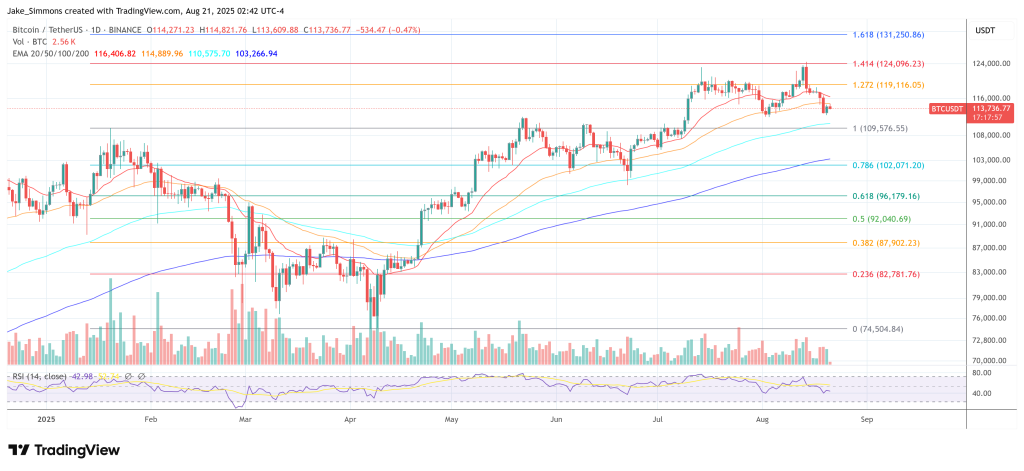
At press time, BTC traded at $113,736.

Bitcoin price
시장 기회
니어 로고
니어 가격(NEAR)
$1.6167
$1.6167$1.6167
+6.75%
USD
니어 (NEAR) 실시간 가격 차트
면책 조항: 본 사이트에 재게시된 글들은 공개 플랫폼에서 가져온 것으로 정보 제공 목적으로만 제공됩니다. 이는 반드시 MEXC의 견해를 반영하는 것은 아닙니다. 모든 권리는 원저자에게 있습니다. 제3자의 권리를 침해하는 콘텐츠가 있다고 판단될 경우, [email protected]으로 연락하여 삭제 요청을 해주시기 바랍니다. MEXC는 콘텐츠의 정확성, 완전성 또는 시의적절성에 대해 어떠한 보증도 하지 않으며, 제공된 정보에 기반하여 취해진 어떠한 조치에 대해서도 책임을 지지 않습니다. 본 콘텐츠는 금융, 법률 또는 기타 전문적인 조언을 구성하지 않으며, MEXC의 추천이나 보증으로 간주되어서는 안 됩니다.

No Chart Skills? Still Profit

No Chart Skills? Still ProfitNo Chart Skills? Still Profit

Copy top traders in 3s with auto trading!