Flashbots, a leading research group focused on MEV ( Maximal Extractable Value ), has issued a new warning that spam from MEV bots is quickly becoming the main barrier to blockchain scalability. In a thesis published this week, Flashbots said that “MEV has become the dominant limit to scaling blockchains,” pointing to rising inefficiencies across Ethereum rollups and Solana. The group stated that current scaling efforts by major blockchains are being neutralized by increasingly dominant MEV-driven activity. Flashbots Exposes Scaling Illusion on Rollups As layer-1 and layer-2 networks race to boost throughput, the report finds that wasteful on-chain activity from MEV bots is consuming a growing share of available capacity. On Solana, MEV bots are now responsible for 40% of all blockspace . On Ethereum’s OP-Stack rollups like Base and OP Mainnet, spam bots account for over half of all gas usage while paying just a fraction of the network’s fees. Failed transactions consume a disproportionate share of network Compute Units (CUs) relative to the fees they generate. Arb bots are a key factor: their failed txs make up ~40% of _all_ CUs used but only ~7% of total fees paid pic.twitter.com/RJl2O65l2n — chris (@chrischang43) May 17, 2025 The report noted that between November 2024 and February 2025, Base added 11 million gas units per second of throughput, nearly triple the Ethereum mainnet. However, most of that additional capacity was devoured by bots running repetitive, low-value trades. This activity creates artificially high fees for users and renders technical scaling efforts less effective. Flashbots introduced a new metric, “effective gas throughput,” to show the difference. Despite Base increasing its total gas capacity by 11 million gas per second over several months, the throughput available to real users barely changed. Almost all new capacity was eaten up by bots. The report identified spam as a specific kind of wasteful behavior, mostly DEX queries that never result in token transfers. These could be done off-chain, but instead they clog networks and raise the computational load on nodes. On Base, bots were responsible for 56% of gas usage and 26% of L1 data availability usage, but paid just 14% of fees. Spam is also driving up user fees. Flashbots explained that despite technical progress in reducing costs on rollups, fees stay artificially high due to bots continuously bidding for blockspace. “The promise of scaling is to drive fees near zero,” the report stated. “But what we’re seeing is a fee floor created by spam—not user demand.” The report also showed that this spam is highly concentrated. Just two searchers are behind over 80% of all spam on Base. According to Flashbots, the structure of the current market makes spam more profitable than participating in a fair auction, leading to inefficient and wasteful outcomes. “Spam bots are flooding blocks, not to serve users, but to extract MEV,” the report said. “It’s a structural issue, not just a technical one.” Flashbots Proposes MEV Auction Fix Amid Rising Exploits Flashbots has proposed a new framework to address growing concerns around MEV exploitation in Ethereum and other blockchain networks. Rather than relying on gas-heavy spam auctions, Flashbots suggests a shift toward explicit MEV auctions, allowing searchers to bid directly for transaction ordering rights. This, they argue, would reduce network congestion and wasted fees while preserving efficiency for traders and validators. The organization is also advocating for “programmable privacy,” a model that allows bots to view live blockchain state and plan profitable trades without the ability to front-run users or leak sensitive data. Flashbots is currently testing this concept using Trusted Execution Environments (TEEs), which allow secure transaction backrunning without the back-run transactions to abuse. “We’ve proven this on Ethereum L1,” Flashbots wrote in its latest report. “And we’re actively adapting it for L2s.” The proposal comes at a key time as concerns over MEV-related abuse continue to mount. According to EigenPhi data, more than 33,000 users were victims of sandwich attacks in March 2025, orchestrated by just 101 entities. These attacks now account for nearly $1 billion in weekly trading volume on Ethereum-based DEXs. In 2023, a single MEV searcher earned over $1 million in one day using sandwich attacks on Ethereum. On that day alone, the address accounted for 7% of total gas usage across the network. The same operator continued to profit into 2024 with improved strategies. The issue isn’t limited to Ethereum. On Solana, a well-known MEV bot named “arsc” exploited users through similar tactics, generating around $30 million in just two months. MEV allows validators to extract profits by reordering or inserting transactions. While it can boost DeFi efficiency, it also drives up fees and undermines fairness, especially for beginners unfamiliar with blockchain mechanics. Critics warn that unchecked MEV practices could deter user adoption and erode trust in decentralized finance .Flashbots, a leading research group focused on MEV ( Maximal Extractable Value ), has issued a new warning that spam from MEV bots is quickly becoming the main barrier to blockchain scalability. In a thesis published this week, Flashbots said that “MEV has become the dominant limit to scaling blockchains,” pointing to rising inefficiencies across Ethereum rollups and Solana. The group stated that current scaling efforts by major blockchains are being neutralized by increasingly dominant MEV-driven activity. Flashbots Exposes Scaling Illusion on Rollups As layer-1 and layer-2 networks race to boost throughput, the report finds that wasteful on-chain activity from MEV bots is consuming a growing share of available capacity. On Solana, MEV bots are now responsible for 40% of all blockspace . On Ethereum’s OP-Stack rollups like Base and OP Mainnet, spam bots account for over half of all gas usage while paying just a fraction of the network’s fees. Failed transactions consume a disproportionate share of network Compute Units (CUs) relative to the fees they generate. Arb bots are a key factor: their failed txs make up ~40% of _all_ CUs used but only ~7% of total fees paid pic.twitter.com/RJl2O65l2n — chris (@chrischang43) May 17, 2025 The report noted that between November 2024 and February 2025, Base added 11 million gas units per second of throughput, nearly triple the Ethereum mainnet. However, most of that additional capacity was devoured by bots running repetitive, low-value trades. This activity creates artificially high fees for users and renders technical scaling efforts less effective. Flashbots introduced a new metric, “effective gas throughput,” to show the difference. Despite Base increasing its total gas capacity by 11 million gas per second over several months, the throughput available to real users barely changed. Almost all new capacity was eaten up by bots. The report identified spam as a specific kind of wasteful behavior, mostly DEX queries that never result in token transfers. These could be done off-chain, but instead they clog networks and raise the computational load on nodes. On Base, bots were responsible for 56% of gas usage and 26% of L1 data availability usage, but paid just 14% of fees. Spam is also driving up user fees. Flashbots explained that despite technical progress in reducing costs on rollups, fees stay artificially high due to bots continuously bidding for blockspace. “The promise of scaling is to drive fees near zero,” the report stated. “But what we’re seeing is a fee floor created by spam—not user demand.” The report also showed that this spam is highly concentrated. Just two searchers are behind over 80% of all spam on Base. According to Flashbots, the structure of the current market makes spam more profitable than participating in a fair auction, leading to inefficient and wasteful outcomes. “Spam bots are flooding blocks, not to serve users, but to extract MEV,” the report said. “It’s a structural issue, not just a technical one.” Flashbots Proposes MEV Auction Fix Amid Rising Exploits Flashbots has proposed a new framework to address growing concerns around MEV exploitation in Ethereum and other blockchain networks. Rather than relying on gas-heavy spam auctions, Flashbots suggests a shift toward explicit MEV auctions, allowing searchers to bid directly for transaction ordering rights. This, they argue, would reduce network congestion and wasted fees while preserving efficiency for traders and validators. The organization is also advocating for “programmable privacy,” a model that allows bots to view live blockchain state and plan profitable trades without the ability to front-run users or leak sensitive data. Flashbots is currently testing this concept using Trusted Execution Environments (TEEs), which allow secure transaction backrunning without the back-run transactions to abuse. “We’ve proven this on Ethereum L1,” Flashbots wrote in its latest report. “And we’re actively adapting it for L2s.” The proposal comes at a key time as concerns over MEV-related abuse continue to mount. According to EigenPhi data, more than 33,000 users were victims of sandwich attacks in March 2025, orchestrated by just 101 entities. These attacks now account for nearly $1 billion in weekly trading volume on Ethereum-based DEXs. In 2023, a single MEV searcher earned over $1 million in one day using sandwich attacks on Ethereum. On that day alone, the address accounted for 7% of total gas usage across the network. The same operator continued to profit into 2024 with improved strategies. The issue isn’t limited to Ethereum. On Solana, a well-known MEV bot named “arsc” exploited users through similar tactics, generating around $30 million in just two months. MEV allows validators to extract profits by reordering or inserting transactions. While it can boost DeFi efficiency, it also drives up fees and undermines fairness, especially for beginners unfamiliar with blockchain mechanics. Critics warn that unchecked MEV practices could deter user adoption and erode trust in decentralized finance .

MEV Bots Now Clog Blockchains Faster Than They Can Scale, Flashbots Warns – Is Raw Throughput Obsolete?

2025/06/18 06:08
4분 읽기
이 콘텐츠에 대한 의견이나 우려 사항이 있으시면 [email protected]으로 연락주시기 바랍니다

Flashbots, a leading research group focused on MEV (Maximal Extractable Value), has issued a new warning that spam from MEV bots is quickly becoming the main barrier to blockchain scalability.

In a thesis published this week, Flashbots said that “MEV has become the dominant limit to scaling blockchains,” pointing to rising inefficiencies across Ethereum rollups and Solana.

The group stated that current scaling efforts by major blockchains are being neutralized by increasingly dominant MEV-driven activity.

Flashbots Exposes Scaling Illusion on Rollups

As layer-1 and layer-2 networks race to boost throughput, the report finds that wasteful on-chain activity from MEV bots is consuming a growing share of available capacity.

On Solana, MEV bots are now responsible for 40% of all blockspace. On Ethereum’s OP-Stack rollups like Base and OP Mainnet, spam bots account for over half of all gas usage while paying just a fraction of the network’s fees.

The report noted that between November 2024 and February 2025, Base added 11 million gas units per second of throughput, nearly triple the Ethereum mainnet. However, most of that additional capacity was devoured by bots running repetitive, low-value trades.

This activity creates artificially high fees for users and renders technical scaling efforts less effective. Flashbots introduced a new metric, “effective gas throughput,” to show the difference.
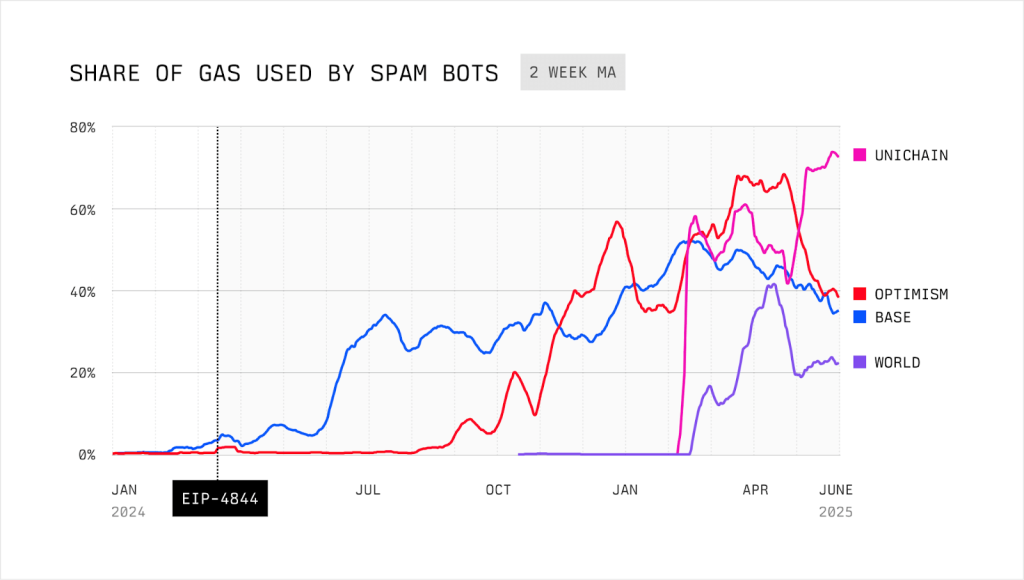
Despite Base increasing its total gas capacity by 11 million gas per second over several months, the throughput available to real users barely changed. Almost all new capacity was eaten up by bots.

The report identified spam as a specific kind of wasteful behavior, mostly DEX queries that never result in token transfers. These could be done off-chain, but instead they clog networks and raise the computational load on nodes.

On Base, bots were responsible for 56% of gas usage and 26% of L1 data availability usage, but paid just 14% of fees.

Spam is also driving up user fees. Flashbots explained that despite technical progress in reducing costs on rollups, fees stay artificially high due to bots continuously bidding for blockspace.

“The promise of scaling is to drive fees near zero,” the report stated. “But what we’re seeing is a fee floor created by spam—not user demand.”

The report also showed that this spam is highly concentrated. Just two searchers are behind over 80% of all spam on Base.

According to Flashbots, the structure of the current market makes spam more profitable than participating in a fair auction, leading to inefficient and wasteful outcomes.

“Spam bots are flooding blocks, not to serve users, but to extract MEV,” the report said. “It’s a structural issue, not just a technical one.”

Flashbots Proposes MEV Auction Fix Amid Rising Exploits

Flashbots has proposed a new framework to address growing concerns around MEV exploitation in Ethereum and other blockchain networks. Rather than relying on gas-heavy spam auctions, Flashbots suggests a shift toward explicit MEV auctions, allowing searchers to bid directly for transaction ordering rights.

This, they argue, would reduce network congestion and wasted fees while preserving efficiency for traders and validators.

The organization is also advocating for “programmable privacy,” a model that allows bots to view live blockchain state and plan profitable trades without the ability to front-run users or leak sensitive data.

Flashbots is currently testing this concept using Trusted Execution Environments (TEEs), which allow secure transaction backrunning without the back-run transactions to abuse.

“We’ve proven this on Ethereum L1,” Flashbots wrote in its latest report. “And we’re actively adapting it for L2s.”

The proposal comes at a key time as concerns over MEV-related abuse continue to mount. According to EigenPhi data, more than 33,000 users were victims of sandwich attacks in March 2025, orchestrated by just 101 entities.

These attacks now account for nearly $1 billion in weekly trading volume on Ethereum-based DEXs.

In 2023, a single MEV searcher earned over $1 million in one day using sandwich attacks on Ethereum. On that day alone, the address accounted for 7% of total gas usage across the network. The same operator continued to profit into 2024 with improved strategies.

The issue isn’t limited to Ethereum. On Solana, a well-known MEV bot named “arsc” exploited users through similar tactics, generating around $30 million in just two months.

MEV allows validators to extract profits by reordering or inserting transactions. While it can boost DeFi efficiency, it also drives up fees and undermines fairness, especially for beginners unfamiliar with blockchain mechanics.

Critics warn that unchecked MEV practices could deter user adoption and erode trust in decentralized finance.


시장 기회
니어 로고
니어 가격(NEAR)
$1.5312
$1.5312$1.5312
+0.47%
USD
니어 (NEAR) 실시간 가격 차트
면책 조항: 본 사이트에 재게시된 글들은 공개 플랫폼에서 가져온 것으로 정보 제공 목적으로만 제공됩니다. 이는 반드시 MEXC의 견해를 반영하는 것은 아닙니다. 모든 권리는 원저자에게 있습니다. 제3자의 권리를 침해하는 콘텐츠가 있다고 판단될 경우, [email protected]으로 연락하여 삭제 요청을 해주시기 바랍니다. MEXC는 콘텐츠의 정확성, 완전성 또는 시의적절성에 대해 어떠한 보증도 하지 않으며, 제공된 정보에 기반하여 취해진 어떠한 조치에 대해서도 책임을 지지 않습니다. 본 콘텐츠는 금융, 법률 또는 기타 전문적인 조언을 구성하지 않으며, MEXC의 추천이나 보증으로 간주되어서는 안 됩니다.

추천 콘텐츠

Why The Green Bay Packers Must Take The Cleveland Browns Seriously — As Hard As That Might Be

Why The Green Bay Packers Must Take The Cleveland Browns Seriously — As Hard As That Might Be

The post Why The Green Bay Packers Must Take The Cleveland Browns Seriously — As Hard As That Might Be appeared on BitcoinEthereumNews.com. Jordan Love and the Green Bay Packers are off to a 2-0 start. Getty Images The Green Bay Packers are, once again, one of the NFL’s better teams. The Cleveland Browns are, once again, one of the league’s doormats. It’s why unbeaten Green Bay (2-0) is a 8-point favorite at winless Cleveland (0-2) Sunday according to betmgm.com. The money line is also Green Bay -500. Most expect this to be a Packers’ rout, and it very well could be. But Green Bay knows taking anyone in this league for granted can prove costly. “I think if you look at their roster, the paper, who they have on that team, what they can do, they got a lot of talent and things can turn around quickly for them,” Packers safety Xavier McKinney said. “We just got to kind of keep that in mind and know we not just walking into something and they just going to lay down. That’s not what they going to do.” The Browns certainly haven’t laid down on defense. Far from. Cleveland is allowing an NFL-best 191.5 yards per game. The Browns gave up 141 yards to Cincinnati in Week 1, including just seven in the second half, but still lost, 17-16. Cleveland has given up an NFL-best 45.5 rushing yards per game and just 2.1 rushing yards per attempt. “The biggest thing is our defensive line is much, much improved over last year and I think we’ve got back to our personality,” defensive coordinator Jim Schwartz said recently. “When we play our best, our D-line leads us there as our engine.” The Browns rank third in the league in passing defense, allowing just 146.0 yards per game. Cleveland has also gone 30 straight games without allowing a 300-yard passer, the longest active streak in the NFL.…
공유하기
BitcoinEthereumNews2025/09/18 00:41
Stakestone (STO) Soars: Token Surpasses $1.14 After Stunning 367% Rally

Stakestone (STO) Soars: Token Surpasses $1.14 After Stunning 367% Rally

BitcoinWorld Stakestone (STO) Soars: Token Surpasses $1.14 After Stunning 367% Rally In a remarkable display of market momentum, the Stakestone (STO) token has

공유하기
bitcoinworld2026/04/02 17:10
HGTV star spills about being snubbed from show over one misused word

HGTV star spills about being snubbed from show over one misused word

Former Battle on the Beach co-host Alison Victoria says one stray word may have cost her a return ticket to HGTV's seaside design competition.In a new interview
공유하기
Rawstory2026/05/17 22:25

No Chart Skills? Still Profit

No Chart Skills? Still ProfitNo Chart Skills? Still Profit

Copy top traders in 3s with auto trading!

