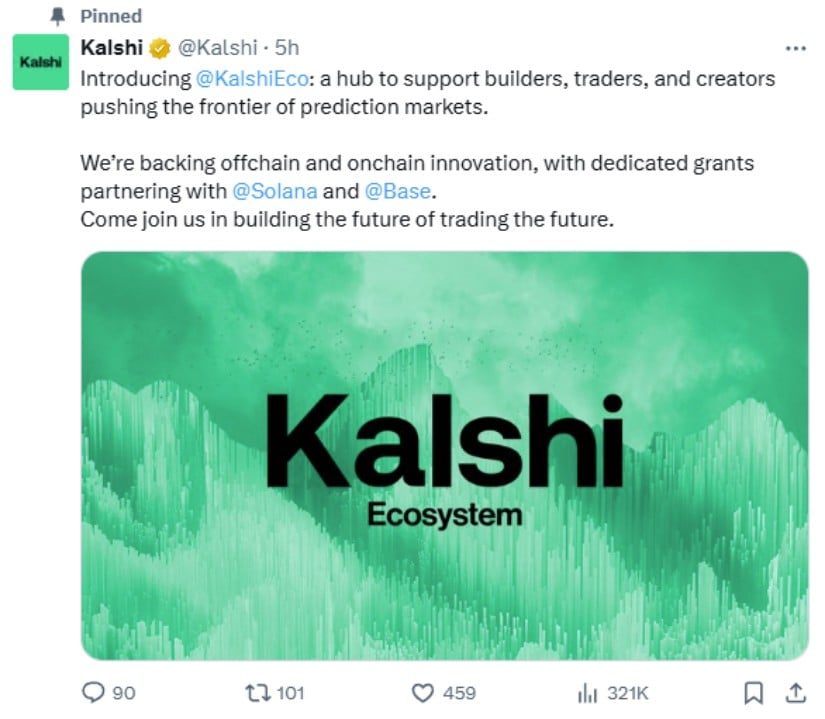
The regulated prediction market platform Kalshi announced today the launch of KalshiEco Hub, a new initiative partnering with Solana and Coinbase's Base network to drive blockchain-based prediction market innovation.The regulated prediction market platform Kalshi announced today the launch of KalshiEco Hub, a new initiative partnering with Solana and Coinbase's Base network to drive blockchain-based prediction market innovation.

Kalshi Launches Blockchain Ecosystem Hub with Solana and Base Partnership
Kalshi Launches Blockchain Ecosystem Hub with Solana and Base Partnership

The hub aims to attract builders, traders, and content creators through grants, technical support, and marketing assistance.

This move represents Kalshi’s expansion into blockchain development after establishing itself as the first CFTC-regulated prediction market platform in the United States. The company allows users to trade on real-world event outcomes, from political elections to economic indicators.

Building Bridges Between Traditional Finance and Crypto

KalshiEco Hub combines Kalshi’s regulatory expertise with crypto-native infrastructure from two major blockchain networks. The partnership brings together Solana’s high-speed transaction capabilities—processing up to 65,000 transactions per second—with Base’s layer-2 scaling technology designed to reduce costs and increase processing speed.

The hub offers multiple support services to ecosystem participants. These include financial grants for developers, technical assistance for project building, and marketing support for selected initiatives. Early collaborators include Kalshinomics, a market analytics dashboard, and Verso, which develops professional trading tools for market discovery.
Building Bridges Between Traditional Finance and Crypto

Source: @Kalshi

Kalshi also announced native support for Solana (SOL) deposits, allowing users to fund accounts directly from their wallets with limits up to $500,000. This builds on the platform’s existing crypto support for Bitcoin, USDC, and Worldcoin through partnerships with Zero Hash for regulatory compliance.

Closing the Gap with Market Leaders

The ecosystem launch comes as Kalshi narrows the trading volume gap with competitor Polymarket. Last month, Kalshi registered $875 million in volume compared to Polymarket’s $1 billion, according to industry data.

Kalshi’s growth trajectory shows significant momentum. The platform reported monthly trading volumes of $13 million in early 2025, with peak volumes reaching $26 million in October 2024. Revenue growth hit 1,220% in 2024, while the company recently completed a $185 million Series C funding round led by Paradigm and Sequoia at a $2 billion valuation.

The prediction market sector has attracted major institutional interest. Reports suggest Kalshi is close to raising additional funds at a $5 billion valuation, while Polymarket recently secured $200 million at a $1 billion valuation.

Expanding Solana’s Utility Beyond Memes and DEX Trading

For Solana, the Kalshi partnership creates new use cases beyond decentralized exchange trading and meme coins, which accounted for 65% of the network’s trading volume in May 2025. The integration allows SOL holders to participate in prediction markets without converting to stablecoins first, potentially boosting on-chain demand and market depth.

The timing aligns with significant institutional adoption of Solana. In Q2 2025, $1.4 billion in institutional capital flowed into Solana, with public companies staking 1.9 million SOL valued at $320.4 million. Solana’s DeFi total value locked reached $8.6 billion, supported by the launch of the first U.S. Solana staking ETF and growing corporate treasury holdings totaling 3.44 million SOL worth $970 million.

Strategic Positioning Against Regulatory Headwinds

Kalshi’s regulatory status provides a competitive advantage as prediction markets face scrutiny at state levels. The platform holds CFTC approval across all 50 U.S. states, granting legitimacy with traditional investors and institutions that unregulated platforms lack.

The company recently hired crypto influencer John Wang as head of crypto to expand its digital asset presence. Strategic partnerships include collaboration with Robinhood for football prediction markets and integration with World App for Worldcoin users.

Coinbase Ventures head Hoolie Tejwani identified prediction markets as a “killer onchain use case” due to blockchain’s growth, smart contract security, and stablecoin adoption.

The regulatory environment remains complex. While prediction markets gained mainstream attention during the 2024 presidential election cycle, some states have issued cease-and-desist orders questioning whether event contracts constitute gambling rather than legitimate financial products.

The Road Ahead: Innovation Meets Regulation

The KalshiEco Hub launch positions the platform at the intersection of regulated finance and blockchain innovation. Early partnerships focus on analytics tools, professional trading infrastructure, and retail user experiences. The initiative may establish new standards for regulatory-compliant DeFi integration as traditional finance increasingly explores blockchain applications.

Prediction markets demonstrated their accuracy during major events, often outperforming traditional polling methods. According to Kalshi data from late 2024, there was a 91% chance Bitcoin would hit $100,000 before the end of that year, showing the platform’s role in aggregating market sentiment on financial outcomes.

The success of this blockchain ecosystem initiative could accelerate broader institutional adoption of prediction markets while creating new utility for established networks like Solana and emerging platforms like Base.

Betting on Blockchain’s Future

Kalshi’s ecosystem hub represents a calculated bet that prediction markets will become a major blockchain use case. By combining regulatory compliance with crypto-native infrastructure, the platform aims to bridge traditional finance and decentralized innovation. The partnership’s success may determine whether regulated prediction markets can compete with their unregulated counterparts while maintaining institutional legitimacy.


Disclaimer: The articles reposted on this site are sourced from public platforms and are provided for informational purposes only. They do not necessarily reflect the views of MEXC. All rights remain with the original authors. If you believe any content infringes on third-party rights, please contact [email protected] for removal. MEXC makes no guarantees regarding the accuracy, completeness, or timeliness of the content and is not responsible for any actions taken based on the information provided. The content does not constitute financial, legal, or other professional advice, nor should it be considered a recommendation or endorsement by MEXC.

You May Also Like

X to cut off InfoFi crypto projects from accessing its API

X to cut off InfoFi crypto projects from accessing its API

X, the most widely used app for crypto projects, is changing its API access policy. InfoFi projects, which proliferated non-organic bot content, will be cut off
Share
Cryptopolitan2026/01/16 02:50
X Just Killed Kaito and InfoFi Crypto, Several Tokens Crash

X Just Killed Kaito and InfoFi Crypto, Several Tokens Crash

The post X Just Killed Kaito and InfoFi Crypto, Several Tokens Crash appeared on BitcoinEthereumNews.com. X has revoked API access for apps that reward users for
Share
BitcoinEthereumNews2026/01/16 03:42
Google's AP2 protocol has been released. Does encrypted AI still have a chance?

Google's AP2 protocol has been released. Does encrypted AI still have a chance?

Following the MCP and A2A protocols, the AI Agent market has seen another blockbuster arrival: the Agent Payments Protocol (AP2), developed by Google. This will clearly further enhance AI Agents' autonomous multi-tasking capabilities, but the unfortunate reality is that it has little to do with web3AI. Let's take a closer look: What problem does AP2 solve? Simply put, the MCP protocol is like a universal hook, enabling AI agents to connect to various external tools and data sources; A2A is a team collaboration communication protocol that allows multiple AI agents to cooperate with each other to complete complex tasks; AP2 completes the last piece of the puzzle - payment capability. In other words, MCP opens up connectivity, A2A promotes collaboration efficiency, and AP2 achieves value exchange. The arrival of AP2 truly injects "soul" into the autonomous collaboration and task execution of Multi-Agents. Imagine AI Agents connecting Qunar, Meituan, and Didi to complete the booking of flights, hotels, and car rentals, but then getting stuck at the point of "self-payment." What's the point of all that multitasking? So, remember this: AP2 is an extension of MCP+A2A, solving the last mile problem of AI Agent automated execution. What are the technical highlights of AP2? The core innovation of AP2 is the Mandates mechanism, which is divided into real-time authorization mode and delegated authorization mode. Real-time authorization is easy to understand. The AI Agent finds the product and shows it to you. The operation can only be performed after the user signs. Delegated authorization requires the user to set rules in advance, such as only buying the iPhone 17 when the price drops to 5,000. The AI Agent monitors the trigger conditions and executes automatically. The implementation logic is cryptographically signed using Verifiable Credentials (VCs). Users can set complex commission conditions, including price ranges, time limits, and payment method priorities, forming a tamper-proof digital contract. Once signed, the AI Agent executes according to the conditions, with VCs ensuring auditability and security at every step. Of particular note is the "A2A x402" extension, a technical component developed by Google specifically for crypto payments, developed in collaboration with Coinbase and the Ethereum Foundation. This extension enables AI Agents to seamlessly process stablecoins, ETH, and other blockchain assets, supporting native payment scenarios within the Web3 ecosystem. What kind of imagination space can AP2 bring? After analyzing the technical principles, do you think that's it? Yes, in fact, the AP2 is boring when it is disassembled alone. Its real charm lies in connecting and opening up the "MCP+A2A+AP2" technology stack, completely opening up the complete link of AI Agent's autonomous analysis+execution+payment. From now on, AI Agents can open up many application scenarios. For example, AI Agents for stock investment and financial management can help us monitor the market 24/7 and conduct independent transactions. Enterprise procurement AI Agents can automatically replenish and renew without human intervention. AP2's complementary payment capabilities will further expand the penetration of the Agent-to-Agent economy into more scenarios. Google obviously understands that after the technical framework is established, the ecological implementation must be relied upon, so it has brought in more than 60 partners to develop it, almost covering the entire payment and business ecosystem. Interestingly, it also involves major Crypto players such as Ethereum, Coinbase, MetaMask, and Sui. Combined with the current trend of currency and stock integration, the imagination space has been doubled. Is web3 AI really dead? Not entirely. Google's AP2 looks complete, but it only achieves technical compatibility with Crypto payments. It can only be regarded as an extension of the traditional authorization framework and belongs to the category of automated execution. There is a "paradigm" difference between it and the autonomous asset management pursued by pure Crypto native solutions. The Crypto-native solutions under exploration are taking the "decentralized custody + on-chain verification" route, including AI Agent autonomous asset management, AI Agent autonomous transactions (DeFAI), AI Agent digital identity and on-chain reputation system (ERC-8004...), AI Agent on-chain governance DAO framework, AI Agent NPC and digital avatars, and many other interesting and fun directions. Ultimately, once users get used to AI Agent payments in traditional fields, their acceptance of AI Agents autonomously owning digital assets will also increase. And for those scenarios that AP2 cannot reach, such as anonymous transactions, censorship-resistant payments, and decentralized asset management, there will always be a time for crypto-native solutions to show their strength? The two are more likely to be complementary rather than competitive, but to be honest, the key technological advancements behind AI Agents currently all come from web2AI, and web3AI still needs to keep up the good work!
Share
PANews2025/09/18 07:00