

Bitcoin Sits 45% Below Its Peak As Short Sellers Absorb $276M In Losses
West Texas Intermediate crude has hit $115 a barrel, gasoline prices in the US are up nearly 40% since late February, and Bitcoin is still trying to break through a wall it has failed to climb six times now.
That is the world Bitcoin finds itself in on Monday as it briefly touched $69,550 — a modest 3.30% gain that nevertheless sent shockwaves through the derivatives market.
Short Sellers Take The Hardest Hit
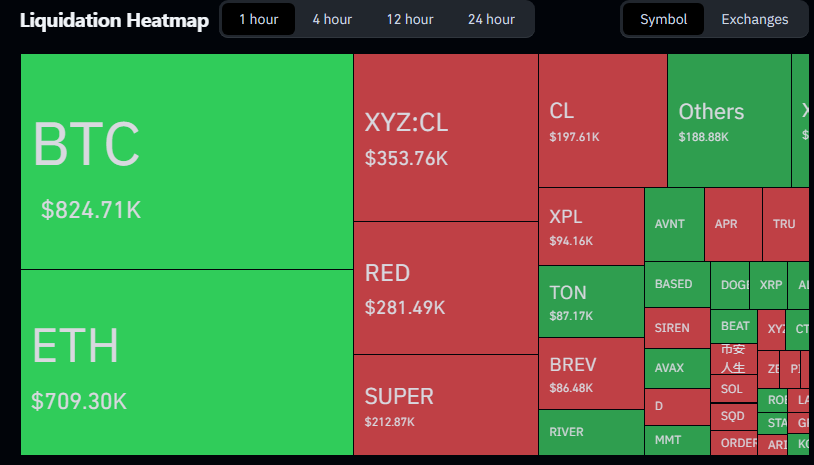
Over $276 million in leveraged positions were wiped out in 24 hours, hitting 80,200 traders across crypto derivatives platforms. The damage was not spread evenly.
Bears took the brunt of it. According to CoinGlass data, short positions accounted for $188 million of the $210 million liquidated in just the 12-hour window around the price surge.
Long liquidations, by comparison, came in at $24 million. Traders who had been betting on a continued decline were caught flat-footed as Bitcoin pushed back toward the $70,000 mark it has repeatedly failed to hold since early February.
The asset remains well off its best levels. Bitcoin set an all-time high of $126,000 on October 6, 2025. At current prices, it is trading roughly 45% below that record — context that puts Monday’s rally in sharper perspective.
A Squeeze Could Still Be Coming
The positioning data tells an uneven story. Based on CoinGlass figures, more than $6 billion in short positions are stacked near $72,500. If Bitcoin pushes up to that level, those positions could be forced to close in rapid succession.
On the downside, about $2 billion in long positions sit near $65,000 — a smaller but real risk if momentum fades. That gap between short and long exposure is what has some traders watching closely for a possible extended squeeze.
Bitcoin has made six runs at $70,000 since slipping below it in early February. Each attempt has fallen short. Monday’s move is the latest test of that resistance, and it arrives against a backdrop that is anything but calm.
Energy Shock Adds Pressure On All FrontsA standoff over the Strait of Hormuz has been tightening its grip on global energy markets since late February. Iran has rejected ceasefire terms, insisting compensation for war-related damage must be addressed before the strait reopens.
Oil prices have surged as a result. US gasoline costs are up sharply, and broader inflation fears have followed.
US President Donald Trump has called for Iran to reopen the waterway, citing global trade concerns. Reports indicate he has also suggested a deal with Iran may be within reach, while warning of severe consequences if talks collapse — including potential US control over Iranian oil resources.
Featured image from Unsplash, chart from TradingView


You May Also Like

Stellar (XLM) Trading at a Crossroads: Analyzing the 24-Hour Decline vs. 7-Day Rally

Why Isn’t Robert Kiyosaki Buying the Dip in BTC, ETH, Gold, and Silver?

CZ: “I’m Not Going to Exit” as Bitcoin Cycle Still Outperforms Despite 50% Drop



