GITEX Africa is no longer about who shows up, but what they leave with
GITEX Africa started yesterday, and it did not feel like another “Africa Rising” conference.
The organisers are no longer beating the drums of ambition and potential. It is time for execution, one speaker said on the main stage, at least from the parts of the opening ceremony I could understand, i.e., the English parts.
GITEX is still the biggest tech and startup showcase on the continent, and organisers say 50,000 people are expected to walk its 24 halls between April 7 and 9. Over 130 countries are represented.
Its ambition has been clear from day one: to make Morocco a nerve centre for technology investments in Africa, pulling capital, startups, and policy attention into one place, and away from the continent’s usual hubs, Nigeria, Kenya, Egypt, and South Africa.
But four years in, the conversation is starting to tilt towards outcomes. Every tech event starts with hype and what the organisers say on stage. Eventually, this must shift to what founders say they took home from the last edition, if the event wants to retain its relevance.
In 2025, Mohammed Drissi Melyani, Director-General of Morocco’s Digital Development Agency, said GITEX was becoming more than a showcase for innovation and turning into a platform for strengthening digital inclusion across African markets.
This year, Aziz Akhannouch, Head of Government, Kingdom of Morocco, put it more directly in his speech during the opening ceremony, “GITEX Africa Morocco has become far more than an annual exhibition. It is a real platform for building partnerships and creating opportunities.”
I spoke to a couple of returning startups to ask if they felt the same way.
Abdoul Zakari, cofounder of Sako, a fintech in Niger Republic, told me he got actual business from last year’s event. He did not raise money, but he closed deals that translated into revenue in 2025. This year, he is back, hoping for more of the same.
His startup focuses on cross-border payments in Francophone Africa. Now, it is looking at Nigeria.
“There is a lot of trade between Nigeria and Niger, but payment is still complicated,” he said.
Low bank account penetration in Niger makes it hard to move money into Nigeria. According to the World Bank, only 15% of people above age 15 have bank accounts.
A system that allows businesses to pay from mobile money into Nigerian bank accounts would unlock much of that trade, Zakari argues.
I also met Amsa, a Senegalese founder building Kaycber, a transit payments startup, who said he had just gotten a company ready to partner with his startup in Senegal.
When he realised I was Nigerian, he did not try to explain his product from scratch. He just said: “We are like Cowry.”
That was enough. Cowry is a contactless payment card developed by Touch and Pay (TAP) Technologies Limited, a Nigerian fintech company, that allows commuters to pay for bus and train rides using near-field communication (NFC).
According to him, some 5,000 people use their cards, with adoption strongest in Uganda.
Is Nigeria losing steam?
One of the first things I did when I got to the venue was look for Nigeria’s pavilion.
There was none. Last year, there was.
This year, the National Information Technology Development Agency (NITDA), Nigeria’s tech regulator, sponsored 10 startups.
The agency only covered the cost of exhibition booths, which cost about $2,000, according to two founders who paid for theirs. Last year, it sponsored 12 startups.
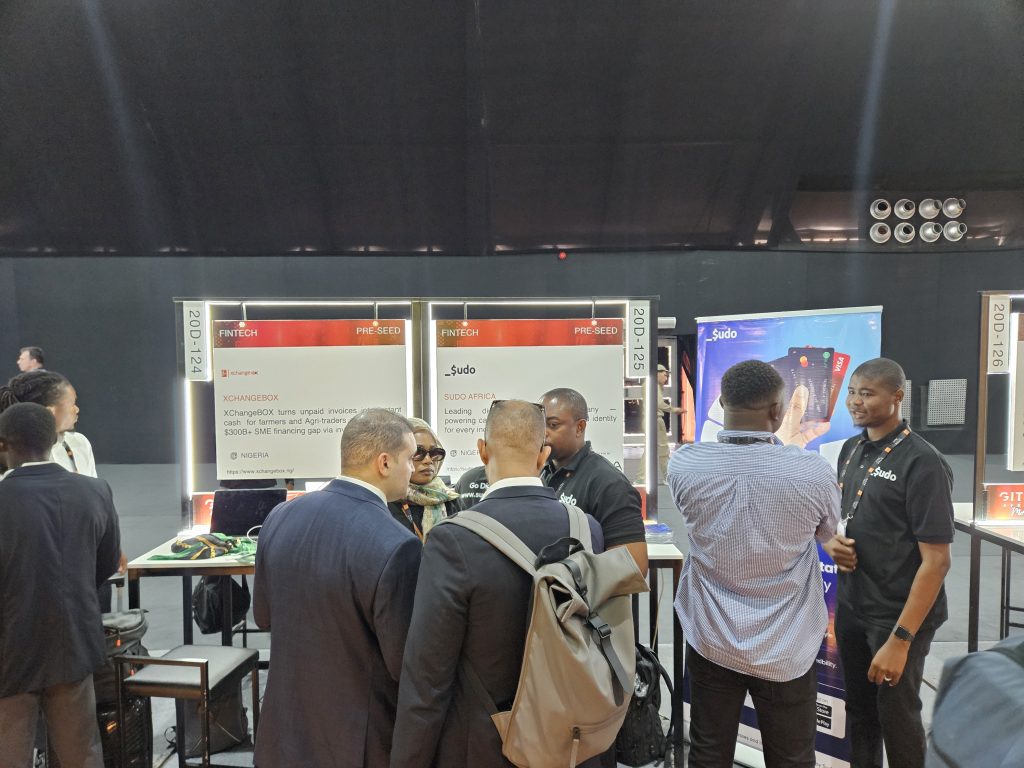 Image source: TechCabal
This is the first year NITDA is not fully funding participation.
According to Aristole Onumo, the agency’s director of stakeholder management and partnership, this was intentional.
“We want startups to show that their commitments too,” he told me.
According to the agency, instead of running roadshows, a nationwide startup discovery tour, like previous years, it picked startups from its database, specifically those willing to cover the cost of their trip.
“We have had people come to our roadshows, pitch great ideas, get selected, and after the event, they disappear into other businesses,” he said.
Some founders, according to him, saw the opportunity as “their share of the national cake.” But showing up is expensive.
One of the selected founders, who had to pay for his flight, hotel, and feeding, told me it costs between ₦4 million ($2,885) and ₦6 million ($4,327) on top of what NITDA had covered.
Another self-funded Nigerian founder, who wasn’t sponsored by NITDA, said it cost him about $6,000, including hotel, booth, and flights, to attend with his co-founder,
When I mentioned the funding issue, Onumo dismissed it, arguing that the agency has been playing its role as ecosystem orchestrator well.
Six of the 10 startups NITDA sponsored were in attendance when I found the booths around 2 pm local time.
One of the startups, Rescue Tap, was founded by Oyewole Joledo after losing two staff members to ‘one chance,’ a form of robbery or kidnapping involving fake public transport vehicles.
The product is designed to alert security agencies automatically in such situations.
Payments giant Visa funded another six Nigerian startups for this year’s event, David Adeleke, founder of open banking startup Zeeh, who was part of the cohort, told me. These startups are part of a cohort of about 18 African startups that the payment company is sponsoring for this year’s event.
For the Nigerian contingent, attention is already shifting to GITEX Nigeria, scheduled for August. Space remains its biggest constraint, NITDA officials told me.
Morocco can accommodate the foot traffic of close to tens of thousands of people across multiple halls. Nigeria, despite its scale, cannot.
I have only scratched the surface of GITEX Africa today. There are still halls I have not walked and conversations I have not had, and I hope to do so today.


You May Also Like

Oil: Prices slump below $100 on ceasefire – ING

Thailand SEC Targets Hidden Crypto Funding With New Rules