Oil Prices Rebound After Historic Drop as Strait of Hormuz Remains Disrupted
TLDR
- Brent crude and WTI both rose around 3% on Thursday after a 13%+ crash on Wednesday
- The drop came after Trump announced a temporary U.S.-Iran ceasefire
- Israeli strikes on Lebanon are raising doubts about the ceasefire’s scope
- Iran has halted oil tanker traffic through the Strait of Hormuz
- Goldman Sachs warns Brent could average above $100/barrel if the strait stays closed another month
Oil prices bounced back on Thursday after their worst single-day drop since April 2020. Brent crude rose 2.8% to $97.68 a barrel, and West Texas Intermediate climbed 3.3% to $97.50 a barrel.
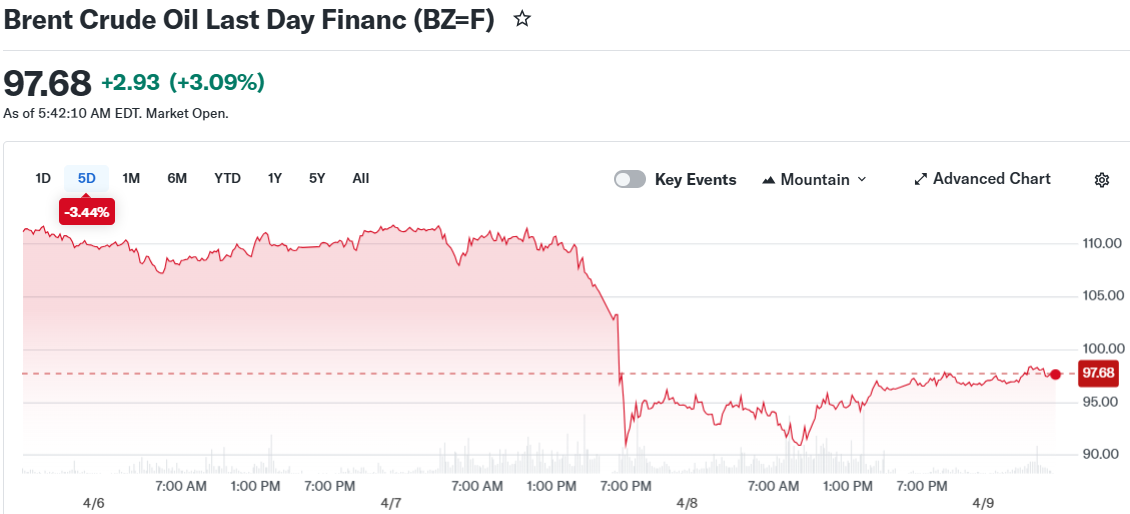 Brent Crude Oil Last Day Financ (BZ=F)
The selloff on Wednesday came after U.S. President Donald Trump announced a two-week ceasefire with Iran. Traders initially saw that as a sign supply disruptions would ease.
But the recovery faded fast. Israel continued striking targets in Lebanon even after the ceasefire was announced, raising questions about what the truce actually covers.
Israel said its operations against Hezbollah are not part of the agreement. Iran pushed back, calling peace talks with the U.S. “unreasonable” under current conditions and accusing Israel of violating the deal.
Iran has kept oil tanker traffic through the Strait of Hormuz on hold. The strait handles about a quarter of the world’s seaborne oil trade and has been largely closed since the U.S. and Israeli attack on Iran in February.
Goldman Sachs Lays Out the Scenarios
Goldman Sachs analysts warned that if the strait stays closed for another month, Brent could average above $100 a barrel in the second half of 2026.
Their base case assumes flows begin picking up this weekend and Persian Gulf exports return to pre-war levels within a month. Under that scenario, Brent averages $82 a barrel in the third quarter and $80 in the fourth.
A more negative outcome, involving a longer closure and lost regional production, puts Brent at $120 in the third quarter and $115 in the fourth.
Analysts at Goldman said risks to their price forecast are “skewed to the upside.” Vice President JD Vance was also quoted describing the ceasefire as fragile.
Trump posted on social media that it had been agreed “a long time ago” that the Strait of Hormuz would be open and safe. He warned that military action against Iran could resume if the terms are not met.
U.S. Crude Stocks Jump to Three-Year High
The U.S. Energy Information Administration reported that crude stockpiles rose by 3.1 million barrels to 464.7 million barrels in the week ending April 3. That is the highest level in nearly three years and came in well above expectations for a 1 million barrel increase.
Fuel inventories told a different story. Distillate stocks, which include diesel and heating oil, dropped by 3.1 million barrels on strong exports. Gasoline inventories fell by 1.6 million barrels.
Iran’s Ports and Maritime Organization announced two designated safe routes for vessels moving through the strait, centered around Larak Island near Bandar Abbas.
ING analysts said a full reopening of the strait is unlikely in the near term and that prices are expected to stay supported as supply disruptions take time to unwind.
Brent futures had hit a high of $119.50 during the height of the crisis before falling sharply on ceasefire news Wednesday.
The post Oil Prices Rebound After Historic Drop as Strait of Hormuz Remains Disrupted appeared first on CoinCentral.


You May Also Like

Scott Bessent Urges Senate to Pass CLARITY Act Immediately

Solo Bitcoin Miner Achieves Stunning Victory, Defying 1-in-100,000 Odds to Mine Full Block