Bitcoin’s rally is still just a bear market bounce unless it reclaims this key level
Bitcoin (BTC) moved from roughly $67,000 to $72,000 in the days surrounding the US-Israel-Iran ceasefire announcement, a 7.5% rebound that reduced volatility and lifted sentiment across risk assets.
Glassnode's Apr. 8 Week On-chain report noted that the bounce and stabilization still fit the fingerprint of a bear market rebound. BTC still trades inside a bear market value zone, and the level that would genuinely flip the picture is $81,600.
That number is the Short-Term Holder Cost Basis, which is the aggregate breakeven price for Bitcoin bought in recent months. Glassnode identifies it as the line the market needs to reclaim before rallies can plausibly represent a durable move.
Below it, recent buyers as a cohort carry losses, and the report says every rally into that range is apt to run into supply from trapped holders seeking to exit near breakeven.
The ceasefire eased the macro shock, compressing the volatility of the options markets. Short-dated implied vol fell to the low 40s, and the 6-month tenor settled around 45%.
Reuters reported on Apr. 9 that the truce already looked fragile, with oil rebounding and broader risk sentiment softening within a day of the announcement.
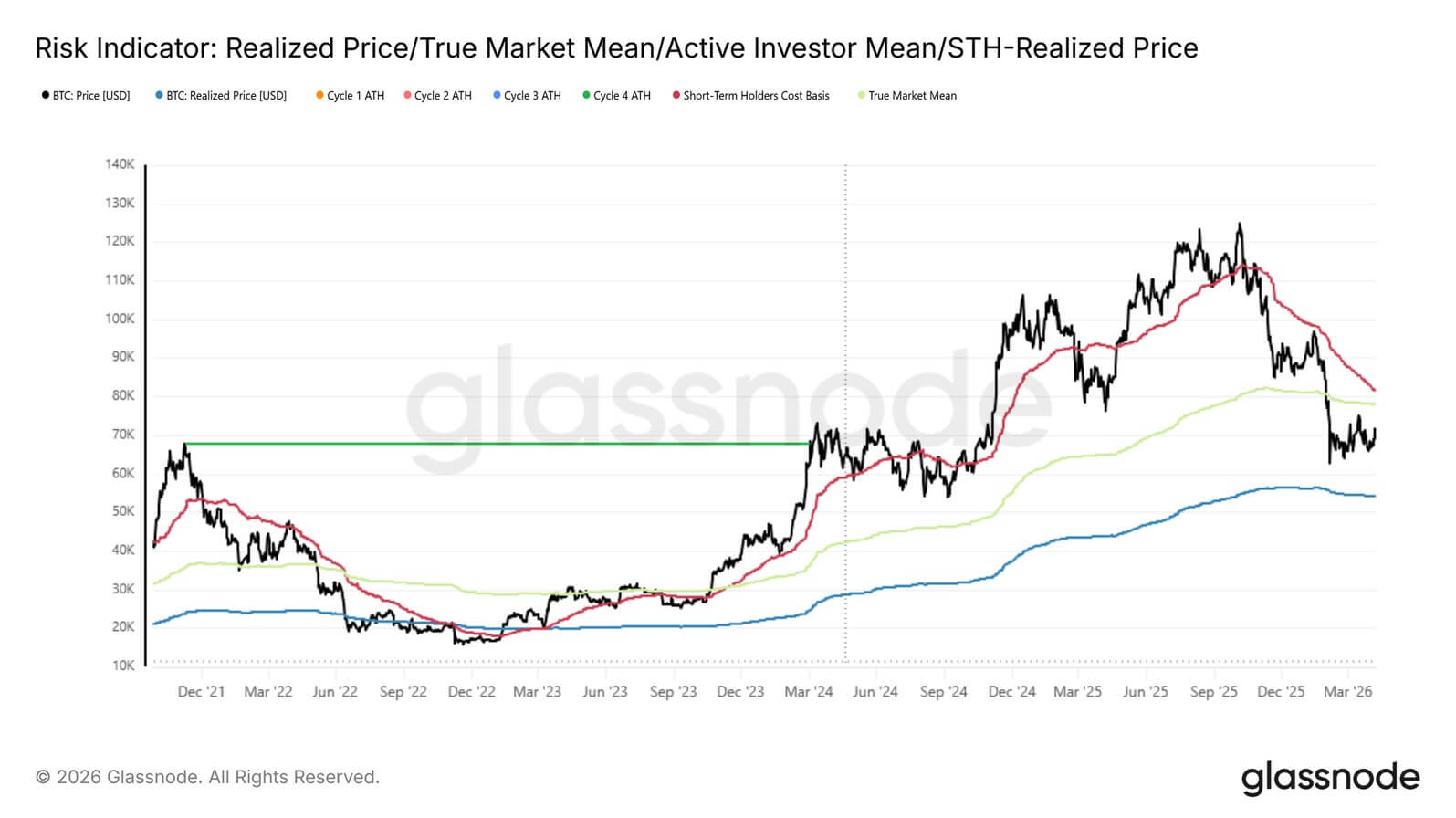 Bitcoin's price fell below the Short-Term Holder Cost Basis in early 2026 and now trades between the True Market Mean and Realized Price. Source: Glassnode
Three numbers
Glassnode's framework reduces to a clean progression, pointing to the $69,000-$71,500 zone as to where dealer positioning shows long gamma concentration, a mechanical structure that may help absorb near-term selling.
With BTC trading slightly above $72,000 at press time, the market is above the top of that support shelf. The $78,000 True Market Mean sits 8.5% higher and represents the probable ceiling for any relief rally.
Glassnode places the AVIV Ratio at 0.92, below 1.0 since early February. The firm says that reading is comparable to May-June 2022, a period during a bear market, and is well above the deepest capitulation extremes of late 2022.
The current setup is a bounce inside an ongoing bear phase, with a plausible floor, a probable near-term ceiling, and a more important level above both.
Binance's 30-day relative spot volume holds below its 1.0 baseline, which Glassnode reads as weak organic demand. US spot ETF flows turned modestly positive on a 14-day basis, ending an extended outflow stretch, with Apr. 7 and 8 still showing negative prints.
Futures volume contracted sharply and rolled over on a 30-day basis, while the 25-delta options skew still tilts toward puts, meaning that traders continue to pay a premium for downside protection.
Together, those readings describe a market stabilizing on thin participation.
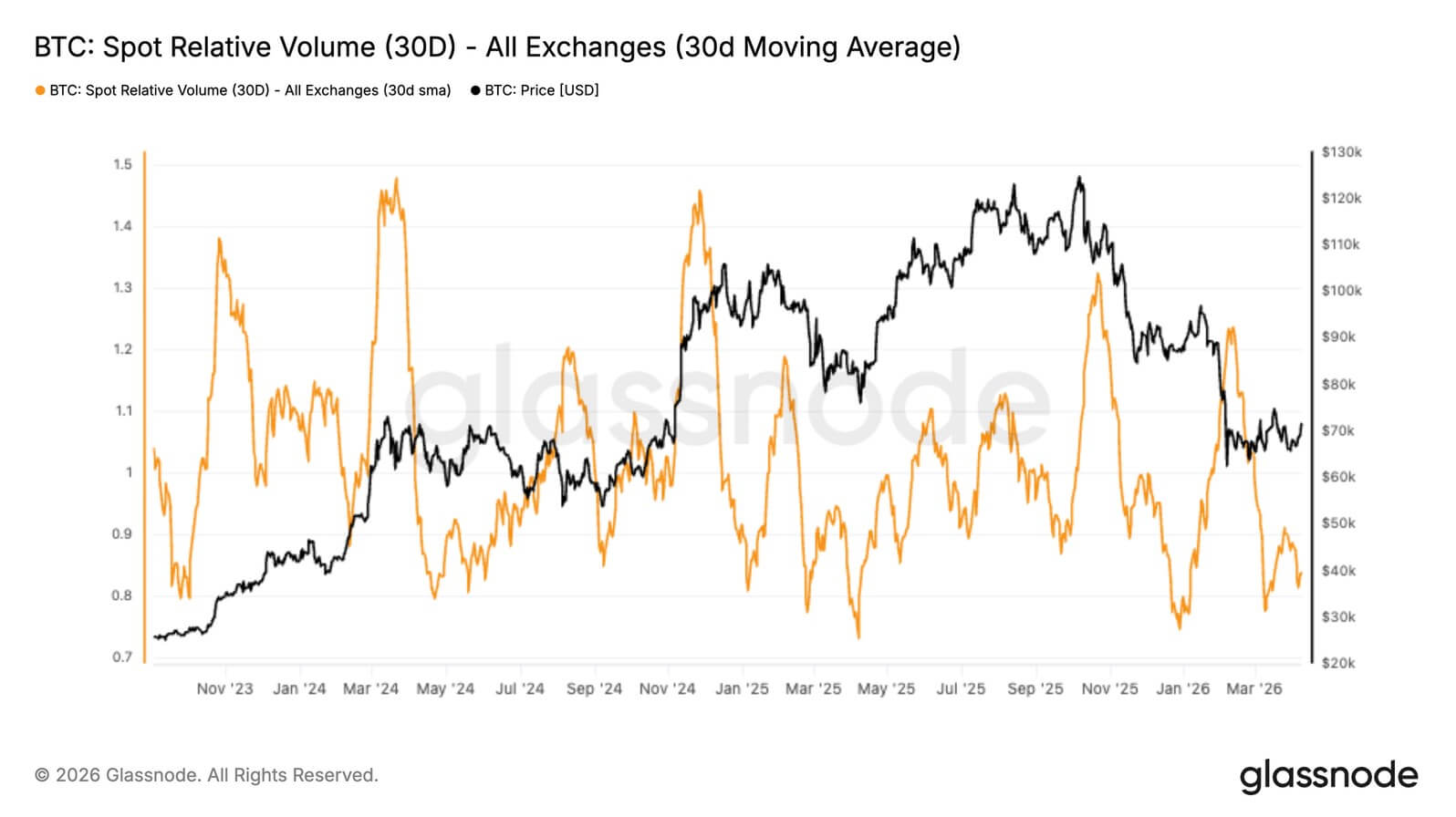 Bitcoin's 30-day spot relative volume across all exchanges has fallen below 0.9 as of March 2026, its lowest reading since the 2023 bear market. Source: Glassnode
The architecture of a relief rally
Glassnode says the market has entered a more balanced state, in which catastrophic downside is less imminent, a grind toward $78,000 is plausible, and durability is still an open question. The difference comes down to whether the buyer base is absorbing or distributing.
Below $81,600, recent buyers are carrying losses, creating a mechanical constraint on upside momentum. Each rally toward breakeven delivers an exit opportunity to a cohort that accumulated at higher prices and waited out a drawdown.
Glassnode explicitly describes that mechanism, saying that distribution pressure from trapped holders makes rallies within the current range structurally vulnerable.
Long-term holders have realized losses of over 4,000 BTC per day since November 2025. The report noted that cooling that figure toward under 1,000 BTC per day, alongside a reclaim of $81,600, would constitute the clearest on-chain signal of a genuine regime turn.
Potential pathways
In the bull case, BTC reclaims $81,600, ETF inflows continue to expand, and futures participation re-expands, pulling volume back into the market.
Glassnode's own framework provides that falsification test: a reclaim of the Short-Term Holder Cost Basis, combined with long-term-holder realized losses cooling materially, would be the most credible on-chain confirmation that the current bear phase is giving way to a pre-bull recovery structure.
In that outcome, the ceasefire was the catalyst that began a genuine demand-regime transition.
In the bear case, BTC loses the $69,000-$71,500 support shelf, and weak spot demand fails to absorb supply from trapped holders.
The relief rally stalls well short of $78,000, and the current bounce earns a footnote as a volatility event. Glassnode's data on softer futures, persistently defensive options positioning, and still-weak spot volumes make that outcome consistent with the current participation profile.
The ceasefire reduced near-term volatility and left sustained demand improvement yet to follow.
| Scenario | What price does | What participation does | What it means |
|---|---|---|---|
| Bear-market bounce | Holds or loses $69K–$71.5K, stalls below $78K or $81.6K | Spot stays soft, futures stay weak, options stay defensive | Relief rally inside a bear structure |
| Credible recovery | Reclaims $81.6K | ETF inflows expand, futures re-accelerate, LTH realized losses cool toward under 1K BTC/day | Transition toward pre-bull recovery |
| Failure / relapse | Loses support shelf decisively | Trapped-holder supply overwhelms weak demand | Bounce becomes a volatility event, not a regime change |
Ceasefire late shock
The macro backdrop sets the ceiling on sentiment-driven demand. The US-Israel-Iran truce compressed volatility faster than it rebuilt risk appetite, and the one-day reversal in oil prices that Reuters captured on Apr. 9 illustrates why geopolitical relief rallies carry an expiry date.
Once the acute fear subsides, the demand structure reasserts itself, and Glassnode's data indicate that the underlying structure remains thin.
Realized volatility at 42.5% and implied vol in the low 40s describe a calm market that has yet to turn bullish.
Durable breakouts require expanding volume, improving ETF flows beyond modest, and futures curves showing real speculative appetite. On Glassnode's Apr. 8 data, those conditions have yet to appear.
For now, the cleaner read from Glassnode is that Bitcoin has found enough footing for a bounce.
Below $81,600, the market is still rallying within a bearish structure, and the participants most likely to sell on the next push are the same buyers who have been underwater since the rally peaked.
The post Bitcoin’s rally is still just a bear market bounce unless it reclaims this key level appeared first on CryptoSlate.


You May Also Like

USD: Inflation focus into CPI release – TD Securities

OKX Ventures and HashKey Capital Join CAEX as Strategic Partners to Advance Vietnam’s Regulated Crypto Asset Trading Pilot