

When oil and power lines fail, Camiguin uses the sun to make its own power
CAMIGUIN, Philippines — When Typhoon Odette hit Cebu in 2021, Graham Pilapil did not have power in his home for an entire month. To continue working, he traveled to his company’s office every day to do his IT job, which was supposed to be fully remote.
He eventually moved back to his home province of Camiguin in 2024, bought a 250-square-meter house, and has since lived there with his wife and four children. But even in a different region, power outages — shorter, but at frequent intervals — continued to plague him.
This time, though, he was paying one of the country’s highest electricity prices for it.
 NO REGRETS. Camiguin resident Graham Pilapil talks to reporters about his home solar power setup during a media tour organized by the Mindanao Goes Solar movement on March 29, 2026. Photo by Mindanao Goes Solar
In April 2025, his electricity bill had climbed to P12,000 in a single month — all while he continued to suffer from frequent brownouts.
That was when he decided enough was enough.
Luckily, he had a friend who worked as an engineer for a solar energy company based in Cagayan de Oro. That friend helped him figure out what and how much he had to install for his household’s needs.
In less than a month and coughing up P350,000 upfront, the Pilapil family had a fully functioning 6-kW solar photovoltaic (PV) system by June 2025.
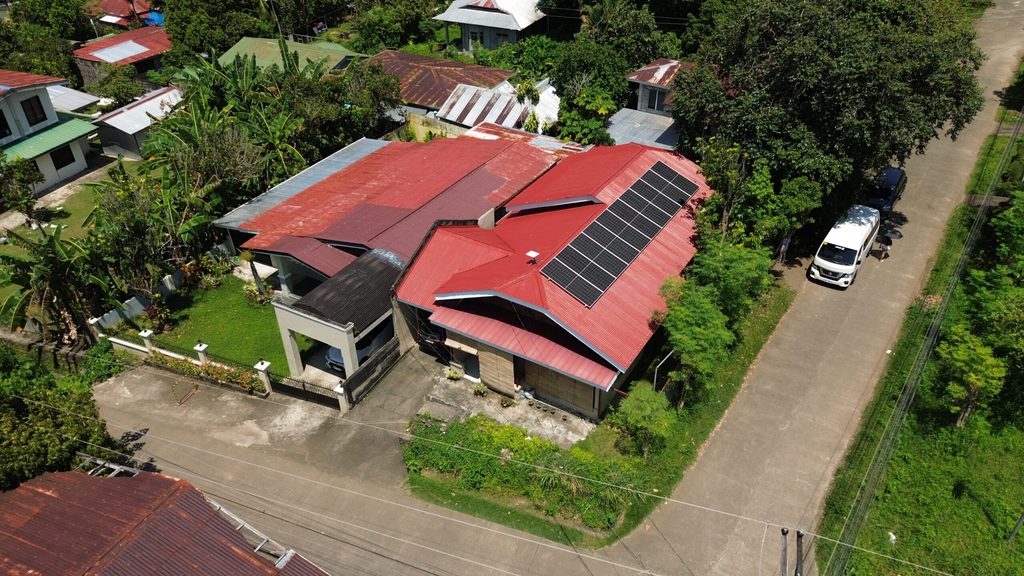 PILAPIL RESIDENCE. Solar panels line the roof of the Pilapil residence in Camiguin. Photo by Mindanao Goes Solar
  CONTROL. The Pilapil family keeps their solar inverter inside their house. Photo by Mindanao Goes Solar
Nine months into his solar setup, Pilapil has no regrets. His P12,000 electricity bill has gone down to around P2,000 during summer months and P8,000 when the weather is gloomy. The lowest his electricity bill had ever gotten was P900.
Now, amid an oil crisis and soaring fuel prices, Pilapil continues to enjoy the perks of his new energy rig. His solar panels have made the option of switching to an electric vehicle (EV) even more attractive — especially in Camiguin, where there aren’t any EV charging stations yet.
Pilapil is far from being the only one to have switched to solar and not looked back. Government offices and businesses across the province have been adopting solar energy technology, whether in small or big investments.
In the middle of an oil crisis, those investments have only made even more sense.
Camiguin’s power situation: Brownout-prone and expensive
Camiguin, as a small island separated from mainland Mindanao, has a unique power situation.
Full-fledged electric services in the province started after the failure of a mini-hydro project, according to the island’s distribution utility, the Camiguin Electric Cooperative (CAMELCO).
“Due to last minute changes, the project was shelved and instead NEA (National Electrification Administration) opted for the use of a submarine cable,” the cooperative wrote. “Thus, was born the beginning of a 24-hour electric service.”
A 13.2-KV distribution line then began connecting Camiguin to the Misamis Oriental II Electric Cooperative in mainland Mindanao. Then, when that cable aged and became too little for the island’s demand, a P7-million 69 KV line, later bought by CAMELCO through a loan, became the island’s new point of connection to the grid.
But the loan to pay for that connection point — along with the electricity that passes through it mainly coming from the hydro power plants of the government-owned Power Sector Assets and Liabilities Management (PSALM) Corporation — was absorbed by the electric bills of Camuiguingnons.
All the while, brownouts on the island were still commonplace. Camiguin Governor XJ Romualdo said the power outages were caused by a whole host of factors, but the “weird” setup certainly did not help things.
“Since our distribution system covers part of the mainland…when there’s a brownout, the usual message we send out is ‘there’s a problem in Misamis Oriental,’” he told Rappler in Filipino.
 ENERGY PLAN. Camiguin Governor XJ Romualdo speaks to media about the island’s plan for solar energy and the impact of the Middle East crisis during a media tour organized by the Mindanao Goes Solar movement on March 30, 2026. Photo by Mindanao Goes Solar
The weirdness did not stop there. When the submarine cable’s capacity became too small for the island’s exponentially growing demand, CAMELCO was tasked with finding a solution.
Predictably, it tried to find more power suppliers to meet that growing demand. But to Camuiguingnons’ surprise, the electric cooperative contracted in the span of five months the services of two coal-fired power plants and one diesel plant for a total of 10.73 MW.
At the time, Camiguin’s peak demand was only 4.7 MW. While more power seems like a good thing, it actually meant higher bills for Camiguin consumers, who ended up paying for much more energy than they were actually using.
According to Romualdo, CAMELCO had explained the overcontracting to be a practical, time-saving measure. The approval of new power supply agreements by regulatory bodies takes a long time, so they wanted the power supply to be able to handle the island’s demand as it grew over time.
Either way, Camiguin consumers continued to pay for the excess in the meantime. This drove electricity prices to spike, coming from P7.88 per kilowatt hour (kWH) in December 2016 to P13.40 in January 2017, becoming the highest in Mindanao and one of the highest in the country, according to Department of Energy data.
At one point, the rate had even gone as high as P16, even before some of the power supply agreements had come into full effect.
Later on, through congressional probes and government intervention, the diesel plant’s contracted capacity was brought back down to 2 MW, while the agreement with GNPower’s coal plant had some of its provisions suspended until February 2023, which saw to it that CAMELCO would only pay for the electricity it actually used rather than a certain minimum.
Still, Camiguin’s power rates remain among the highest in the country, even as of March 2026 at P14/kwh. Around half of that price comes from generation costs, the most expensive of which are KEGI’s diesel plant and GNPower’s coal plant.
In particular, the diesel power plant only made up 12.56% of Camiguin’s electricity in March, but it made up almost half of the generation cost that Camiguin consumers were paying for.
The staggeringly high price in exchange for persistent power outages has led to complaints from Camiguin consumers. This whole ordeal with the plant that started nearly a decade ago has led to Romualdo saying that he is considering no longer renewing the plant’s contract that is due to expire this month.
The Camiguin governor has been pushing for solar energy projects in the province for a few years now, one panel at a time.
Traces of the sun
Solar panels can be found almost anywhere in Camiguin. Houses, restaurants, and resorts have solar panels — both big and small — lined along their roofs.
 SMALL WAYS. A small solar panel is installed along the roof of a pizza place in Camiguin. Photo by Shay Du/Rappler
Paras Beach Resort, among the pioneering solar-powered resorts in Camiguin, has avoided the inconveniences and damage caused by frequent brownouts, while their electric bills had lessened by about 40%.
 SUNNY PARADISE. Paras Beach Resort in Mambajao, Camiguin is powered by solar panels. Photo by Mindanao Goes Solar
Small panels are also attached to street lights, made possible by both local and provincial governments all chipping in to cover more surface area. It was an effort to keep the streets safe at night, especially along the island’s inroads, funded by a now-defunct community development program by the Department of Social Welfare and Development.

 SAFE STREETS. Solar street lights line the highway and inroads of Camiguin. Photos by Shay Du/Rappler
Even in the tourist sites located on the island’s furthest corners — where even mobile signal does not reach — there are solar panels. They have been there since 2023.
Whether near the help desk in Katibawasan Falls, or along the entrance of the Old Church Ruins, there will be at least three things: a small solar panel, an inverter, and a Starlink modem. These small setups only make enough power to keep the WiFi and CCTV system running.
 A solar panel in Katibawasan Falls
  A solar inverter and Starlink system in Katibawasan Falls
  A solar inverter and Starlink system in the Old Church Ruins
But according to tourism officer Candice Dael, it’s a conscious decision to prioritize those two services. It’s for the safety of tourists, especially when they do adventurous activities in areas with poor signal. It’s also about improving their overall experience by making sure they can post and share in real time the moments they have in Camiguin’s most beautiful spots.
Big ticket solar projects in the province have also been completed or have made great progress in recent years.
A 4-MWp solar project that has been at least a decade in the making will soon be fully operational by September this year, according to Romualdo. And that project will be the first renewable energy project in the Philippines that will eventually be owned by the island’s electric cooperative through a lease-to-own arrangement.
The province’s new capitol building was also equipped with a 200-kw solar energy system in 2025, with continuous upgrades being installed since then.
 Photo by Mindanao Goes Solar
  Photo by Mindanao Goes Solar
“So, before solar, our electricity bill reached almost P1 million…. Now, our bill dropped to around P500,000 to P700,000,” Romualdo told Rappler.
They also installed new batteries by the end of 2025, which is expected to drop their electricity bill even more in the coming months.
The success of the project has led the provincial government to procure a P36-million solar setup for the old provincial capitol, where all the national government agencies still operate. They are also working on equipping their district hospital with solar panels, while other government buildings have installed their own solar systems.
The mayors of Mahinog, Guinsiliban, and Sagay saw the provincial government’s success with their solar panels, and secured funding from the national government to make their own municipal halls solar-powered as well.
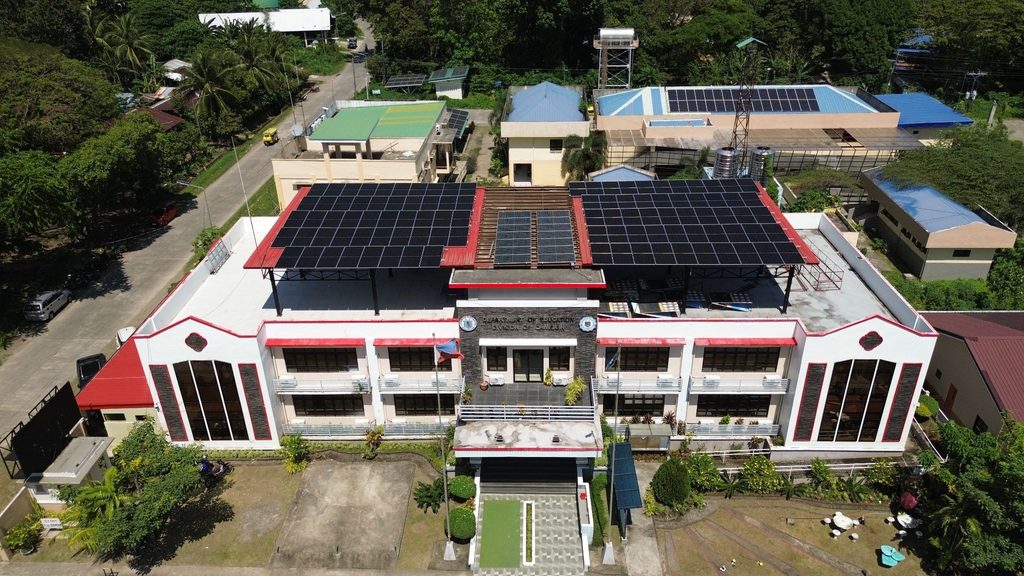 Photo by Mindanao Goes Solar
To Romualdo, making these investments in solar energy to save on electricity bills wasn’t optional. It was “a need.”
“A million pesos a month for an electric bill is not sustainable, since that will eat up on programs and projects and budget for services,” he said. “If you could save like two or three million pesos from that, you can use it to add to medical assistance, for social services, for jobs.”
Long road ahead
For many renewable energy advocates, power should be distributed, democratized, and decarbonized to be reliable and affordable. Households and communities should be able to make and manage their own clean energy, free from the influence of flawed distribution systems and volatile fossil fuel prices.
Mindanao Goes Solar (MGS), an advocacy group composed of solar installers, has been pushing for a future like that in every way they can, through educational campaigns, trainings, and consultations.
But throughout the course of that journey, there have been two main challenges to the promotion of solar energy: financing and net-metering guidelines.
When it comes to financing, the goal should be that solar loan options would have monthly amortizations similar to what a consumer would usually pay for their electricity bill. Philline Donggay, project lead of MGS and long-time advocate for clean energy, said that they have been trying to convince banks and financial institutions to incorporate those kinds or terms.
There has been some progress on that front, especially in the wake of the Middle East crisis. The Government Service Insurance System anounced in March the availability of solar loans for government employees. Meanwhile, major banks and even home credit services have been rolling out their own versions of these financing options.
Net-metering, or the mechanism by which solar panel owners can sell back the excess energy they generated to their electric cooperative for credits that can be subtracted from their electric bill, is another issue.
Despite being required by law, many rural electric cooperatives still struggle to roll out the program. That includes Camiguin, which was already reprimanded by the Energy Regulatory Commission for failing to implement net-metering in the province.
While a new advisory fast-tracking the program was recently released on March 30, the fix isn’t so simple. The issue stems from the financial position of these cooperatives, and whether they even have the capacity to pay for the electricity. CAMELCO, for example, has long been in a poor financial position, operating with “substantial losses,” as the province’s governor would describe it, while having debts to its power suppliers.
“It must be noted that for some Mindanao rural electric cooperatives with limited operational budgets, additional support is needed to ensure they have the capacity to implement net metering,” Donggay said in a statement. “As net metering applications are fast-tracked everywhere, rural electric coops [must be] equipped with knowledge and resources to fulfill these duties.”
Even with these challenges, many Camiguin locals remain firm believers in the potential of solar energy. Some have even resorted to cheap, plug-and-play “Shopee solar” installations like lamps and street lights, as restaurant owner Potpot Pinili would call them.
 SELF-SUSTAINING. Potpot Pinili, owner of Daos plant-based kitchen and Haruhay eco-beach in Mambajao, Camiguin, speaks to reporters during a media tour organized by the Mindanao Goes Solar movement on March 29, 2026. Photo by Shay Du
He owns a vegan restaurant and ecobeach resort along the coast of Mambajao. His setup there is almost fully self-sustaining — the architecture makes use of proper ventilation to do away with the need for air conditioning — except for the lack of proper solar energy.
If he had a grant to help finance the setup, he would have made the transition long ago. In the meantime, his Shopee solar installations have not failed him yet even after three years of using them.
The people of Camiguin learned long ago that solar energy is an investment that will give them control over their own power system. In the middle of an uncontrollable oil crisis, that investment has only become more valuable.
To Camuiguingnons, the sun not only gives them free power, but also power that is free from war, calamity, external price shocks, and “weird” distribution systems. – Rappler.com
This story was done in collaboration with the Mindanao Goes Solar movement, an advocacy group pushing for a clean energy transition in the area through the adoption of solar photovoltaic (PV) technology.


You May Also Like

Scotland Predicted Lineup vs Haiti: Starting XI, Team News & Tactical Analysis

Binance TR’s Pizza-Themed Social Media Event: Opportunity to Win a Domino’s Gift Voucher Worth 800 TL

Türkiye Predicted Lineup vs Australia: Starting XI, Team News & Tactical Analysis



