Gold Gains Ground as US-Iran Diplomatic Overtures Boost Market Sentiment
Key Highlights
- Precious metal advanced as much as 1.2% to reach $4,796 per ounce following consecutive days of declines
- Washington initiated a maritime blockade strategy in the Strait of Hormuz amid ongoing diplomatic efforts
- Tehran and Washington both indicated willingness to pursue additional rounds of diplomatic engagement
- Weakening greenback provided tailwinds for bullion, with the dollar index extending losses for seven consecutive trading days
- March Producer Price Index figures scheduled for release Tuesday remain critical for assessing energy-related inflationary pressures
Bullion markets experienced a notable recovery during Tuesday’s trading session, bouncing back from two consecutive days of selling pressure as renewed prospects for diplomatic engagement between Washington and Tehran boosted investor confidence.
The spot market saw bullion advance 0.7% to settle at $4,773.26 per ounce. Futures contracts posted gains of 0.4%, reaching $4,784.05 per ounce. Intraday trading witnessed the precious metal briefly test the $4,796 level.
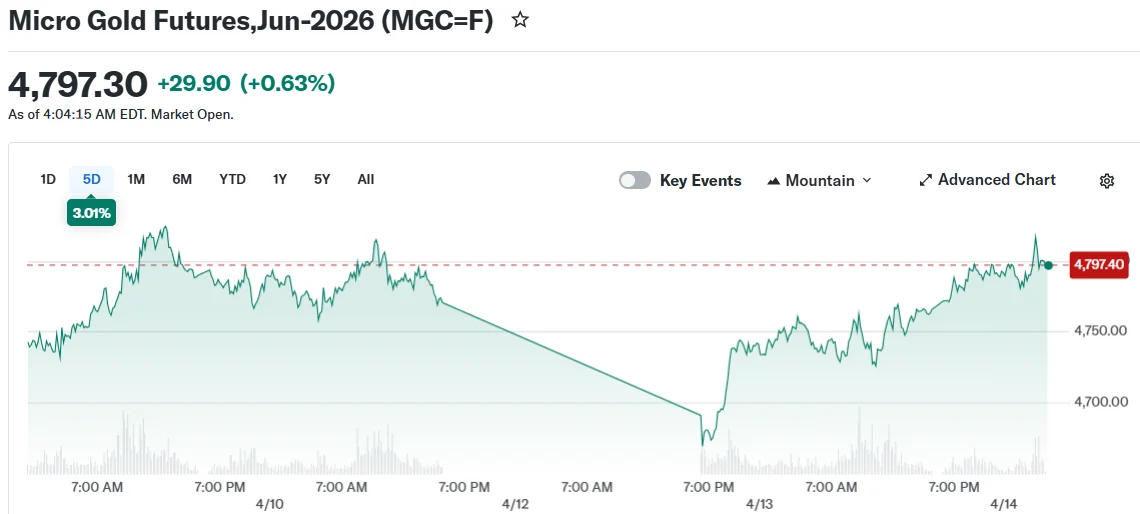 Micro Gold Futures,Jun-2026 (MGC=F)
This uptick occurred despite Washington’s deployment of naval forces to enforce a blockade around Iranian coastal regions and Persian Gulf port facilities, intensifying strategic pressure on the Islamic Republic.
President Donald Trump revealed that Iranian representatives had initiated contact with his administration, expressing desire to “work a deal.” Iranian President Masoud Pezeshkian acknowledged Tehran’s readiness to pursue continued negotiations within established international frameworks.
US Vice President JD Vance, who spearheaded weekend diplomatic sessions in Pakistan, maintained measured optimism about prospects. He emphasized that any agreement’s success would hinge on decisions made in Tehran.
Emerging reports indicate American and Iranian representatives are exploring the possibility of additional negotiations before the current two-week ceasefire arrangement concludes next week. The Pakistan-hosted discussions over the weekend yielded limited tangible outcomes.
The greenback extended its decline for a seventh consecutive session, marking its most prolonged downturn in twenty-four months. Currency weakness typically provides support for gold, as the precious metal is denominated in US dollars.
Oil prices retreated beneath the $100 per barrel threshold. This development alleviated some inflationary anxieties that have pressured precious metals since hostilities commenced more than six weeks ago.
Interest Rate Outlook Constrains Bullion Gains
Notwithstanding Tuesday’s rebound, the yellow metal has surrendered approximately 10% of its value since warfare erupted in late February. During the conflict’s initial phase, market participants liquidated gold positions to address margin calls and losses across other asset classes amid a liquidity crunch.
Gold has been responding more significantly to monetary policy projections than traditional safe-haven dynamics, according to Justin Lin, investment strategist at Global X ETFs Australia. He noted that bullion was drawing support from de-escalation expectations rather than geopolitical anxiety.
The Federal Reserve’s monetary trajectory remains ambiguous. Current money market pricing reflects below 20% probability of a rate reduction by year-end December.
Silver jumped 2.5% to $77.51 per ounce. Platinum and palladium similarly recorded advances. Spot silver traded 1.4% higher at $76.64 per ounce during earlier sessions.
Key Inflation Metrics Awaited
March Producer Price Index figures were scheduled for release later Tuesday. Market participants anticipated the data would reflect additional energy-related pricing pressures.
Previous week’s Consumer Price Index statistics revealed significant inflationary acceleration. The Iran conflict disrupted international energy systems after Tehran implemented blockade measures in the Strait of Hormuz during the confrontation’s early stages.
Elevated energy costs have intensified speculation that the Federal Reserve might maintain current policy settings or implement tightening measures, which would weigh on non-interest-bearing assets such as gold.
Spot bullion was quoted at $4,773.26 as of Tuesday afternoon Singapore trading hours, with valuations generally confined within a $4,700 to $4,900 range throughout the preceding week.
The post Gold Gains Ground as US-Iran Diplomatic Overtures Boost Market Sentiment appeared first on Blockonomi.


You May Also Like

JPMorgan CFO Flags Regulatory Arbitrage Risks From Stablecoins

Chainlink Whale Activity Rises While Price Bleeds for 7 Straight Months