This article introduces a non-diffusive neural network (NDNN) solver for one-dimensional scalar hyperbolic conservation laws (HCLs) containing shock waves. The approach models both smooth solutions and discontinuity lines using neural networks, first for a single shock wave and then for multiple shocks. It also addresses shock generation, shock–shock interaction, and extensions to systems, showing how 2D+1 neural networks can be applied to approximate solutions in complex PDE scenarios.This article introduces a non-diffusive neural network (NDNN) solver for one-dimensional scalar hyperbolic conservation laws (HCLs) containing shock waves. The approach models both smooth solutions and discontinuity lines using neural networks, first for a single shock wave and then for multiple shocks. It also addresses shock generation, shock–shock interaction, and extensions to systems, showing how 2D+1 neural networks can be applied to approximate solutions in complex PDE scenarios.

Neural Networks vs. Scalar Shock Waves

Abstract and 1. Introduction

1.1. Introductory remarks

1.2. Basics of neural networks

1.3. About the entropy of direct PINN methods

1.4. Organization of the paper

  1. Non-diffusive neural network solver for one dimensional scalar HCLs

    2.1. One shock wave

    2.2. Arbitrary number of shock waves

    2.3. Shock wave generation

    2.4. Shock wave interaction

    2.5. Non-diffusive neural network solver for one dimensional systems of CLs

    2.6. Efficient initial wave decomposition

  2. Gradient descent algorithm and efficient implementation

    3.1. Classical gradient descent algorithm for HCLs

    3.2. Gradient descent and domain decomposition methods

  3. Numerics

    4.1. Practical implementations

    4.2. Basic tests and convergence for 1 and 2 shock wave problems

    4.3. Shock wave generation

    4.4. Shock-Shock interaction

    4.5. Entropy solution

    4.6. Domain decomposition

    4.7. Nonlinear systems

  4. Conclusion and References

2. Non-diffusive neural network solver for one dimensional scalar HCLs

In this section, we derive a NDNN algorithm for solving solutions to HCL containing (an arbitrary number of) shock waves. The derivation is proposed in several steps:

\ • Case of one shock wave.

\ • Case of an arbitrary number of shock waves.

\ • Generation of shock waves.

\ • Shock-shock interaction.

\ • Extension to systems.

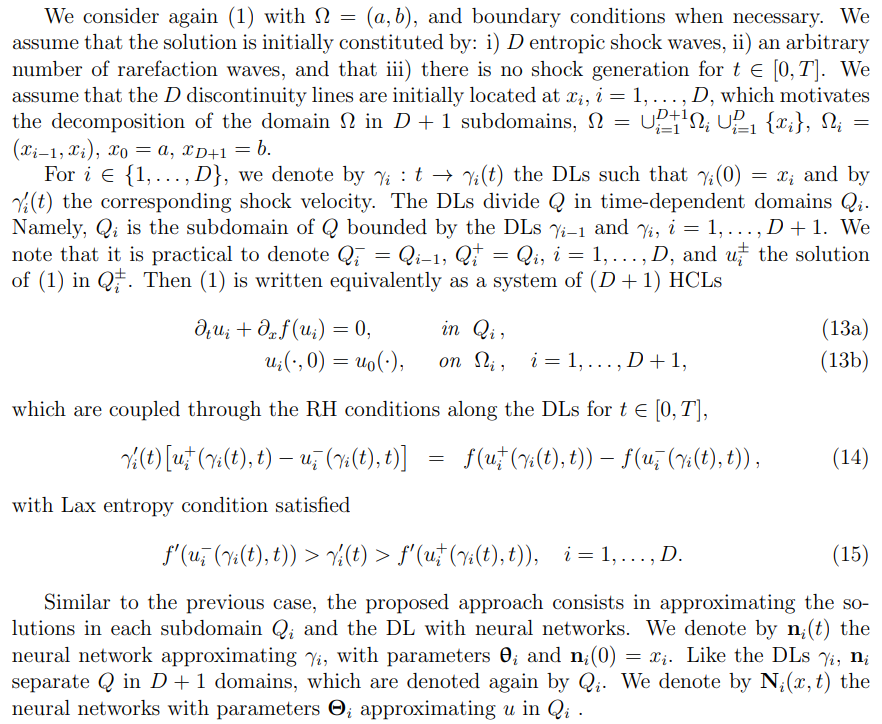
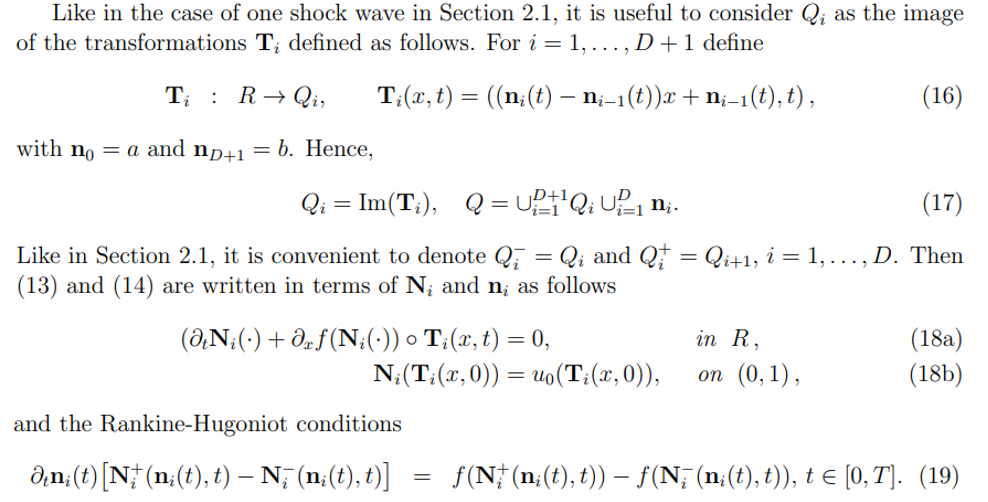
\ Generally speaking for D shock waves, the basic approach will require 2D+1 neural networks, more specifically, D + 1 two-dimensional neural networks for approximating the local HCL smooth solutions, and D one-dimensional networks for approximating the DLs.

2.1. One shock wave

We consider (1) with boundary conditions when necessary (incoming characteristics at the boundary), with Ω = (a, b), and (without restriction) 0 ∈ Ω. We assume that the corresponding solution contains an entropic shock wave, with discontinuity line (DL) initially located at x = 0, parameterized by γ : t 7→ γ(t), with t ∈ [0, T] and γ(0) = 0. The DL γ separates Ω in two subdomains Ω−, Ω+ (counted from left to right) and Q in two time-dependent subdomains denoted Q− and Q+ (counted from left to right). We denote by u ± the solution u of (1) in Q±. Then (1) is written in the form of a system of two HCLs

\ \

\ \ which are coupled through the Rankine-Hugoniot (RH) condition along the DL for t ∈ [0, T],

\ \

\ \ with the Lax shock condition reading as

\ \

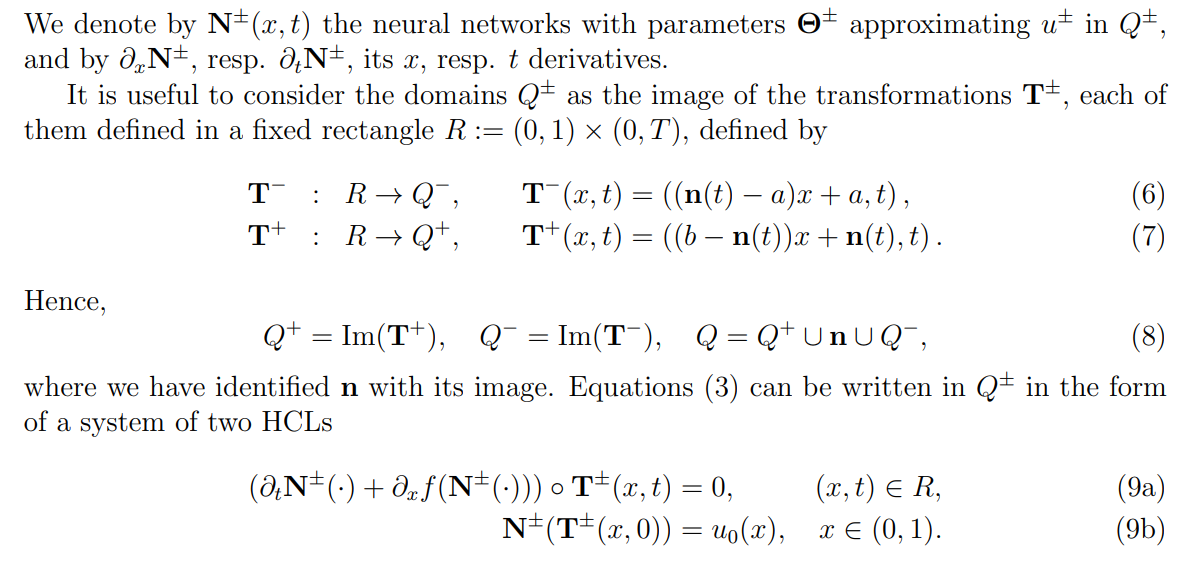
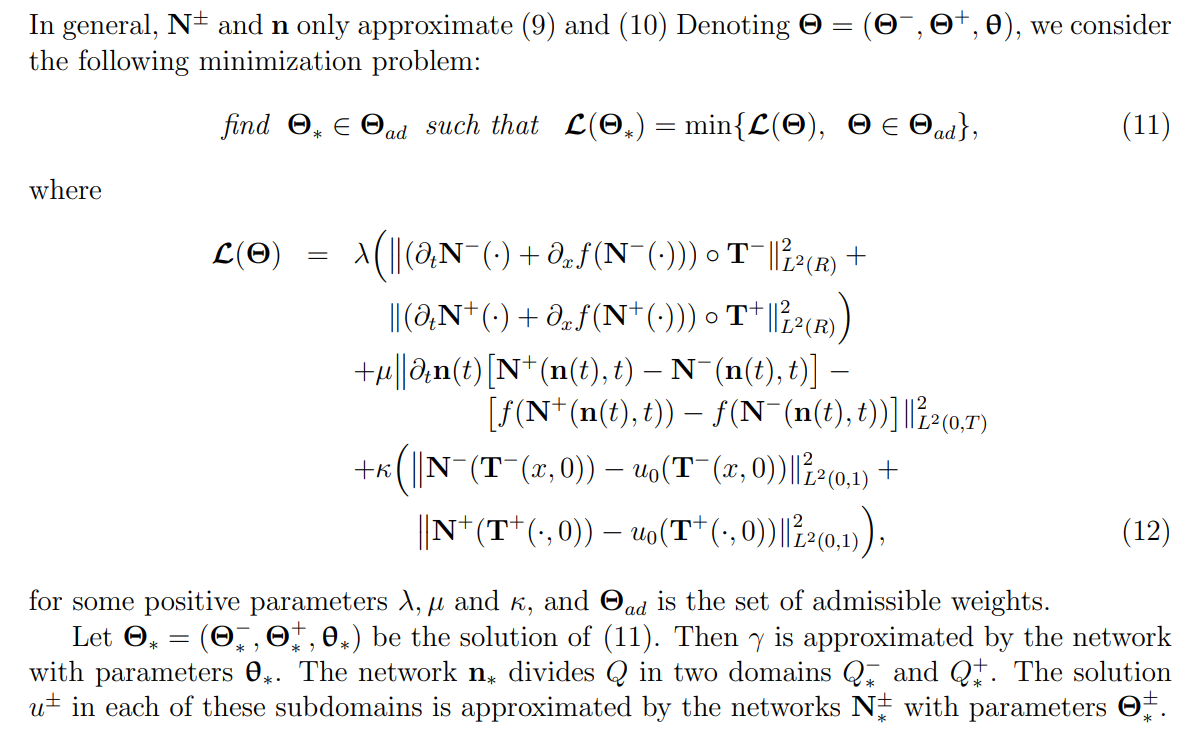
\ \ The proposed approach consists in approximating the DL and the solutions in each subdomain Q± with neural networks. We denote by n(t) the neural network approximating γ, with parameters θ and n(0) = 0. We will refer still by n to DL given by the image of n. Like in the continuous case, n separates Q in two domains, which are denoted again by Q±.

\ \
\ \ \
\

2.2. Arbitrary number of shock waves

\
\ \ \
\ \ \
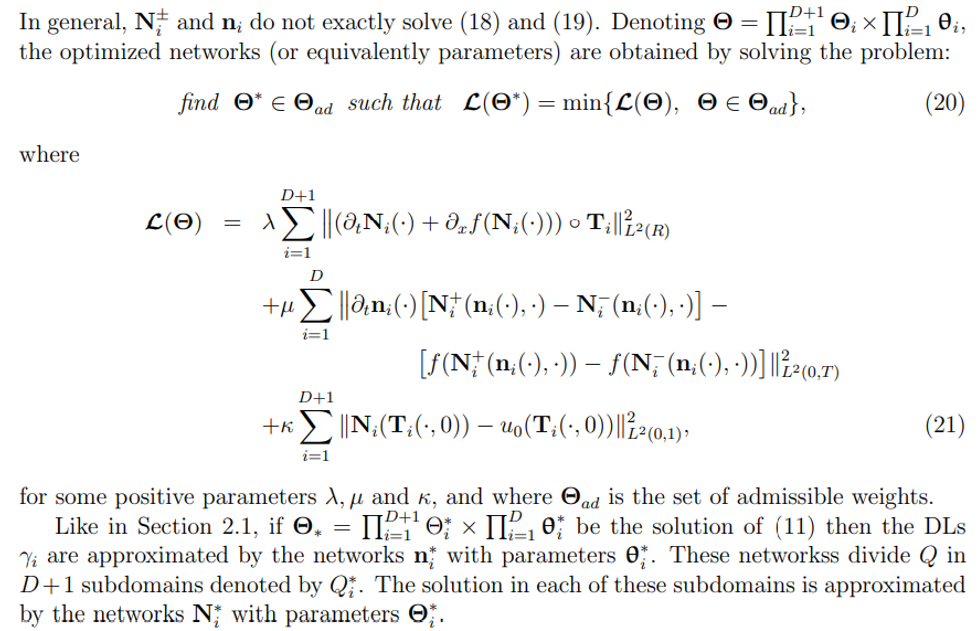
\ \ This approach involves 2D+1 neural networks. Hence the convergence of the optimization algorithm may be hard to achieve for large D. However, the solutions ui being smooth and DLs being dimensional functions, the networks Ni and ni do not need to be deep.

\

:::info Authors:

(1) Emmanuel LORIN, School of Mathematics and Statistics, Carleton University, Ottawa, Canada, K1S 5B6 and Centre de Recherches Mathematiques, Universit´e de Montr´eal, Montreal, Canada, H3T 1J4 ([email protected]);

(2) Arian NOVRUZI, a Corresponding Author from Department of Mathematics and Statistics, University of Ottawa, Ottawa, ON K1N 6N5, Canada ([email protected]).

:::


:::info This paper is available on arxiv under CC by 4.0 Deed (Attribution 4.0 International) license.

:::

\

Market Opportunity
Waves Logo
Waves Price(WAVES)
$0.6564
$0.6564$0.6564
-1.97%
USD
Waves (WAVES) Live Price Chart
Disclaimer: The articles reposted on this site are sourced from public platforms and are provided for informational purposes only. They do not necessarily reflect the views of MEXC. All rights remain with the original authors. If you believe any content infringes on third-party rights, please contact [email protected] for removal. MEXC makes no guarantees regarding the accuracy, completeness, or timeliness of the content and is not responsible for any actions taken based on the information provided. The content does not constitute financial, legal, or other professional advice, nor should it be considered a recommendation or endorsement by MEXC.

You May Also Like

Fed Decides On Interest Rates Today—Here’s What To Watch For

Fed Decides On Interest Rates Today—Here’s What To Watch For

The post Fed Decides On Interest Rates Today—Here’s What To Watch For appeared on BitcoinEthereumNews.com. Topline The Federal Reserve on Wednesday will conclude a two-day policymaking meeting and release a decision on whether to lower interest rates—following months of pressure and criticism from President Donald Trump—and potentially signal whether additional cuts are on the way. President Donald Trump has urged the central bank to “CUT INTEREST RATES, NOW, AND BIGGER” than they might plan to. Getty Images Key Facts The central bank is poised to cut interest rates by at least a quarter-point, down from the 4.25% to 4.5% range where they have been held since December to between 4% and 4.25%, as Wall Street has placed 100% odds of a rate cut, according to CME’s FedWatch, with higher odds (94%) on a quarter-point cut than a half-point (6%) reduction. Fed governors Christopher Waller and Michelle Bowman, both Trump appointees, voted in July for a quarter-point reduction to rates, and they may dissent again in favor of a large cut alongside Stephen Miran, Trump’s Council of Economic Advisers’ chair, who was sworn in at the meeting’s start on Tuesday. It’s unclear whether other policymakers, including Kansas City Fed President Jeffrey Schmid and St. Louis Fed President Alberto Musalem, will favor larger cuts or opt for no reduction. Fed Chair Jerome Powell said in his Jackson Hole, Wyoming, address last month the central bank would likely consider a looser monetary policy, noting the “shifting balance of risks” on the U.S. economy “may warrant adjusting our policy stance.” David Mericle, an economist for Goldman Sachs, wrote in a note the “key question” for the Fed’s meeting is whether policymakers signal “this is likely the first in a series of consecutive cuts” as the central bank is anticipated to “acknowledge the softening in the labor market,” though they may not “nod to an October cut.” Mericle said he…
Share
BitcoinEthereumNews2025/09/18 00:23
Sonami Token Presale Launches With 53% Staking Rewards, Powering a Solana Layer-Two Network Vision

Sonami Token Presale Launches With 53% Staking Rewards, Powering a Solana Layer-Two Network Vision

The post Sonami Token Presale Launches With 53% Staking Rewards, Powering a Solana Layer-Two Network Vision appeared on BitcoinEthereumNews.com. Sonami Token Presale
Share
BitcoinEthereumNews2026/01/21 16:05
Will Intel stock keep soaring as Q4 earnings approach?

Will Intel stock keep soaring as Q4 earnings approach?

The post Will Intel stock keep soaring as Q4 earnings approach? appeared on BitcoinEthereumNews.com. Even though Intel (INTC) was once the world’s largest semiconductor
Share
BitcoinEthereumNews2026/01/21 16:24