This article explores advanced methods for simulating shock waves using non-diffusive neural networks (NDNNs). It explains how AI techniques can handle shock wave generation without requiring prior knowledge of their location, model interactions between multiple waves, and efficiently decompose initial wave states for Riemann problems. By leveraging neural networks to approximate shock and rarefaction curves, the approach provides a scalable solution for complex one-dimensional systems of conservation laws, offering improved accuracy and efficiency over traditional numerical solvers.This article explores advanced methods for simulating shock waves using non-diffusive neural networks (NDNNs). It explains how AI techniques can handle shock wave generation without requiring prior knowledge of their location, model interactions between multiple waves, and efficiently decompose initial wave states for Riemann problems. By leveraging neural networks to approximate shock and rarefaction curves, the approach provides a scalable solution for complex one-dimensional systems of conservation laws, offering improved accuracy and efficiency over traditional numerical solvers.

Neural Network Tools for Shock Wave Decomposition

Abstract and 1. Introduction

1.1. Introductory remarks

1.2. Basics of neural networks

1.3. About the entropy of direct PINN methods

1.4. Organization of the paper

  1. Non-diffusive neural network solver for one dimensional scalar HCLs

    2.1. One shock wave

    2.2. Arbitrary number of shock waves

    2.3. Shock wave generation

    2.4. Shock wave interaction

    2.5. Non-diffusive neural network solver for one dimensional systems of CLs

    2.6. Efficient initial wave decomposition

  2. Gradient descent algorithm and efficient implementation

    3.1. Classical gradient descent algorithm for HCLs

    3.2. Gradient descent and domain decomposition methods

  3. Numerics

    4.1. Practical implementations

    4.2. Basic tests and convergence for 1 and 2 shock wave problems

    4.3. Shock wave generation

    4.4. Shock-Shock interaction

    4.5. Entropy solution

    4.6. Domain decomposition

    4.7. Nonlinear systems

  4. Conclusion and References

\

2.3. Shock wave generation

So far we have not discussed the generation of shock waves within a given domain. Interestingly the method developed above for pre-existing shock waves can be applied directly for the generation of shock waves in a given subdomain. In order to explain the principle of the approach, we simply consider one space-time domain Ω × [0, T]. We initially assume that: i) u0 is a smooth function, and ii) at time t ∗ ∈ (0, T) a shock is generated in x ∗ ∈ Ω, and the corresponding DL is defined by γ : t 7→ γ(t) for t ∈ [t ∗ , T].

\ Although t ∗ could be analytically estimated from −1/ minx f ′ (u0(x)), our algorithm does not require a priori the knowledge of t ∗ and x ∗ . The only required information is the fact that a shock will be generated which can again be deduced by the study of the variations of f ′ (u0).

\ Unlike the framework in Sections 2.1 and 2.2, here we cannot initially specify the position of the DL. However proceed here using a similar approach. Let x0 ∈ Ω be such that γ can be extended as a smooth curve in [0, T], still denoted by γ, with γ(0) = x0. Without loss of generality we may assume x0 = 0. Then we proceed exactly as in Section 2.1, with one network n representing the DL, and N± the solutions on each side of n. We define t ∗ = max{t ∈ (0, T], N+(n(t), t) = N−(n(t), t)}. Note that for t < t∗ we have N+(n(t), t) = N−(n(t), t), and the curve {n(t), t ∈ [0, t∗ )} does not have any significant meaning

2.4. Shock wave interaction

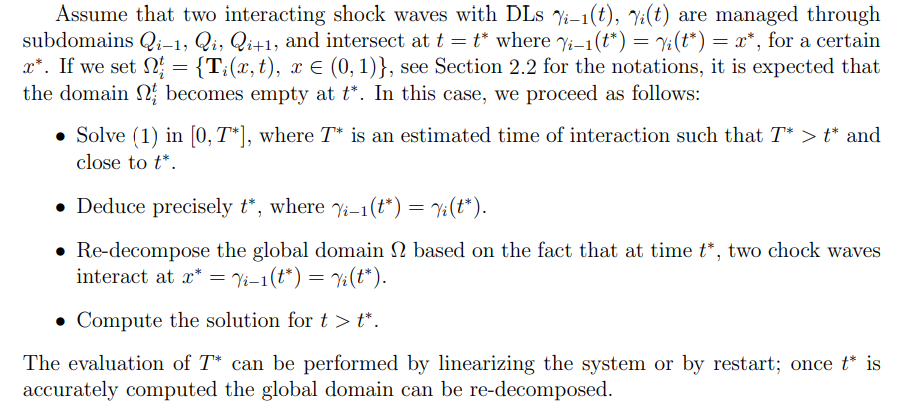
As described above, for D pre-existing shock waves we decompose the global domain in D + 1 subdomains. So far we have not considered shock wave interactions leading to a new shock wave, which reduces by one the total number of shock waves for each shock interaction.

\
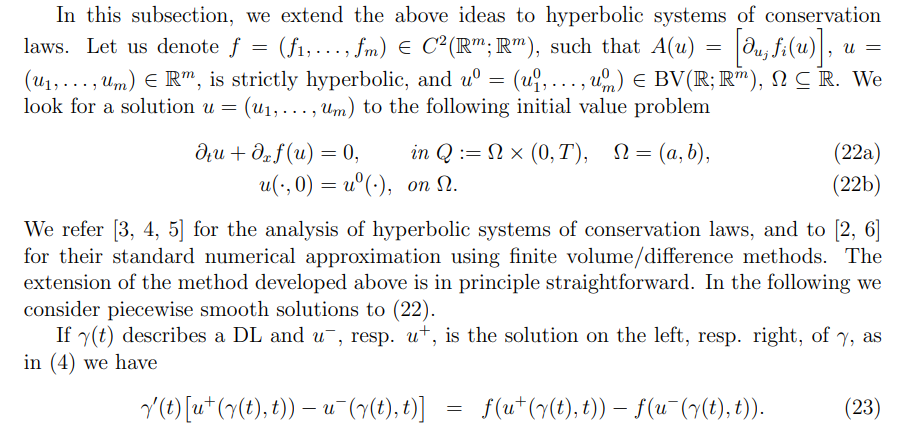
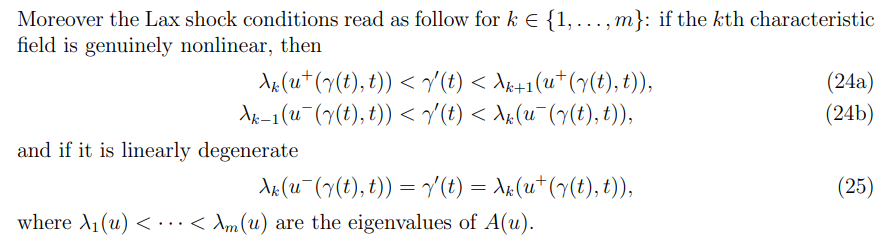
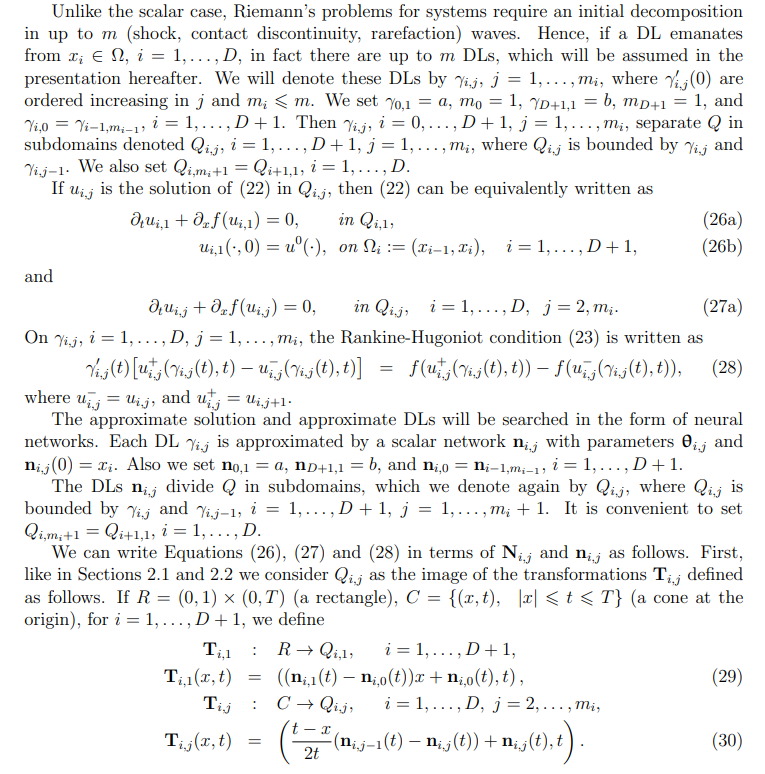
2.5. Non-diffusive neural network solver for one dimensional systems of CLs

\
\ \ \
\ \ \
\ \ \
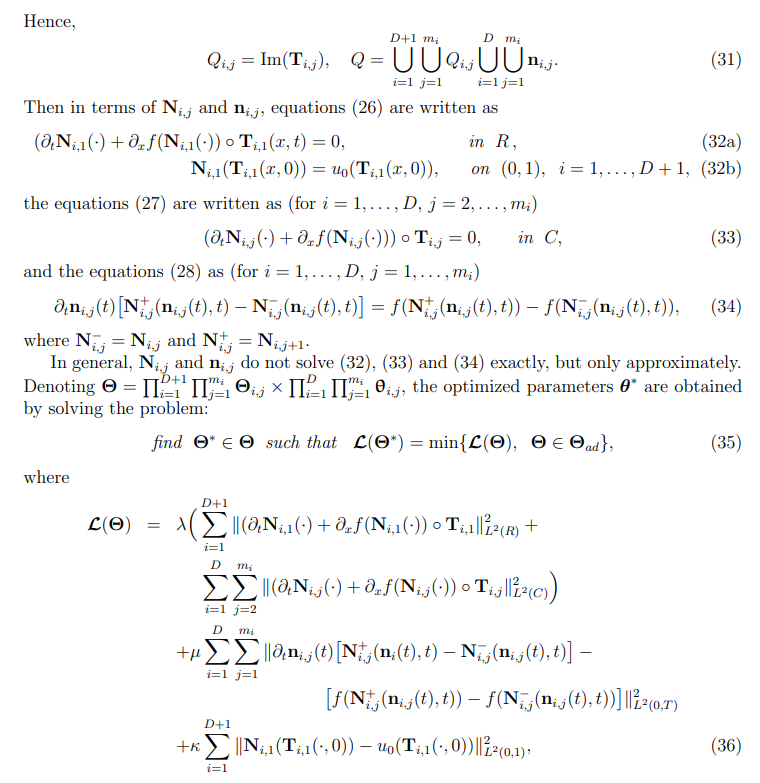
\ \ for some positive subdomain-independent parameters λ, µ and κ. Notice that when the considered IVP problems involve cones/subdomains of “very different” sizes, the choice of the hyper-parameters may be taken subdomain-dependent. This question was not investigated in this paper. If mi = 1 for all i, then the problem (11), with L given by (36), is no different from the scalar case, except that (36) involves the evaluation of norms for vector valued functions.

\ If Θ∗ is the solution of the problem (35), then the approximates of γi,j and of the solution u in each Qi,j is computed similarly as in Section 2.2.

2.6. Efficient initial wave decomposition

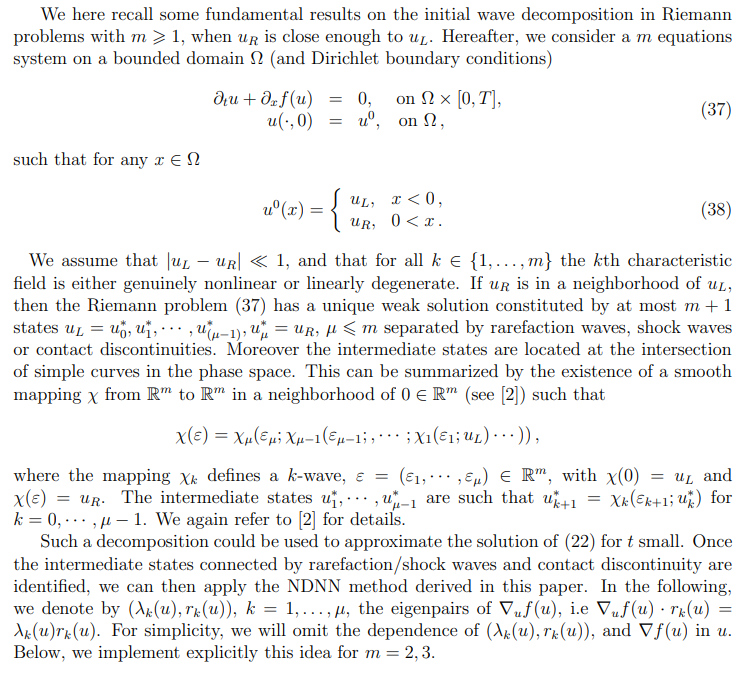
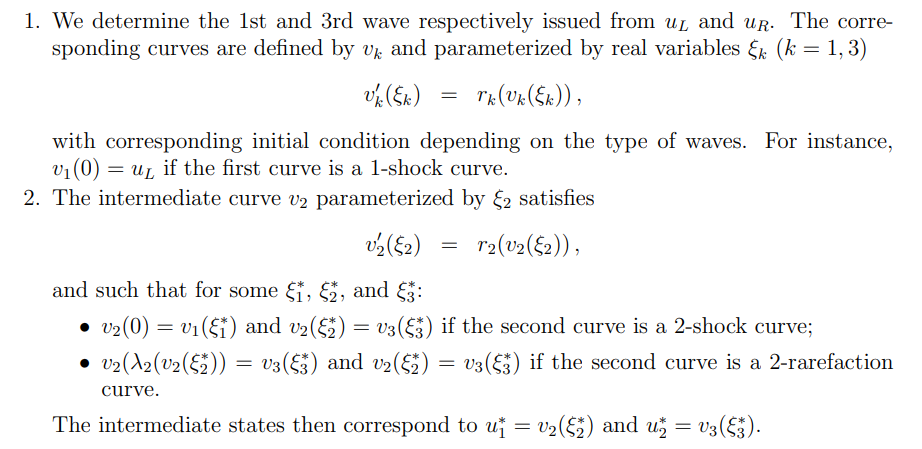
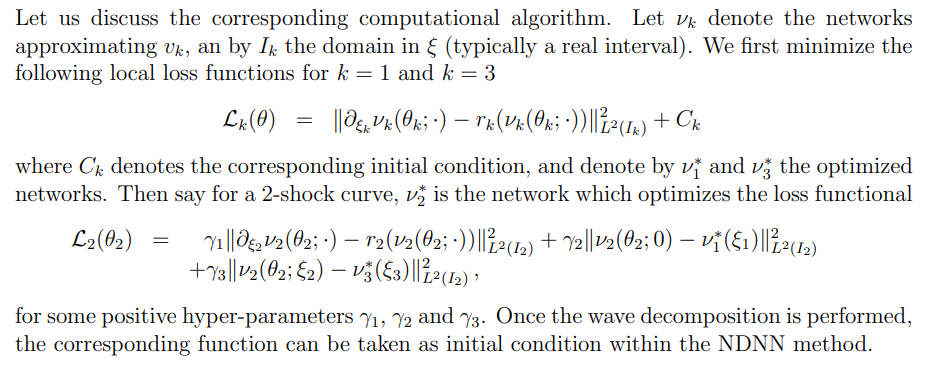
In this section we present an efficient initial wave decomposition for a Rieman problem which can be used to solve the problem (22).The idea is to solve a Riemann problem for t small, and once the states are identified we use NDNN method. Here we propose an efficient neural network based approach for the initial wave decomposition, which can easily be combined with the NDNN method. We first recall some general principles on the existence of at most m curves connecting two constant states uL and uR in the phase space. We then propose a neural network approach for constructing the rarefaction and shock curves as well as their intersection.

\ 2.6.1. Initial wave decomposition for arbitrary m

\ \
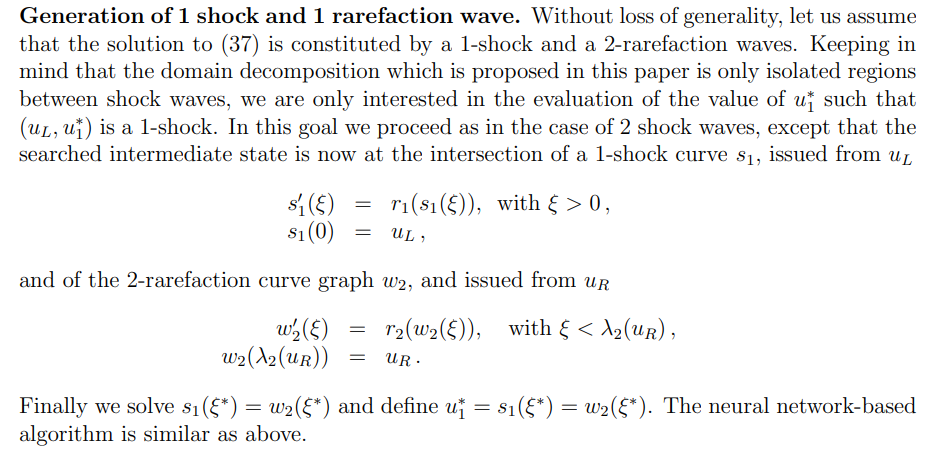
\ \ 2.6.2. Initial wave decomposition for 2 equation systems (m = 2, µ = 2)

\ We detail the computation of the intermediate state via the construction and intersection of the shock curves (Hugoniot loci) in the phase-plane (u1, u2). Let us recall that k-shock curves are defined as the following integral curves with k = 1, 2, see [2, 6]

\ \
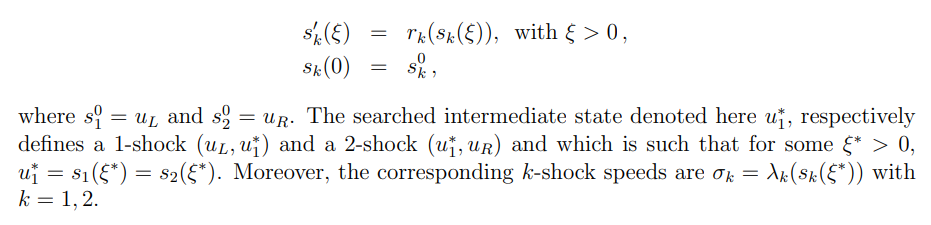
\ \ Following is the neural network strategy,

\ \
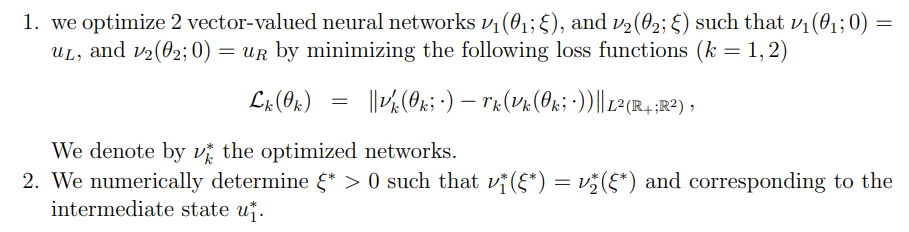
\ \ Once these intermediate waves identified, we can use them as initial condition for NDNN method.

\ \
\ \ 2.6.3. Initial wave decomposition for 3 equation systems (m = 3, µ = 3)

\ The additional difficulty compared to the case m = 2, is that the starting and ending states connected by the 2-wave are both unknown. We then propose the following approach.

\ \
\ \ \
\

:::info Authors:

(1) Emmanuel LORIN, School of Mathematics and Statistics, Carleton University, Ottawa, Canada, K1S 5B6 and Centre de Recherches Mathematiques, Universit´e de Montr´eal, Montreal, Canada, H3T 1J4 ([email protected]);

(2) Arian NOVRUZI, a Corresponding Author from Department of Mathematics and Statistics, University of Ottawa, Ottawa, ON K1N 6N5, Canada ([email protected]).

:::


:::info This paper is available on arxiv under CC by 4.0 Deed (Attribution 4.0 International) license.

:::

\

Market Opportunity
Waves Logo
Waves Price(WAVES)
$0,6549
$0,6549$0,6549
-2,19%
USD
Waves (WAVES) Live Price Chart
Disclaimer: The articles reposted on this site are sourced from public platforms and are provided for informational purposes only. They do not necessarily reflect the views of MEXC. All rights remain with the original authors. If you believe any content infringes on third-party rights, please contact [email protected] for removal. MEXC makes no guarantees regarding the accuracy, completeness, or timeliness of the content and is not responsible for any actions taken based on the information provided. The content does not constitute financial, legal, or other professional advice, nor should it be considered a recommendation or endorsement by MEXC.

You May Also Like

Is Doge Losing Steam As Traders Choose Pepeto For The Best Crypto Investment?

Is Doge Losing Steam As Traders Choose Pepeto For The Best Crypto Investment?

The post Is Doge Losing Steam As Traders Choose Pepeto For The Best Crypto Investment? appeared on BitcoinEthereumNews.com. Crypto News 17 September 2025 | 17:39 Is dogecoin really fading? As traders hunt the best crypto to buy now and weigh 2025 picks, Dogecoin (DOGE) still owns the meme coin spotlight, yet upside looks capped, today’s Dogecoin price prediction says as much. Attention is shifting to projects that blend culture with real on-chain tools. Buyers searching “best crypto to buy now” want shipped products, audits, and transparent tokenomics. That frames the true matchup: dogecoin vs. Pepeto. Enter Pepeto (PEPETO), an Ethereum-based memecoin with working rails: PepetoSwap, a zero-fee DEX, plus Pepeto Bridge for smooth cross-chain moves. By fusing story with tools people can use now, and speaking directly to crypto presale 2025 demand, Pepeto puts utility, clarity, and distribution in front. In a market where legacy meme coin leaders risk drifting on sentiment, Pepeto’s execution gives it a real seat in the “best crypto to buy now” debate. First, a quick look at why dogecoin may be losing altitude. Dogecoin Price Prediction: Is Doge Really Fading? Remember when dogecoin made crypto feel simple? In 2013, DOGE turned a meme into money and a loose forum into a movement. A decade on, the nonstop momentum has cooled; the backdrop is different, and the market is far more selective. With DOGE circling ~$0.268, the tape reads bearish-to-neutral for the next few weeks: hold the $0.26 shelf on daily closes and expect choppy range-trading toward $0.29–$0.30 where rallies keep stalling; lose $0.26 decisively and momentum often bleeds into $0.245 with risk of a deeper probe toward $0.22–$0.21; reclaim $0.30 on a clean daily close and the downside bias is likely neutralized, opening room for a squeeze into the low-$0.30s. Source: CoinMarketcap / TradingView Beyond the dogecoin price prediction, DOGE still centers on payments and lacks native smart contracts; ZK-proof verification is proposed,…
Share
BitcoinEthereumNews2025/09/18 00:14
Seeker (SKR) will soon be listed on Bybit Spot, Alpha, and Byreal.

Seeker (SKR) will soon be listed on Bybit Spot, Alpha, and Byreal.

PANews reported on January 21 that Bybit will launch Seeker (SKR) on its spot, Alpha, and Byreal platforms. Users can quickly trade without setting up a separate
Share
PANews2026/01/21 08:20
CME Group to Launch Solana and XRP Futures Options

CME Group to Launch Solana and XRP Futures Options

The post CME Group to Launch Solana and XRP Futures Options appeared on BitcoinEthereumNews.com. An announcement was made by CME Group, the largest derivatives exchanger worldwide, revealed that it would introduce options for Solana and XRP futures. It is the latest addition to CME crypto derivatives as institutions and retail investors increase their demand for Solana and XRP. CME Expands Crypto Offerings With Solana and XRP Options Launch According to a press release, the launch is scheduled for October 13, 2025, pending regulatory approval. The new products will allow traders to access options on Solana, Micro Solana, XRP, and Micro XRP futures. Expiries will be offered on business days on a monthly, and quarterly basis to provide more flexibility to market players. CME Group said the contracts are designed to meet demand from institutions, hedge funds, and active retail traders. According to Giovanni Vicioso, the launch reflects high liquidity in Solana and XRP futures. Vicioso is the Global Head of Cryptocurrency Products for the CME Group. He noted that the new contracts will provide additional tools for risk management and exposure strategies. Recently, CME XRP futures registered record open interest amid ETF approval optimism, reinforcing confidence in contract demand. Cumberland, one of the leading liquidity providers, welcomed the development and said it highlights the shift beyond Bitcoin and Ethereum. FalconX, another trading firm, added that rising digital asset treasuries are increasing the need for hedging tools on alternative tokens like Solana and XRP. High Record Trading Volumes Demand Solana and XRP Futures Solana futures and XRP continue to gain popularity since their launch earlier this year. According to CME official records, many have bought and sold more than 540,000 Solana futures contracts since March. A value that amounts to over $22 billion dollars. Solana contracts hit a record 9,000 contracts in August, worth $437 million. Open interest also set a record at 12,500 contracts.…
Share
BitcoinEthereumNews2025/09/18 01:39