

Strategy’s STRC hits record trading volume after massive $1B Bitcoin purchase as market cap doubles since Friday
Strategy's perpetual preferred stock, STRC, played a key role in the company's Bitcoin strategy this week after it saw more than $1.1 billion in daily trading volume.
In an X post, Strategy declared April 13 the record date for STRC. Michael Saylor also noted that the security closed at par with just “one penny of volatility” after $1.156 billion in liquidity moved through the market.
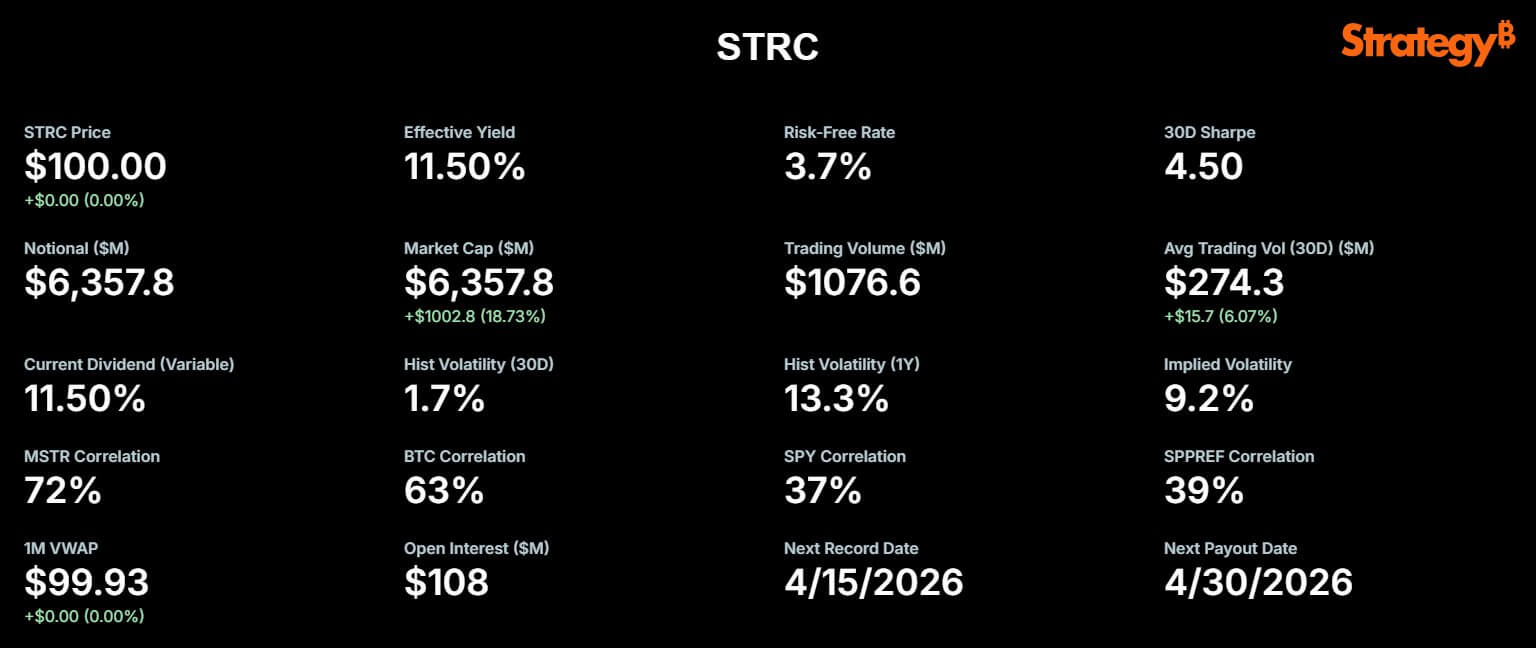 STRC Record Trading Volume. (Source: Strategy)
This trading surge came after Strategy revealed it had bought 13,927 Bitcoin for about $1 billion between April 6 and April 12.
With this purchase, the company now holds 780,897 Bitcoin, bought for a total of $59.02 billion, averaging $75,577 per coin.
The company stated that the purchase was fully funded through at-the-market (ATM) sales of 10.02 million STRC shares, generating approximately $1 billion in net proceeds.
Meanwhile, that pairing of record trading activity in STRC and a weekly Bitcoin purchase funded exclusively through that preferred program marks a significant shift in emphasis for the company.
For equity investors, this shift could significantly change the balance of potential gains and risks. Increased reliance on preferred stock may reduce immediate dilution for common shareholders, since fewer ordinary shares are issued right away.
However, it brings more fixed claims ahead of equity in the capital structure, meaning holders of preferred stock have the right to receive dividends before common shareholders receive anything. In other words, preferred shareholders are prioritized for payments, so common shareholders only benefit if the company has enough profit left over after meeting these obligations.
This approach could enhance returns if Bitcoin performs well, but it increases reliance on ongoing market access and disciplined dividend management. While the shift may boost short-term buying power and reduce equity dilution, it also raises financial leverage and execution risk for common shareholders over time.
How STRC preferred stock took the lead for Strategy's Bitcoin purchases
Launched in July 2025, STRC was designed to operate fundamentally differently from Strategy's MSTR common stock.
The preferred stock carries a variable annualized dividend rate, currently at 11.50% as of April. Its adjustable-rate structure is intended to incentivize trading near its $100 par value strongly.
This stable price anchor enables Strategy to use its ATM issuance program efficiently. Issuing new STRC shares at a consistent price allows the company to quickly raise capital and convert it into Bitcoin, minimizing the friction and discounts typically seen with large secondary offerings.
Market observers note that STRC aims to provide investors with double-digit returns and minimal price volatility, combining high-yield income with capital stability.
Essentially, Strategy's executive chairman, Michael Saylor, said:
Since its inception, STRC has financed the acquisition of nearly 70,000 Bitcoin, according to STRC.live. The recent $1 billion volume on April 13 could fund the purchase of over 6,000 additional BTC.
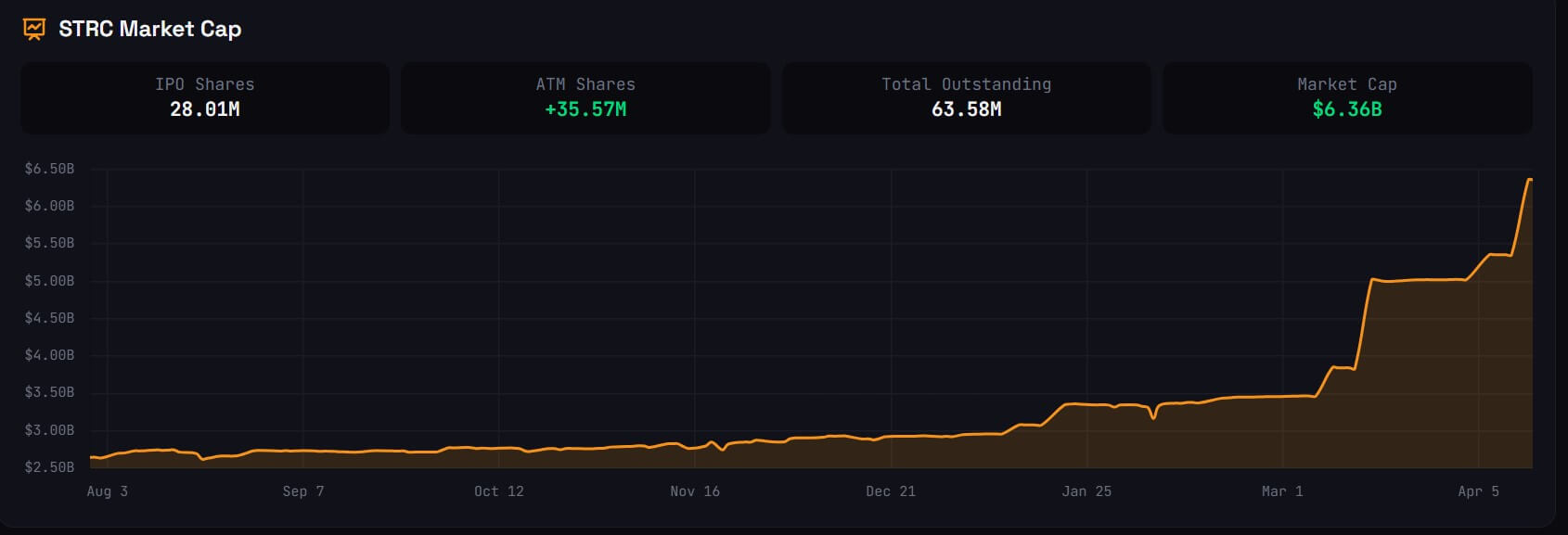 Strategy's STRC Market Cap (Source: STRC.live)
Unsurprisingly, STRC's market capitalization has ballooned alongside this utility, nearly doubling from $3.4 billion in February to $6.36 billion today. With $21.6 billion worth of STRC shares still authorized for future issuance, the runway for further BTC accumulation remains vast.
Bears point to reserves, refinancing, and the growing preferred stack risks
Despite market optimism, several analysts have raised concerns about the sustainability of this model, citing Strategy's own financial disclosures.
Because Strategy's software business does not generate sufficient operating cash flow to meet its financial obligations, the company established a $2.25 billion reserve in early February. This reserve serves as a financial safety net, intended to cover nearly 2.5 years of dividend payments on preferred stock and interest payments on outstanding debt.
The reserve is necessary because, without enough regular business income, the company relies on this set-aside cash to meet fixed payments. If this reserve is depleted before Strategy generates enough new income or finds additional sources of financing, the company could face pressure to sell assets or issue more shares, putting both preferred and common shareholders at risk.
Critics argue that a structure reliant on ongoing market access may appear stable until financing conditions shift.
Independent Bitcoin analyst Derin Olenik recently published a critical analysis of the company's obligations, warning that the current ATM growth rate is unsustainable.
According to Olenick's calculations, the STRC obligations are growing astronomically, with the notional value growing at a compound monthly rate of roughly 30%.
At this pace, the company's obligations could more than double every three months and increase tenfold within a year, dramatically accelerating the pressure on cash flow and reserves.
If this trajectory holds, Olenik estimates Strategy will burn through its $2.25 billion reserve in just nine to ten months, rather than the projected two-and-a-half years.
He warned that, to cover such a deficit without selling Bitcoin, Strategy would need to dilute its common shareholders significantly.
Even if MSTR returns to its previous all-time high, Olenik calculates that the company would need to issue over 1 billion new shares to pay preferred dividends, diluting existing common equity by nearly 400%.
Considering this, he concluded that:
MSTR bulls see STRC as a cleaner way to add Bitcoin
However, Strategy supporters argue against the grim picture Olenik has postulated.
According to them, Strategy has successfully tapped into a distinct investor pool of income-oriented buyers willing to accept a fixed claim and limited upside for STRC.
By directing proceeds from these conservative investors into an asset with high expected long-term volatility and upside, Strategy maintains Bitcoin exposure for common shareholders.
Preferred investors receive a yield-focused instrument that currently trades more like short-duration credit than a cryptocurrency proxy. In practical terms, ‘short-duration credit' refers to debt securities or financial instruments that mature in a relatively short period, typically less than five years.
These investments are often considered less risky because their values are less sensitive to interest rate changes and are expected to return principal to investors sooner. For STRC, this means its trading behavior is more stable and predictable, similar to short-term corporate bonds, rather than following the price swings typical of cryptocurrencies.
Notably, Strategy itself has consistently referred to STRC as its flagship “Digital Credit” instrument.
Bitcoin analyst Adam Livingston said:
Supporters argue that the model is effective as long as Bitcoin appreciates faster than the cash cost of servicing the preferred dividend.
In this scenario, each successful STRC issuance converts capital markets demand into additional Bitcoin holdings, while the fixed preferred claim becomes smaller relative to the asset base as Bitcoin appreciates over time.
Saylor has also reassured jittery investors, saying:
MSTR common shareholders remain the key audience
For MSTR holders, the real question is whether this funding model remains accretive to the common stock over time.
In the near term, the evidence is positive. STRC saw record turnover, remained at par, and Strategy used this market access to purchase $1 billion of Bitcoin in one week.
This outcome supports management's view that STRC can serve as a reliable, repeatable funding channel rather than a one-time financing tool.
Over a longer horizon, the picture is inherently more complicated. Every successful STRC raise adds another layer of fixed claims ahead of the common stock.
Strategy's own risk disclosures acknowledge that future preferred issuance could dilute existing shareholders and that adverse shifts in financing conditions could make it harder to maintain the necessary dividend reserves.
Dilution refers to the reduction in existing shareholders' ownership percentage when new shares are issued, thereby decreasing each shareholder's claim on the company's assets and profits. Financing conditions matter because if the company cannot access cheap or stable funding, it may struggle to raise enough capital to support dividend payments or maintain its financial structure, increasing overall risk for both preferred and common shareholders.
Ultimately, STRC demonstrates both strength and risk. It performs as intended by attracting significant liquidity and maintaining a price near par.
Yet it creates tension because each issuance round ties the broader Strategy thesis ever more tightly to the company's ability to preserve market access, maintain dividend support, and keep Bitcoin valuable enough to justify the financial stack built around it.
The post Strategy’s STRC hits record trading volume after massive $1B Bitcoin purchase as market cap doubles since Friday appeared first on CryptoSlate.


You May Also Like

One Of Frank Sinatra’s Most Famous Albums Is Back In The Spotlight

Not a loophole: Singapore AI export controls let China tap US AI legally

LIST: Bayanihan initiatives amid soaring oil prices



