Salesforce Trailblazer Community Meetup Signals AI Execution Shift
Salesforce Trailblazer Community Meetup Signals Shift from AI Hype to Enterprise Execution
The Salesforce Trailblazer Community Meetup hosted by Bounteous in Chennai marks a decisive turning point in how enterprises approach AI and platform transformation. What once centered on exploration and pilot programs has now moved firmly into execution—where integration, architecture, and operational readiness determine success.
This becomes critical as enterprises face increasing pressure to justify AI investments. The Salesforce Trailblazer Community Meetup demonstrates that value is no longer created through isolated innovation, but through system-level coherence, where platforms like Salesforce are deeply integrated into enterprise workflows.
The deeper implication is clear: AI is no longer the differentiator—execution is.
From Fragmented Workflows to Integrated Systems
At a structural level, enterprises are transitioning away from fragmented digital ecosystems toward unified, orchestrated platforms. Historically, organizations deployed CRM systems, analytics tools, and integration layers in silos, leading to inconsistent customer experiences.
This is where the shift occurs.
The conversations at the Salesforce Trailblazer Community Meetup reveal that integration is no longer a backend concern—it is a frontline CX enabler. With technologies like MuleSoft acting as connective tissue, enterprises can enable real-time data synchronization across systems.
From a CX standpoint, this translates to:
- Seamless omnichannel interactions
- Context-aware personalization
- Reduced friction across touchpoints
The deeper implication is that customer experience is now engineered at the architecture level, not just designed at the interface level.
Strategy Has Become Architecture
Strategically, enterprises are redefining transformation priorities. Instead of focusing on tool adoption, organizations are now investing in architecture-first strategies that align AI, data, and workflows.
This insight signals a fundamental shift:
- AI must be embedded into operational workflows
- Integration must be designed, not retrofitted
- Systems must function as unified environments
Operationally, this translates into cross-functional ownership, where business, CX, and engineering teams collaborate to deliver outcomes.
The deeper implication is that strategy is no longer abstract—it is encoded in system architecture.
Competitive Positioning Is Being Redefined
The Salesforce Trailblazer Community Meetup also surfaces a critical competitive shift within the ecosystem. Traditional system integrators like Infosys continue to dominate scale-driven implementations, while specialized firms like Bits In Glass bring deep integration expertise.
However, companies like Bounteous are carving a differentiated position—focusing on experience-led transformation, where business outcomes and CX metrics take precedence over deployment metrics.
This becomes critical as enterprises increasingly evaluate partners based on:
- Time-to-value
- CX impact
- System scalability
The deeper implication is that implementation capability alone is no longer sufficient—outcome ownership is the new benchmark.
Technology Is Now an Orchestrated System
At the core of discussions during the Salesforce Trailblazer Community Meetup was the emergence of a three-layer architecture:
- Platform Layer: Salesforce as the system of engagement
- Integration Layer: MuleSoft enabling API-led connectivity
- Intelligence Layer: AI embedded within workflows
This layered model represents a shift from static deployments to dynamic, orchestrated ecosystems.
However, operationalizing this architecture introduces complexity:
- Data harmonization across legacy systems
- Real-time processing requirements
- Governance and compliance challenges
- Managing AI lifecycle within production systems
From a system perspective, this translates to continuous orchestration, where systems must adapt dynamically to customer behavior and business needs.
The deeper implication is that technology success now depends on orchestration maturity, not individual components.
CX Outcomes Are System-Driven
From a CX standpoint, one insight stands out: customer experience is now a direct outcome of system design.
The discussions highlighted how integrated architectures enable:
- Faster response times
- Hyper-personalized interactions
- Consistent cross-channel journeys
On the business side, this leads to:
- Lower operational costs through automation
- Improved efficiency through integration
- Higher conversion and retention rates
From a system perspective:
- Data becomes unified and actionable
- Platforms become scalable
- Decision-making becomes real-time
This becomes critical when scaling AI. Without integrated systems, personalization efforts break down, and CX consistency suffers.
The deeper implication is that CX is no longer a surface-layer function—it is embedded within the system core.
Maturity Determines Success
The Salesforce Trailblazer Community Meetup underscores that enterprises are in a transitional phase—from experimentation to execution maturity.
While many organizations have initiated AI deployments, gaps remain in:
- Integration maturity
- Data governance frameworks
- Cross-functional alignment
This is where the shift occurs—from ambition to discipline.
The deeper implication is that success in this phase is not determined by innovation alone, but by operational rigor and architectural consistency.
Decision Intelligence Is Becoming Critical
As complexity increases, enterprises must make more nuanced decisions around implementation strategies.
Key considerations include:
- Build vs Buy vs Partner:
Partner-led models are emerging as the most viable, balancing speed and customization - Risk Assessment:
Integration failures, data inconsistencies, and governance gaps remain major risks - Implementation Complexity:
High—requiring alignment across multiple stakeholders and systems
This becomes critical as misaligned decisions at the architecture level can cascade into long-term CX inefficiencies.
The deeper implication is that decision intelligence is now a core capability in CX transformation.
The Ecosystem Is Rewiring Itself
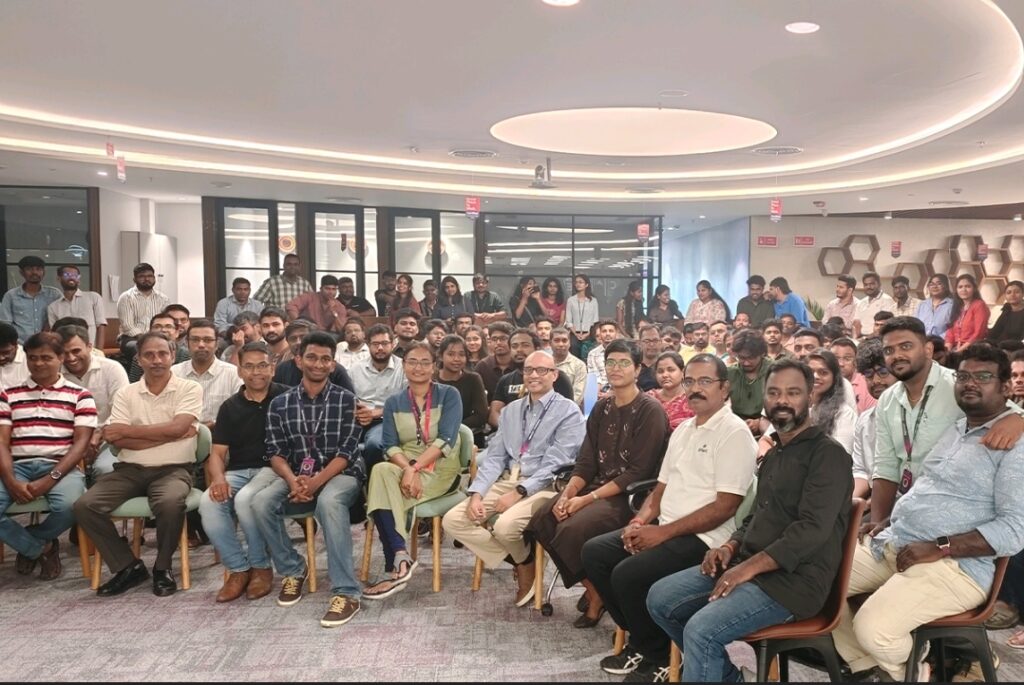
Beyond technology, the Salesforce Trailblazer Community Meetup highlights a broader ecosystem transformation.
Participants from Softsquare, Firstsource, Logitech, and DXC Technology contributed to a shared understanding: no single organization can deliver end-to-end CX transformation alone.
This is where the shift occurs—from isolated capability building to ecosystem collaboration.
The deeper implication is that competitive advantage will increasingly depend on:
- Partnership networks
- Integration ecosystems
- Shared knowledge platforms
What Comes Next: Experience Engineering
Looking ahead, the next phase of enterprise transformation will be defined by experience engineering—where systems, data, and AI are designed as a unified whole.
This becomes critical as customer expectations continue to rise. Enterprises will need to:
- Build adaptive architectures
- Enable real-time orchestration
- Continuously evolve AI capabilities
The deeper implication is that organizations that master this integrated approach will lead the next wave of CX innovation.
Final Takeaway
The Salesforce Trailblazer Community Meetup is more than a regional event—it is a signal of a global shift.
A shift from:
- Experimentation → Execution
- Tools → Systems
- Features → Experiences
The deeper implication is unmistakable:
Enterprise success in the AI era will not be defined by what technologies are adopted, but by how effectively they are integrated, orchestrated, and aligned to deliver customer experience at scale.
The post Salesforce Trailblazer Community Meetup Signals AI Execution Shift appeared first on CX Quest.


You May Also Like

Iran’s foreign minister targeted in assassination attempt, wife killed

Swatilina Barik Honoured at Crafting Bharat International Awards for Excellence in Immigration Strategy and AI-Driven Legal Innovation