

As Europe welcomes Chinese solar, some see a Trojan horse
In seeking a cheaper and more independent energy system, Europe has only Chinese technology to turn to. Are they handing the country a “kill-switch?”
The sun was almost at its peak above the control room when the maps started flickering: first from green to red, and then suddenly to black.
In a matter of seconds, tens of thousands of small-scale solar installations on rooftops across west and central Europe disconnected from the grid. On their own, each disconnection made little difference — but more than five gigawatts, equivalent to three of the continent’s largest gas-fired power stations, had just gone down at once. Now the whole grid was powering off. It was a hack. Across the continent, telecommunications networks were failing, scrambling response coordination and impairing emergency services. Military installations and hospitals were flipping to backup generators, and oil refineries were shutting off production.
That hasn’t happened – yet. It’s a version of a scenario described by cybersecurity, grid operation, and geo-strategy experts in reports and interviews with the Reynolds Center. It bears strong similarities to a real-world blackout in 2025 across Spain and Portugal, when thousands of small-scale solar installations disconnected in just 38 seconds. That daylong disruption was caused by unintentional system failures and cost businesses billions of euros. Experts believe an intentional disruption could be much more damaging.
As Europe’s rapid dispersal of solar power in Europe is being promoted as an answer to the energy security risks of imported fossil fuels, it may also present a new and potentially devastating kind of security threat. The dominant role of a single country — China — in nearly all parts of the solar supply chain is a central concern, leading some to warn that Europe is replacing one kind of energy dependency with another.
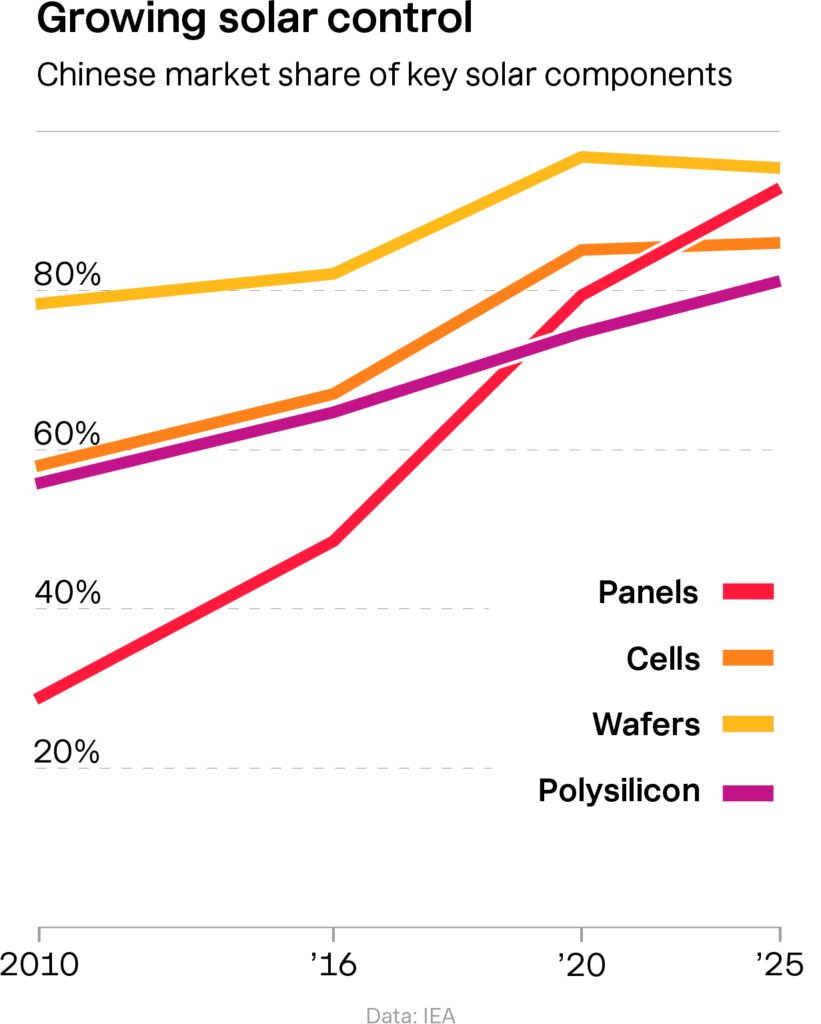
Unlike the coal or gas that fires a traditional thermal power station, the sun cannot be placed under blockade. And, unlike these traditional plants, solar’s power supply is too geographically distributed for significant capacities to be wiped out by a single missile strike. Yet these same factors protecting solar power from traditional forms of attack, these researchers worry, might also make it the vector of a more unconventional sabotage in the future.
The attack may not even need to be triggered to achieve its desired effect. Linking Chinese dominance over all parts of the solar supply chain to a record of state-sponsored cyberattacks and concerning threat disclosure laws, some researchers envision China using the threat of a solar-charged grid meltdown as leverage over Europe’s security and independence: a sword of Damocles above the continent’s head. But the scope of this threat — and the question of whether China would ever use it — is heavily debated.
Hacking the inverter
If the sword in this scenario is the solar panels, spread out on rooftops across the continent, the strand of horsehair it hangs from is the solar inverters, connecting each of those installations to the grid.
As the role of renewables has grown, inverters have become more important, and more complex. Converting solar’s direct-current power to grid-compatible alternating current, inverters also provide remote monitoring, coordinate renewable supplies with battery storage, and can help to stabilize the grid proactively by modulating output. Many of these functions are controlled over the internet, making inverters “cyber-physical” devices, in the words of cybersecurity researcher Daniel dos Santos, in which “the cyber world can impact things in the physical world.”
The scenario he and other researchers interviewed for this article envision involves this internet connection being hijacked across thousands — or even millions — of inverters at once. The attacker would likely use this access to cause violent and unpredictable swings in supply, overwhelming an already-stretched grid system’s ability to sustain a stable voltage. As happened in the Iberian blackout last year, safety equipment at other power installations might automatically shut down to save itself as loads surged above or below preset safety boundaries, leading to a cascading blackout across huge areas of the continent.
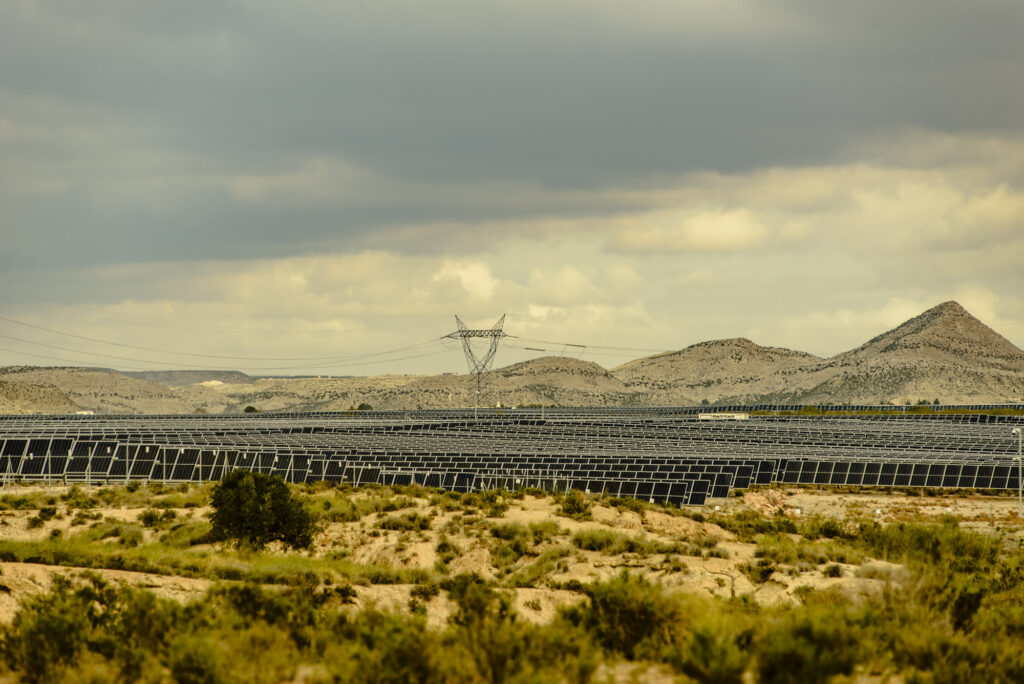 Solar panels in southern Spain. The sudden disconnection of thousands of solar installations throughout the country caused a daylong blackout in 2025. Photo by Reuben J. Brown
A vice president of research at Forescout Technologies based in the Netherlands, dos Santos is one of a small group of white-hat hackers who have identified nearly dozens of cybersecurity vulnerabilities in market-leading brands of solar inverters that may be used to trigger such an attack. One of them is on his own roof. Like around a third of Dutch homes, dos Santos’s Rotterdam new-build is kitted out with solar panels connected to the grid by a potentially compromised inverter. “And it turns out to be a Chinese one,” he said. “Not by coincidence, but by probability … they dominate the market.”
As with solar panels, European, American, and Japanese manufacturers led the initial innovation and early production of solar inverters. But aggressive subsidies and competition, combined with vast home-country demand, have in the last decade given Chinese companies a controlling share of global supply, providing products at a lower cost than their Western counterparts. Today, the largest European manufacturer — Germany’s SMA — has one-tenth the manufacturing output of the largest Chinese manufacturer, Huawei.
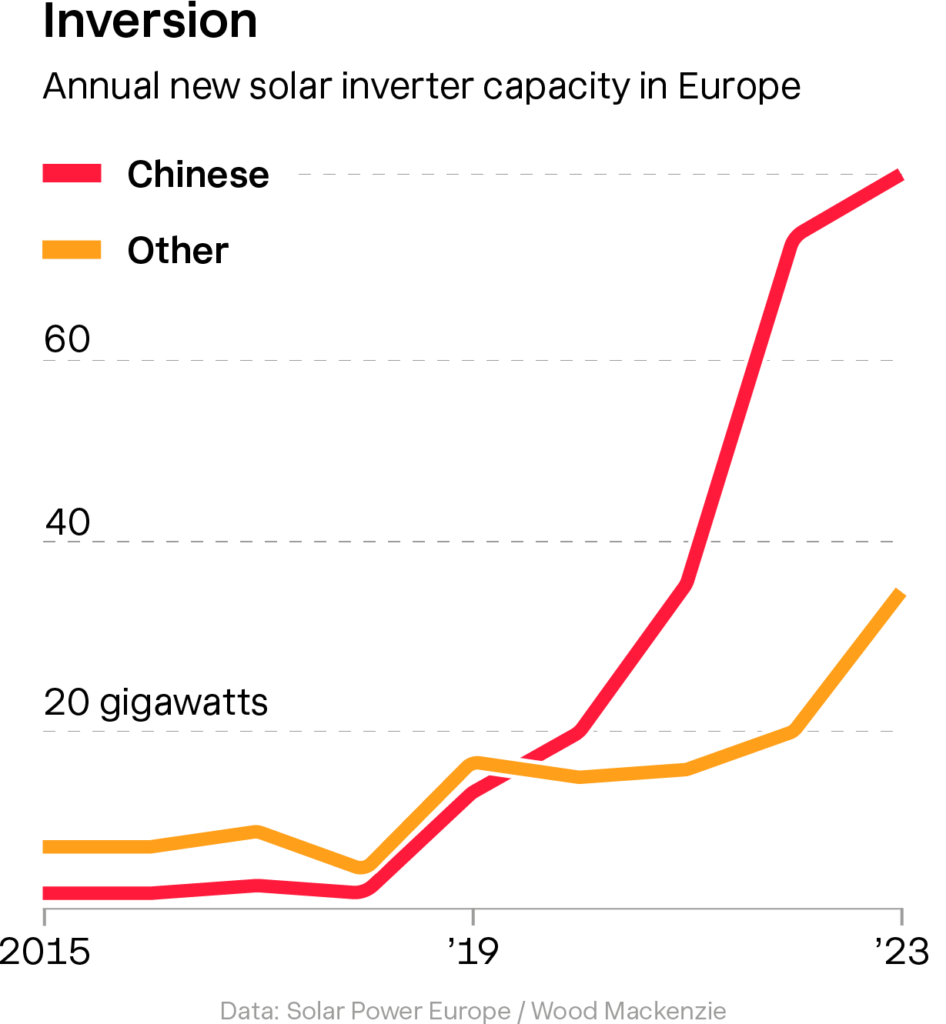
Collectively, the country’s inverters now control hundreds of gigawatts of European solar power. Manipulating the output of just a fraction of these devices during the midday solar peak would be enough to cause widespread “misery,” said Willem Westerhof, the researcher who first discovered the potential inverter attack scenario in 2016.
Vulnerabilities are not exclusive to Chinese inverters — dos Santos identified one in an SMA system — but they are often more severe. And Chinese companies commonly take a more lackadaisical approach to fixing vulnerabilities when they’re found, according to researchers. “I was surprised with the immaturity” of Chinese manufacturers, said dos Santos. “They don’t understand security issues.”
Westerhof was more blunt, using an expletive to describe most Chinese manufacturers’ cybersecurity protocols. “You will find serious vulnerabilities,” he said. “And even if you try to responsibly disclose, you get nothing.” To his knowledge, just a few companies take the solar inverters risk seriously, including Huawei and SMA.
Solar geopolitics
For some, the role of Chinese firms goes beyond careless malpractice.
Last May, Reuters reported evidence of “rogue communication devices” in Chinese solar inverters in the United States, prompting fears they could be used as direct remote control devices. In January, a Department of Energy analysis found the devices were “non-malicious” and “non-intentional,” but the episode is still mentioned with unease by industry observers.
Two years earlier, Microsoft alerted researchers and the U.S. government that a Chinese state-sponsored hacking group called Volt Typhoon had performed surveillance on critical infrastructure installations in Guam and the mainland United States, possibly in preparation for an attack. The disclosure followed a 2021 Chinese law that requires companies operating in the country to disclose unpatched security vulnerabilities to parts of the government, including ministries that were previously responsible for several state-sponsored offensive hacking operations. In the case of its market dominance of solar inverters, this “obviously could become a weapon for exploitation,” said dos Santos.
But there is considerable disagreement between China energy analysts and Western security researchers over whether China would actually seek to use its growing position of leverage in the European grid system to achieve geopolitical goals.
The former group sees China’s renewables manufacturing push as largely a response to internal concerns, with benevolent knock-on benefits for other countries. “We always believe that the highest priority for decision makers is to build your home as a better place to live,” said Muyi Yang, a senior analyst at renewable energy think tank Ember who is originally from China. Around half the solar equipment produced by Chinese companies is deployed in China itself, making it the fastest electrifying country on earth and allowing it to reduce its import dependencies, the effects of climate change and air pollution. Its solar exports, meanwhile, help “to build a better external environment that can support further progress of the Chinese economy,” said Yang. “And from that lens, I don’t think it is part of China’s strategy that China wants to dominate the clean technology supply chain and then leverage this to dominate the world.”
But security analysts in Europe strike a more hawkish tone.
In late 2025, China leveraged its almost total dominance in the supply of rare earth metals in response to U.S. tariffs by imposing an export embargo to all countries. Europe, and its highly dependent defense manufacturing industry, was struck in the crossfire. Analysts, including Caspar Hobhouse, of the EU Institute for Security Studies, see similar security risks in China’s dominance of solar technology. For example, look to Cuba, where China has made large donations of solar equipment to help the island withstand President Donald Trump’s “maximum pressure” campaign intended to solidify American control of the Caribbean.
“The climate world is very soft on China,” Hobhouse said, and “it tends to be actually quite blind to this because they see that China is this fantastic accelerator of the green transition.” But he believes that “it is absolutely an intentional policy on behalf of the Chinese state” to use the dominant position it has in the technologies behind that shift as “a point of leverage in geopolitics when — not if — when something happens.” That something could be a move in China’s long-signaled intention to capture Taiwan; its potential access to enough solar inverters to down the European grid may play a role.
Structural dependence on China
There are few short-term alternatives to China’s renewable electricity technology for Europe, facing its second major energy crisis in four years directly attributable to its dependency on fossil fuel imports. Seeking a cheaper, more independent energy system, it currently has only one place to turn.
The view that this structural dependency should be corrected crosses the geopolitical debate. For the cybersecurity researchers who fear dramatic grid shutdowns hatched by state-backed hackers, there are renewable energy advocates who see more mundane dangers in an overly concentrated supply chain. The situation is not dissimilar to Taiwan’s control of 90 percent of global advanced semiconductor manufacturing, which strikes equal fear into China foreign policy hawks and supply chain buffs who worry about the island’s susceptibility to earthquakes.
“I think we’ve become very comfortable with this in our globalized trading system: That it’s okay to just have other countries produce things because of their competitive advantage,” said Belinda Schäpe, a China policy analyst at the Centre for Research on Energy and Clean Air. “But we’re also starting to realize now that there are some trade-offs with that, not just because it’s China and because there’s some political sensitivities that we can’t influence: it’s also just an inherent supply chain risk.”
Perhaps for different reasons, Hobhouse agrees. “I would sleep a lot better at night if China only controlled 50 percent” of solar manufacturing, he said. But Europe has so far struggled to diversify that supply chain within its own borders. The high price of energy is one of many headwinds.
Instead, the next solar industrial wave may come from a more unexpected place: a continent with little prior history of solar manufacturing, or of mass manufacturing at all — but one with a young workforce and a huge demand for renewable electricity. It may instead be born in Africa.
Next in Cracking The Sun: Africa is in a colossal solar boom. Can it build the panels, too?
The post As Europe welcomes Chinese solar, some see a Trojan horse appeared first on The Reynolds Center.


You May Also Like

Alex Eala ends winless run vs Czech foes to capture Birmingham Open crown

Putin Says Moscow Will Continue Building Iran’s Nuclear Infrastructure
Moody’s Assigns First-Ever Rating to Bitcoin-Backed Municipal Bond in Historic Crypto Finance Move



