

Majority Of US Crypto Users Are Dodging Their Taxes
- The IRS revealed that only 6.5% of US taxpayers reported their crypto-related activities between 2013 and 2021, despite the agency’s estimated 12% to 21% of crypto users during the same period.
Bloomberg, citing US Internal Revenue Service (IRS) data, revealed that a majority of cryptocurrency users have been dodging their tax obligations. The report stated that only 6.5% of American taxpayers divulged their crypto sales between 2013 and 2021.
In comparison, the source estimated that around 12% to 21% of adults in the US held crypto during the period. The trend indicates significant tax revenue losses from digital asset users alone.
In 2022, the IRS projected the True Tax Liability in the US at $4.635 trillion. Meanwhile, the Net Tax Gap, representing the agency’s uncollected taxes, was $606 billion.
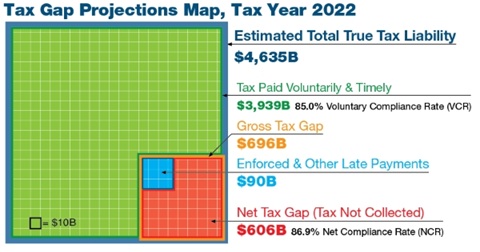 Tax Gap Projections in the US (Source: IRS)
Fast-forward to 2025, CoinTracker showed that crypto transactions in the US averaged 836. Digital asset users disclosed an average profit of $2,692 and an average loss of $636 on their short-term holdings.
Most Common Retail Investor Profile
Interestingly, the study found that most crypto users belonged to the younger and low-income demographics. Additionally, most of them preferred high-stakes meme coins for their speculative potential.
Researchers noted that crypto users typically exhibit more polarized investment habits than the average stock investor.
Challenges in Crypto Tax Evaluation
One can argue that there’s too much transparency in blockchain. However, detecting illicit activities, including money laundering, sanctions evasion, and tax evasion, remains a huge challenge.
The irony of blockchain is that while it records every transaction on a public ledger, the values in transfers and the alphanumeric strings in digital addresses do not reveal the identities of the people behind them. Even when users convert their addresses into human-readable names, they often use pseudonyms. On the other hand, using their real names does not immediately draw conclusive proof of their association with their crypto wallets without external data points that off- or on-ramp their identity.
Given these factors, an IRS agent will have a hard time linking the addresses unless the owners interact with centralized exchanges, complete KYC (Know Your Customer) forms, or attempt to withdraw funds using their banking credentials.
The difficulty is further compounded when users rely solely on decentralized finance (DeFi) platforms operating outside KYC requirements. Likewise, the same holds when fund transfers or conversions occur outside the regulatory scope, or when people use privacy tokens or crypto mixers to obfuscate their tracks.
The post Majority Of US Crypto Users Are Dodging Their Taxes appeared first on Blockzeit.


You May Also Like

Not a loophole: Singapore AI export controls let China tap US AI legally

Crypto Market Drops as Fear Grows and Major Assets Decline

Critical USDT0 Response to Drift Hack Exposes Stark Contrast in Stablecoin Security Protocols



