Solana DEX sees meme token trading decline sharply while stablecoin trading volume rises, marking a major market shift.]]>Solana DEX sees meme token trading decline sharply while stablecoin trading volume rises, marking a major market shift.]]>

Solana DEX Sees Meme Tokens Fade as Stablecoin Trading Rises

  • Meme token trading on Solana DEX dropped below 30%, reflecting a decline in speculative retail activity.
  • SOL-stablecoin trading volume surged to its highest level since December 2023, signaling stronger market stability.

Major changes are underway in the Solana trading ecosystem. The latest data from BlockWorks shows that meme token dominance on Solana DEXs, which had skyrocketed to over 60% by the end of 2024, has now plummeted to below 30%.

In contrast, the SOL-stablecoin trading pair has risen sharply and now reaches its highest level since December 2023. This shift appears to reflect a shift in trader behavior, as traders begin to seek safer paths after the meme token hype wave wore off.
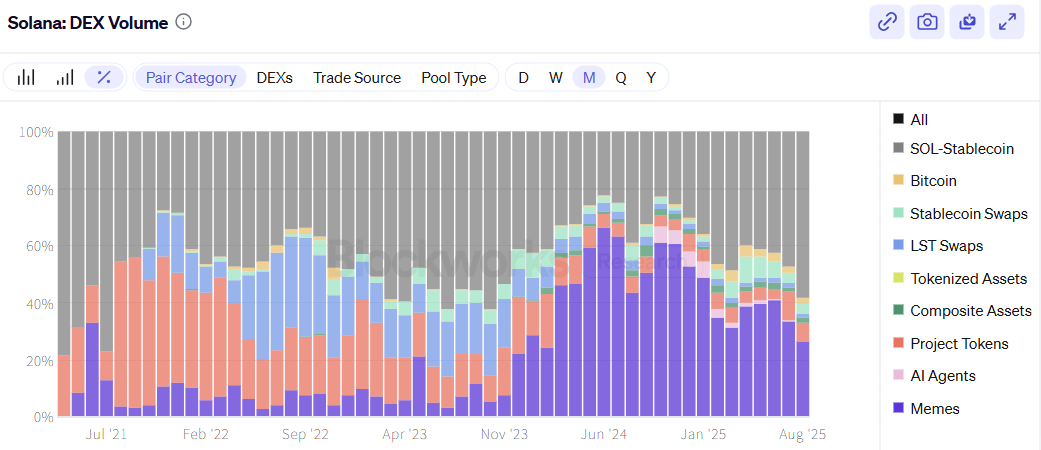
Stablecoins Gain Ground as Meme Frenzy Fades

Furthermore, the number of active daily traders on Solana DEXs has also declined dramatically. From a peak of around 4.8 million traders, there were only around 900,000 left in August 2025. This figure reflects a growing sense of fatigue with high-risk assets, particularly with numerous rug pulls and projects with no clear utility.

However, this shift also opens up space for more stable trading options, with stablecoins becoming a primary option for those looking to remain active without being caught up in the wild volatility of meme tokens.

Solana Proves Its Strength Through DeFi Growth

While many people used to rush to acquire tokens like BONK, WIF, or MEW, that trend is now shifting. Meme tokens once made Solana a household name, especially when network throughput reached 107,540 TPS in a stress test, as revealed by Mert Mumtaz, co-founder of Helius.

This speed was once a major draw for retail traders, but after the hype died down, not all tokens were able to survive. Many lost their appeal due to lack of utility.

On the other hand, CNF reported last week that Solana’s DeFi ecosystem is actually at its peak. Total value locked (TVL) hit a new record of $13.34 billion, reflecting the deepening involvement of institutional users and surging demand for staking.

This means that while the meme token sector appears to be weakening, the Solana ecosystem as a whole has not lost its momentum. In fact, substantial liquidity is now flowing into the more mature and long-term DeFi sector.

Furthermore, SOL’s price performance is also trending positively. In the past 24 hours, SOL has risen 0.81%. Looking at the long term, the increase has reached 33.48% in the past 30 days and even soared 82.84% over 90 days.

This trend signals one important thing: Solana is starting to move from a hype-driven phase to a more utility-oriented one. While many retail traders have left, new funds have emerged from large players seeking transaction efficiencies and DeFi opportunities.

With stablecoins becoming a key trading pillar, liquidity tends to be more controlled. This contrasts with previous periods when meme tokens often made the Solana market appear boisterous but volatile.

However, this doesn’t mean meme tokens will disappear completely. The community is still present, and projects with strong ideas may still survive.

]]>


Market Opportunity
TokenFi Logo
TokenFi Price(TOKEN)
$0.004771
$0.004771$0.004771
-6.70%
USD
TokenFi (TOKEN) Live Price Chart
Disclaimer: The articles reposted on this site are sourced from public platforms and are provided for informational purposes only. They do not necessarily reflect the views of MEXC. All rights remain with the original authors. If you believe any content infringes on third-party rights, please contact [email protected] for removal. MEXC makes no guarantees regarding the accuracy, completeness, or timeliness of the content and is not responsible for any actions taken based on the information provided. The content does not constitute financial, legal, or other professional advice, nor should it be considered a recommendation or endorsement by MEXC.

You May Also Like

UK Lowest in G7 Investments for 2025 Amid Expert Warnings on Frameworks

UK Lowest in G7 Investments for 2025 Amid Expert Warnings on Frameworks

The post UK Lowest in G7 Investments for 2025 Amid Expert Warnings on Frameworks appeared on BitcoinEthereumNews.com. The UK recorded the lowest investment among
Share
BitcoinEthereumNews2025/12/31 06:58
Chinese Bitcoin Hardware Titans Control 95% of Market, Now Coming to America to Dodge Trump Tariff War

Chinese Bitcoin Hardware Titans Control 95% of Market, Now Coming to America to Dodge Trump Tariff War

Three of China’s largest Bitcoin hardware manufacturers are establishing production facilities in the United States as President Donald Trump’s tariff policies reshape the cryptocurrency industry. The three industry leaders, Bitmain, Canaan, and MicroBT, collectively control over 90% of the global mining rig market. These companies are the architects of Bitcoin’s physical infrastructure, manufacturing the specialized ASIC (Application-Specific Integrated Circuit) machines that form the backbone of the world’s most valuable cryptocurrency network. Every Bitcoin mined globally likely passes through hardware bearing Chinese engineering fingerprints. 95% Market Control Sparks “Digital Dependency Trap” and Security Risks According to a June 18 Reuters report, these Bitcoin mining giants are establishing U.S. operations to circumvent potential tariffs. However, critics have raised security concerns about Chinese involvement in sectors spanning semiconductor manufacturing and energy infrastructure. Guang Yang, chief technology officer at crypto technology provider Conflux Network, described the situation as extending beyond trade policy. “The U.S.-China trade war goes beyond tariffs,” Yang stated. “It’s a strategic pivot toward ‘politically acceptable’ hardware sources.” Bitmain, the largest of the three companies by revenue, initiated U.S. production of mining equipment in December , one month after Trump’s presidential election victory. Canaan began trial production in the United States on April 2 to avoid tariffs following Trump’s announcement of new trade levies. One of the largest manufacturers of #bitcoin mining machines, Canaan, has set up a base of operations outside of China. CEO Zhang says, Kazakhstan is essential to "expanding after-sales geographical coverage and providing […] support growing international customer base" pic.twitter.com/7D5Xh2ici5 — Documenting ₿itcoin 📄 (@DocumentingBTC) June 23, 2021 Third-ranked MicroBT announced in a statement that it is “actively implementing a localization strategy in the U.S.” to “avoid the impact of tariffs.” $11.9B by 2028: The Market These Giants Are Fighting for According to Frost & Sullivan’s “2024 Global Blockchain Hardware Industry White Paper,” the ASIC-based Bitcoin mining hardware market demonstrates substantial consolidation. When measured by computing power sold, these three Chinese companies command 95.4% of the global market share. The Bitcoin ecosystem encompasses five primary segments: hardware supply, mining farm operations, mining pool management, trading platforms, and payment processing services. Hardware manufacturers like Canaan, the first Bitcoin mining company to go public and the second-largest by computing power , focus exclusively on integrated circuit (IC) design, manufacturing, and equipment sales. Industry analysts project continued sector expansion, with the market expected to reach $11.9 billion by 2028, representing a compound annual growth rate of 15.3%, contingent on Bitcoin’s continued price appreciation driven by supply scarcity. Source: Frost & Sullivan China’s Historical Bitcoin Mining Advantage Understanding today’s migration requires examining how China achieved such overwhelming market control in the first place. The foundation was laid during the historic 2017 Bitcoin boom, when three key factors aligned to create Chinese mining supremacy. During the early expansion phase, Chinese officials recognized cryptocurrency mining as a profitable venture that attracted substantial foreign investment. Consequently, authorities initially overlooked the mining sector while simultaneously restricting Bitcoin trading and initial coin offerings. Hydro-power plants go on sale in China since #Bitcoin mining crackdown has reduced demand for electricity. – South China Morning Post pic.twitter.com/QKEbUzWN4g — Bitcoin Archive (@BTC_Archive) June 30, 2021 China’s extensive hydroelectric infrastructure further strengthened the country’s mining operations, providing the cheap energy essential for profitable Bitcoin production. Does Chinese Hardware Control America’s Bitcoin Network? While the United States leads global Bitcoin mining operations with over 38% of total network activity , American miners depend almost entirely on Chinese-manufactured equipment. America Leads Bitcoin Mining Operation/ Source: Bitbo This creates what security analysts describe as a “digital dependency trap,” a scenario where America’s cryptocurrency infrastructure relies fundamentally on hardware produced by its primary economic rival. Guang Yang, Conflux Network’s chief technology officer, frames this dependency in geopolitical terms that extend far beyond trade economics . “The U.S.-China trade war goes beyond tariffs,” Yang explains. “It’s a strategic pivot toward ‘politically acceptable’ hardware sources.” His assessment reflects growing concerns within the cryptocurrency community about supply chain vulnerabilities that could impact national economic security.
Share
CryptoNews2025/06/19 04:26
XRP Enters The Same Zone That Preceded Its Last Historic Breakout

XRP Enters The Same Zone That Preceded Its Last Historic Breakout

The post XRP Enters The Same Zone That Preceded Its Last Historic Breakout appeared on BitcoinEthereumNews.com. My name is Godspower Owie, and I was born and brought
Share
BitcoinEthereumNews2025/12/31 07:03





