The disagreement issue in post hoc feature attribution techniques is discussed in this study. Explainers like SHAP, LIME, and gradient-based techniques frequently result in contradictory feature importance rankings for the same model. Post hoc Explainer Agreement Regularization (PEAR), a loss term added after model training, is introduced to counteract this and promote increased explainer consensus without significantly compromising accuracy. Experiments on three datasets show that PEAR offers a customizable balance between explanation consensus and predictive performance, and it enhances agreement across explainers, including those not directly used in training. PEAR improves explanations' dependability and credibility in crucial machine learning applications by turning disagreement into a controlled parameter.The disagreement issue in post hoc feature attribution techniques is discussed in this study. Explainers like SHAP, LIME, and gradient-based techniques frequently result in contradictory feature importance rankings for the same model. Post hoc Explainer Agreement Regularization (PEAR), a loss term added after model training, is introduced to counteract this and promote increased explainer consensus without significantly compromising accuracy. Experiments on three datasets show that PEAR offers a customizable balance between explanation consensus and predictive performance, and it enhances agreement across explainers, including those not directly used in training. PEAR improves explanations' dependability and credibility in crucial machine learning applications by turning disagreement into a controlled parameter.

New AI Study Tackles the Transparency Problem in Black-Box Models

2025/09/21 13:46
7 min read

:::info Authors:

(1) Avi Schwarzschild, University of Maryland, College Park, Maryland, USA and Work completed while working at Arthur (avi1umd.edu);

(2) Max Cembalest, Arthur, New York City, New York, USA;

(3) Karthik Rao, Arthur, New York City, New York, USA;

(4) Keegan Hines, Arthur, New York City, New York, USA;

(5) John Dickerson†, Arthur, New York City, New York, USA ([email protected]).

:::

Abstract and 1. Introduction

1.1 Post Hoc Explanation

1.2 The Disagreement Problem

1.3 Encouraging Explanation Consensus

  1. Related Work

  2. Pear: Post HOC Explainer Agreement Regularizer

  3. The Efficacy of Consensus Training

    4.1 Agreement Metrics

    4.2 Improving Consensus Metrics

    [4.3 Consistency At What Cost?]()

    4.4 Are the Explanations Still Valuable?

    4.5 Consensus and Linearity

    4.6 Two Loss Terms

  4. Discussion

    5.1 Future Work

    5.2 Conclusion, Acknowledgements, and References

Appendix

ABSTRACT

As neural networks increasingly make critical decisions in highstakes settings, monitoring and explaining their behavior in an understandable and trustworthy manner is a necessity. One commonly used type of explainer is post hoc feature attribution, a family of methods for giving each feature in an input a score corresponding to its influence on a model’s output. A major limitation of this family of explainers in practice is that they can disagree on which features are more important than others. Our contribution in this paper is a method of training models with this disagreement problem in mind. We do this by introducing a Post hoc Explainer Agreement Regularization (PEAR) loss term alongside the standard term corresponding to accuracy, an additional term that measures the difference in feature attribution between a pair of explainers. We observe on three datasets that we can train a model with this loss term to improve explanation consensus on unseen data, and see improved consensus between explainers other than those used in the loss term. We examine the trade-off between improved consensus and model performance. And finally, we study the influence our method has on feature attribution explanations.

1 INTRODUCTION

As machine learning becomes inseparable from important societal sectors like healthcare and finance, increased transparency of how complex models arrive at their decisions is becoming critical. In this work, we examine a common task in support of model transparency that arises with the deployment of complex black-box models in production settings: explaining which features in the input are most influential in the model’s output. This practice allows data scientists and machine learning practitioners to rank features by importance – the features with high impact on model output are considered more important, and those with little impact on model output are considered less important. These measurements inform how model users debug and quality check their models, as well as how they explain model behavior to stakeholders.

1.1 Post Hoc Explanation

The methods of model explanation considered in this paper are post hoc local feature attribution scores. The field of explainable artificial intelligence (XAI) is rapidly producing different methods of this

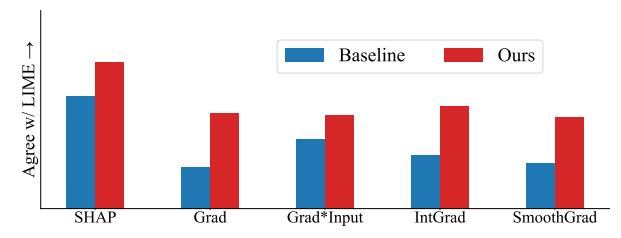
\ Figure 1: Our loss that encourages explainer consensus boosts the correlation between LIME and other common post hoc explainers. This comes with a cost of less than two percentage points of accuracy compared with our baseline model on the Electricity dataset. Our method improves consensus on six agreement metrics and all pairs of explainers we evaluated. Note that this plot measures the rank correlation agreement metric and the specific bar heights depend on this choice of metric.
\ type to make sense of model behavior [e.g., 21, 24, 30, 32, 37]. Each of these methods has a slightly different formula and interpretation of its raw output, but in general they all perform the same task of attributing a model’s behavior to its input features. When tasked to explain a model’s output with a corresponding input (and possible access to the model weights), these methods answer the question, “How influential is each individual feature of the input in the model’s computation of the output?”

\ Data scientists are using post hoc explainers at increasing rates – popular methods like LIME and SHAP have had over 350 thousand and 6 million downloads of their Python packages in the last 30 days, respectively [23].

1.2 The Disagreement Problem

The explosion of different explanation methods leads Krishna et al. [15] to observe that when neural networks are trained naturally, i.e. for accuracy alone, often post hoc explainers disagree on how much different features influenced a model’s outputs. They coin the term the disagreement problem and argue that when explainers disagree about which features of the input are important, practitioners have little concrete evidence as to which of the explanations, if any, to trust.

\ There is an important discussion around local explainers and their true value in reaching the communal goal of model transparency and interpretability [see, e.g., 7, 18, 29]; indeed, there are ongoing discussions about the efficacy of present-day explanation methods in specific domains [for healthcare see, e.g., 8]. Feature importance estimates may fail at making a model more transparent when the model being explained is too complex to allow for easily attributing the output to the contribution of each individual feature.

\ In this paper, we make no normative judgments with respect to this debate, but rather view “explanations” as signals to be used alongside other debugging, validation, and verification approaches in the machine learning operations (MLOps) pipeline. Specifically, we take the following practical approach: make the amount of explanation disagreement a controllable model parameter instead of a point of frustration that catches stakeholders off-guard.

1.3 Encouraging Explanation Consensus

Consensus between two explainers does not require that the explainers output the same exact scores for each feature. Rather, consensus between explainers means that whatever disagreement they exhibit can be reconciled. Data scientists and machine learning practitioners say in a survey that explanations are in basic agreement if they satisfy agreement metrics that align with human intuition, which provides a quantitative way to evaluate the extent to which consensus is being achieved [15]. When faced with disagreement between explainers, a choice has to be made about what to do next – if such an arbitrary crossroads moment is avoidable via specialized model training, we believe it would be a valuable addition to a data scientist’s toolkit.

\ We propose, as our main contribution, a training routine to help alleviate the challenge posed by post hoc explanation disagreement. Achieving better consensus between explanations does not provide more interpretability to a model inherently. But, it may lend more trust to the explanations if different approaches to attribution agree more often on which features are important. This gives consensus the practical benefit of acting as a sanity check – if consensus is observed, the choice of which explainer a practitioner uses is less consequential with respect to downstream stakeholder impact, making their interpretation less subjective.

2 RELATED WORK

Our work focuses on post hoc explanation tools. Some post hoc explainers, like LIME [24] and SHAP [21], are proxy models trained atop a base machine learning model with the sole intention of “explaining” that base model. These explainers rely only on the model’s inputs and outputs to identify salient features. Other explainers, such as Vanilla Gradients (Grad) [32], Gradient Times Input (Grad*Input) [30], Integrated Gradients (IntGrad) [37] and SmoothGrad [34], do not use a proxy model but instead compute the gradients of a model with respect to input features to identify important features.[1] Each of these explainers has its quirks and there are reasons to use, or not use, them all—based on input type, model type, downstream task, and so on. But there is an underlying pattern unifying all these explanation tools. Han et al. [12] provide a framework that characterizes all the post hoc explainers used in this paper as different types of local-function approximation. For more details about the individual post hoc explainers used in this paper, we refer the reader to the individual papers and to other works about when and why to use each one [see, e.g., 5, 13].

\ We build directly on prior work that defines and explores the disagreement problem [15]. Disagreement here refers to the difference in feature importance scores between two feature attribution methods, but can be quantified several different ways as are described by the metrics Krishna et al. [15] define and use. We describe these metrics in Section 4.

\ The method we propose in this paper relates to previous work that trains models with constraints on explanations via penalties on the disagreement between feature attribution scores and handcrafted ground-truth scores [26, 27, 41]. Additionally, work has been done to leverage the disagreement between different posthoc explanations to construct new feature attribution scores that improve metrics like stability and pairwise rank agreement [2, 16, 25].

\

:::info This paper is available on arxiv under CC BY 4.0 DEED license.

:::

\

Market Opportunity
Wink Logo
Wink Price(LIKE)
$0.001805
$0.001805$0.001805
-0.93%
USD
Wink (LIKE) Live Price Chart
Disclaimer: The articles reposted on this site are sourced from public platforms and are provided for informational purposes only. They do not necessarily reflect the views of MEXC. All rights remain with the original authors. If you believe any content infringes on third-party rights, please contact [email protected] for removal. MEXC makes no guarantees regarding the accuracy, completeness, or timeliness of the content and is not responsible for any actions taken based on the information provided. The content does not constitute financial, legal, or other professional advice, nor should it be considered a recommendation or endorsement by MEXC.

You May Also Like

Ultimea Unveils Skywave X100 Dual: 9.2.6 Wireless Home Theater Launching March 2026

Ultimea Unveils Skywave X100 Dual: 9.2.6 Wireless Home Theater Launching March 2026

RANCHO CUCAMONGA, Calif., Feb. 12, 2026 /PRNewswire/ — Ultimea, a leader in immersive home entertainment, announces the upcoming launch of its next-generation flagship
Share
AI Journal2026/02/13 02:45
Why The Green Bay Packers Must Take The Cleveland Browns Seriously — As Hard As That Might Be

Why The Green Bay Packers Must Take The Cleveland Browns Seriously — As Hard As That Might Be

The post Why The Green Bay Packers Must Take The Cleveland Browns Seriously — As Hard As That Might Be appeared on BitcoinEthereumNews.com. Jordan Love and the Green Bay Packers are off to a 2-0 start. Getty Images The Green Bay Packers are, once again, one of the NFL’s better teams. The Cleveland Browns are, once again, one of the league’s doormats. It’s why unbeaten Green Bay (2-0) is a 8-point favorite at winless Cleveland (0-2) Sunday according to betmgm.com. The money line is also Green Bay -500. Most expect this to be a Packers’ rout, and it very well could be. But Green Bay knows taking anyone in this league for granted can prove costly. “I think if you look at their roster, the paper, who they have on that team, what they can do, they got a lot of talent and things can turn around quickly for them,” Packers safety Xavier McKinney said. “We just got to kind of keep that in mind and know we not just walking into something and they just going to lay down. That’s not what they going to do.” The Browns certainly haven’t laid down on defense. Far from. Cleveland is allowing an NFL-best 191.5 yards per game. The Browns gave up 141 yards to Cincinnati in Week 1, including just seven in the second half, but still lost, 17-16. Cleveland has given up an NFL-best 45.5 rushing yards per game and just 2.1 rushing yards per attempt. “The biggest thing is our defensive line is much, much improved over last year and I think we’ve got back to our personality,” defensive coordinator Jim Schwartz said recently. “When we play our best, our D-line leads us there as our engine.” The Browns rank third in the league in passing defense, allowing just 146.0 yards per game. Cleveland has also gone 30 straight games without allowing a 300-yard passer, the longest active streak in the NFL.…
Share
BitcoinEthereumNews2025/09/18 00:41
Unlocking Massive Value: Curve Finance Revenue Sharing Proposal for CRV Holders

Unlocking Massive Value: Curve Finance Revenue Sharing Proposal for CRV Holders

BitcoinWorld Unlocking Massive Value: Curve Finance Revenue Sharing Proposal for CRV Holders The dynamic world of decentralized finance (DeFi) is constantly evolving, bringing forth new opportunities and innovations. A significant development is currently unfolding at Curve Finance, a leading decentralized exchange (DEX). Its founder, Michael Egorov, has put forth an exciting proposal designed to offer a more direct path for token holders to earn revenue. This initiative, centered around a new Curve Finance revenue sharing model, aims to bolster the value for those actively participating in the protocol’s governance. What is the “Yield Basis” Proposal and How Does it Work? At the core of this forward-thinking initiative is a new protocol dubbed Yield Basis. Michael Egorov introduced this concept on the CurveDAO governance forum, outlining a mechanism to distribute sustainable profits directly to CRV holders. Specifically, it targets those who stake their CRV tokens to gain veCRV, which are essential for governance participation within the Curve ecosystem. Let’s break down the initial steps of this innovative proposal: crvUSD Issuance: Before the Yield Basis protocol goes live, $60 million in crvUSD will be issued. Strategic Fund Allocation: The funds generated from the sale of these crvUSD tokens will be strategically deployed into three distinct Bitcoin-based liquidity pools: WBTC, cbBTC, and tBTC. Pool Capping: To ensure balanced risk and diversified exposure, each of these pools will be capped at $10 million. This carefully designed structure aims to establish a robust and consistent income stream, forming the bedrock of a sustainable Curve Finance revenue sharing mechanism. Why is This Curve Finance Revenue Sharing Significant for CRV Holders? This proposal marks a pivotal moment for CRV holders, particularly those dedicated to the long-term health and governance of Curve Finance. Historically, generating revenue for token holders in the DeFi space can often be complex. The Yield Basis proposal simplifies this by offering a more direct and transparent pathway to earnings. By staking CRV for veCRV, holders are not merely engaging in governance; they are now directly positioned to benefit from the protocol’s overall success. The significance of this development is multifaceted: Direct Profit Distribution: veCRV holders are set to receive a substantial share of the profits generated by the Yield Basis protocol. Incentivized Governance: This direct financial incentive encourages more users to stake their CRV, which in turn strengthens the protocol’s decentralized governance structure. Enhanced Value Proposition: The promise of sustainable revenue sharing could significantly boost the inherent value of holding and staking CRV tokens. Ultimately, this move underscores Curve Finance’s dedication to rewarding its committed community and ensuring the long-term vitality of its ecosystem through effective Curve Finance revenue sharing. Understanding the Mechanics: Profit Distribution and Ecosystem Support The distribution model for Yield Basis has been thoughtfully crafted to strike a balance between rewarding veCRV holders and supporting the wider Curve ecosystem. Under the terms of the proposal, a substantial portion of the value generated by Yield Basis will flow back to those who contribute to the protocol’s governance. Returns for veCRV Holders: A significant share, specifically between 35% and 65% of the value generated by Yield Basis, will be distributed to veCRV holders. This flexible range allows for dynamic adjustments based on market conditions and the protocol’s performance. Ecosystem Reserve: Crucially, 25% of the Yield Basis tokens will be reserved exclusively for the Curve ecosystem. This allocation can be utilized for various strategic purposes, such as funding ongoing development, issuing grants, or further incentivizing liquidity providers. This ensures the continuous growth and innovation of the platform. The proposal is currently undergoing a democratic vote on the CurveDAO governance forum, giving the community a direct voice in shaping the future of Curve Finance revenue sharing. The voting period is scheduled to conclude on September 24th. What’s Next for Curve Finance and CRV Holders? The proposed Yield Basis protocol represents a pioneering approach to sustainable revenue generation and community incentivization within the DeFi landscape. If approved by the community, this Curve Finance revenue sharing model has the potential to establish a new benchmark for how decentralized exchanges reward their most dedicated participants. It aims to foster a more robust and engaged community by directly linking governance participation with tangible financial benefits. This strategic move by Michael Egorov and the Curve Finance team highlights a strong commitment to innovation and strengthening the decentralized nature of the protocol. For CRV holders, a thorough understanding of this proposal is crucial for making informed decisions regarding their staking strategies and overall engagement with one of DeFi’s foundational platforms. FAQs about Curve Finance Revenue Sharing Q1: What is the main goal of the Yield Basis proposal? A1: The primary goal is to establish a more direct and sustainable way for CRV token holders who stake their tokens (receiving veCRV) to earn revenue from the Curve Finance protocol. Q2: How will funds be generated for the Yield Basis protocol? A2: Initially, $60 million in crvUSD will be issued and sold. The funds from this sale will then be allocated to three Bitcoin-based pools (WBTC, cbBTC, and tBTC), with each pool capped at $10 million, to generate profits. Q3: Who benefits from the Yield Basis revenue sharing? A3: The proposal states that between 35% and 65% of the value generated by Yield Basis will be returned to veCRV holders, who are CRV stakers participating in governance. Q4: What is the purpose of the 25% reserve for the Curve ecosystem? A4: This 25% reserve of Yield Basis tokens is intended to support the broader Curve ecosystem, potentially funding development, grants, or other initiatives that contribute to the platform’s growth and sustainability. Q5: When is the vote on the Yield Basis proposal? A5: A vote on the proposal is currently underway on the CurveDAO governance forum and is scheduled to run until September 24th. If you found this article insightful and valuable, please consider sharing it with your friends, colleagues, and followers on social media! Your support helps us continue to deliver important DeFi insights and analysis to a wider audience. To learn more about the latest DeFi market trends, explore our article on key developments shaping decentralized finance institutional adoption. This post Unlocking Massive Value: Curve Finance Revenue Sharing Proposal for CRV Holders first appeared on BitcoinWorld.
Share
Coinstats2025/09/18 00:35