A Year Under Paul Atkins: SEC Crypto Policy Breaks with Its Past
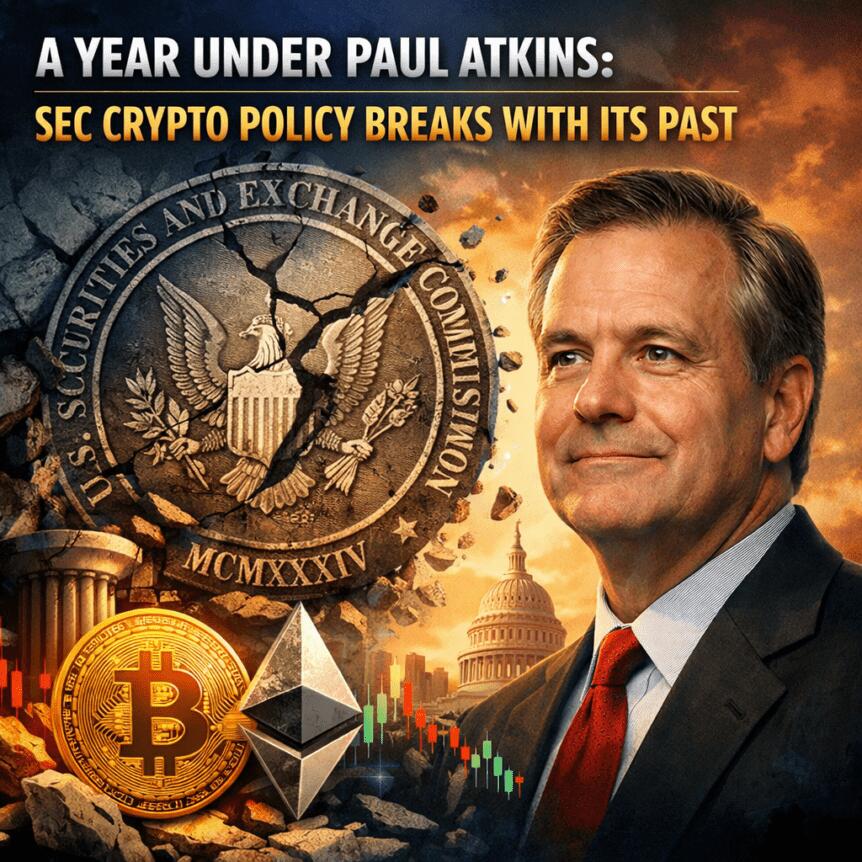
Paul Atkins assumed the chairmanship of the U.S. Securities and Exchange Commission on April 21, 2025, and a year into his tenure the agency appears to have shifted its stance on digital assets. After a presidency that promised robust crypto enforcement, the new leadership has signaled a more targeted, regulation-centered approach that many in the market view as providing clearer guardrails for issuers, exchanges and investors alike.
Trump’s 2024 campaign had positioned the SEC as a principal obstacle to crypto policy, vowing to replace Gary Gensler and to pursue a more crypto-friendly agenda. Gensler stepped down in January 2025, with Commissioner Mark Uyeda serving as acting chair until Atkins’ confirmation. Since then, observers have tracked a notable pivot: enforcement actions have receded in volume, while constructive moves—ranging from product approvals to cooperative regulatory frameworks—have taken center stage. According to Cointelegraph, Atkins and his team have laid out a compliance-forward playbook that many market participants hoped to see from the agency after years of high-profile cases against crypto firms.
In interviews and public remarks, Atkins has framed the change as a deliberate departure from “regulation through enforcement” toward clearer guidance and cooperative oversight. In a CNBC appearance, he summarized the shift by saying, “A new day at the SEC is here. We’ve pivoted from the old practice of regulation through enforcement and the opaqueness of the agency, as, for example, with crypto.”
The first year of Atkins’ tenure thus stands in contrast to the prior era, when the SEC accused several crypto projects and platforms of securities law violations, sometimes triggering high-profile lawsuits. Beyond enforcement posture, the agency’s activities in regulatory policy have touched multiple levers of market structure and investor protection. The changes come as the crypto market, regulators and lawmakers recalibrate expectations for what constitutes a compliant crypto business in the United States.
Key takeaways
- The SEC under Paul Atkins has signaled a shift toward regulation-focused guidance and coordination, reducing reliance on enforcement as the primary tool for crypto supervision.
- Early-year actions included approval of crypto-asset exchange-traded funds (ETFs) and a memorandum of understanding with the Commodity Futures Trading Commission (CFTC) to coordinate digital asset regulation.
- The agency issued an interpretive note clarifying that most cryptocurrencies are not securities under federal law, aiming to reduce ambiguity for issuers and investors alike.
- Enforcement activity has not disappeared, but actions and investigations toward certain crypto firms were paused or scaled back as part of the broader regulatory approach, with the Coinbase matter cited as an early example in 2025–2026 coverage.
- Democratic lawmakers, led by figures such as Massachusetts Senator Elizabeth Warren, have criticized the SEC for potential conflicts of interest and for data that they say shows fewer enforcement actions than in the recent past.
From Gensler to Atkins: a calibrated shift in crypto supervision
Under Gensler’s tenure, the SEC pursued numerous enforcement actions against crypto projects and exchanges, often arguing that many tokens were securities and that firms failed to register adequately. The transition to Atkins, who won Senate confirmation after several months of acting leadership by Uyeda, brought a recalibrated tone. In Atkins’ view, the agency’s mission remains investor protection, but the path to that protection is evolving—from a heavy-handed enforcement posture to a more precise, rules-based framework that provides greater clarity for market participants.
Industry watchers say the change matters because regulatory clarity reduces the risk premia that often accompany crypto funding rounds, token launches and exchange listings. When issuers, investors and developers can point to clearer rules, capital formation tends to become more efficient, and platforms can invest in robust compliance programs rather than navigating ambiguous enforcement expectations. Atkins has repeatedly framed the shift as a meaningful step toward a more transparent federal framework for digital assets, while maintaining vigilance against fraud and unregistered activities.
According to Cointelegraph, Atkins’ remarks in early 2026 highlighted a broader reframing of the agency’s approach to crypto—from a period of opacity to a more collaborative posture with market participants and other regulators. The administration’s emphasis on practical guidance has implications for how startups structure token sales, how exchanges design listings, and how investors assess risk in a fast-evolving sector.
Regulatory moves shaping the market’s risk and opportunity landscape
One of the most visible signals of the new era has been policy signaling rather than courtroom drama. The SEC’s authorization of multiple crypto-related ETFs, for instance, provides a credentialed on-ramp for institutional and retail investors seeking regulated exposure to digital assets. These products typically rely on futures-based or custody-ready underpinnings that are designed to align with traditional financial markets, potentially reducing some of the operational risk that has historically accompanied crypto investments.
Another notable development is the memorandum of understanding signed with the CFTC to coordinate on digital asset regulation. The collaboration aims to reduce regulatory fragmentation and improve cross-agency clarity for market participants who must navigate both the securities and commodities dimensions of digital assets. While the exact contours of future rules remain a work in progress, the MoU signals a shared recognition that seamless, consistent oversight is essential to mainstream adoption.
In a related move, the SEC issued an interpretive notice clarifying that not all digital assets should be treated as securities under federal law. This guidance, though narrow in scope, helps distinguish between the kinds of tokens that may be governed primarily by securities laws and those that may fall under other regulatory regimes. For projects and platforms, the note offers a reference point for structuring token economics, disclosures and governance mechanisms in ways that align with current regulatory expectations.
Perhaps most consequential for market dynamics was the SEC’s shift away from broad enforcement sweeps to a more selective posture. Beginning in February—early in Atkins’ term—the agency pursued a strategy of winding down or pausing certain civil actions and investigations into crypto companies, with Coinbase cited as a prominent example in early coverage. The move has been interpreted by some as an effort to reset the regulatory climate and invite ongoing dialogue with the industry about permissible practices, audits, and disclosures.
These policy shifts have been framed in public remarks and interviews as progress toward a more constructive regulatory regime. Atkins has repeatedly underscored the need for clarity and predictable rules that enable innovation while preserving investor protections. The practical impact for market participants is increased certainty around what kinds of products can be developed and marketed in the United States, and how to structure compliance programs to meet federal expectations.
Political scrutiny and what it means for the market’s faith in regulation
Not all observers have welcomed the pivot uncritically. Democratic lawmakers have expressed concern that the SEC’s softened posture could conflict with long-standing mandates to police market integrity and protect investors. In particular, Senator Elizabeth Warren raised questions about potential conflicts of interest and data gaps after the regulator’s testimony to a House committee. In a formal letter dated April 15, Warren asserted that the SEC’s own fiscal-year 2025 data showed fewer enforcement actions than at any point in the prior decade—a measure she argued could indicate a decline in complaints and oversight rather than a robust enforcement regime.
Supporters of Atkins’ approach argue that the data point is better understood as a transitional phase—an opportunity to recalibrate processes, improve internal transparency and decouple enforcement from partisan or political dynamics. The tension between risk-based regulation and political optics is likely to shape congressional oversight for the next cycle, as lawmakers weigh how to balance investor protection with the imperative to foster American innovation in a highly competitive global landscape.
In the near term, market participants will be watching whether the SEC’s new posture translates into clearer, binding rules on topics such as token classification, exchanges’ custody standards, registration expectations for crypto platforms, and the scope of investor disclosures. The CFTC-MoU and the interpretive note are early signals, but the long arc will hinge on more formal rulemaking and targeted guidance that can withstand legal scrutiny and changing political winds.
Closing perspective: what to watch next
The crypto industry has welcomed the signs of regulatory clarity and constructive cooperation, but important uncertainties remain. The Senate’s stance on Atkins’ confirmation, the pace of additional rulemaking, and the precise criteria used to distinguish securities from non-securities tokens will all influence how the market prices risk in the coming quarters. For investors and builders, the next milestones to watch include detailed guidance on token sale disclosures, exchange listing standards, and the sequencing of any comprehensive crypto asset framework. While the path forward may still include regulatory frictions, the current trajectory suggests a longer horizon of clarity and predictable oversight, rather than episodic enforcement actions that can surprise market participants without warning.
This article was originally published as A Year Under Paul Atkins: SEC Crypto Policy Breaks with Its Past on Crypto Breaking News – your trusted source for crypto news, Bitcoin news, and blockchain updates.
You May Also Like

Solana Gains Traction as Tokenized Stocks Become a Hot Topic

Why Glassnode Just Analyzed Spot Bitcoin-native ETF Volumes

Military Depoliticization, Hegseth, And DEI