Modern economies in advanced nations are rapidly shifting towards a digital, internet-driven landscape dominated by technology giants and decentralized platforms, according to Balaji Srinivasan, former Coinbase executive and author of “The Network State.” “The traditional economy is being sunset in favor of the Internet economy,” Srinivasan asserted in a recent post on X. He shared [...]Modern economies in advanced nations are rapidly shifting towards a digital, internet-driven landscape dominated by technology giants and decentralized platforms, according to Balaji Srinivasan, former Coinbase executive and author of “The Network State.” “The traditional economy is being sunset in favor of the Internet economy,” Srinivasan asserted in a recent post on X. He shared [...]

Venture Capitalist: The World Is Going Internet-First—Here’s What You Need to Know

For feedback or concerns regarding this content, please contact us at [email protected]
Venture Capitalist: The World Is Going Internet-first—here's What You Need To Know

Modern economies in advanced nations are rapidly shifting towards a digital, internet-driven landscape dominated by technology giants and decentralized platforms, according to Balaji Srinivasan, former Coinbase executive and author of “The Network State.”

“The traditional economy is being sunset in favor of the Internet economy,” Srinivasan asserted in a recent post on X. He shared a compelling chart highlighting the stark divergence in stock performance: while the so-called “Magnificent Seven” tech stocks—comprising Apple, Microsoft, Amazon, Google’s parent company Alphabet, Meta Platforms, Nvidia, and Tesla—are experiencing exponential growth, the rest of the S&P 500 has seen relatively stagnant performance since 2005.
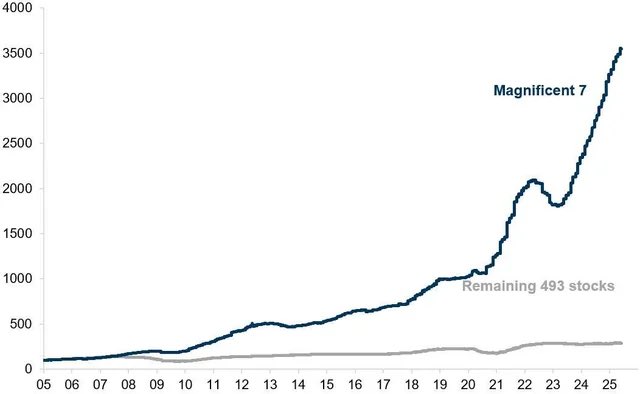
Cryptocurrencies, Technology, Economy, Stocks, Borderless Technology, S&P 500Magnificent Seven tech stock performance versus the remaining 493 companies in the S&P 500 index. Source: Balaji Srinivasan

The S&P 500, a key gauge of U.S. economic health, tracks the performance of the top 500 companies by market capitalization. Srinivasan emphasized that since the 2008 financial crisis, our financial dealings—transactions and communications—have migrated online, foreshadowing a future where entire communities, cities, and even governments operate on internet-based platforms. “The world is becoming Internet-First,” he said.

The legendary tech stocks within the Magnificent Seven include industry leaders: Apple and Microsoft, Amazon, Google, Meta Platforms, Nvidia, and Tesla. These giants exemplify how technology and internet companies are reshaping the landscape of the U.S. stock market, reflecting the broader trend of technology-driven wealth concentration.
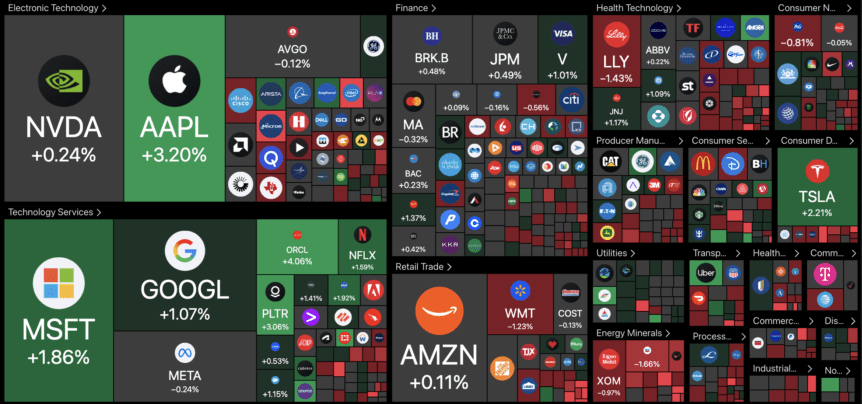
Cryptocurrencies, Technology, Economy, Stocks, Borderless Technology, S&P 500Technology and internet stocks dominate the US stock market. Source: TradingView

Srinivasan has been a prominent voice in the discussion around “Network States”—distributed online communities he predicts will eventually replace traditional nation-states. These digital-constructed entities will rely on internet-native cryptocurrencies, marking a revolutionary shift comparable to the transition from agrarian societies to industrial economies during the Industrial Revolution.

As the crypto ecosystem matures, blockchain technology, decentralized finance (DeFi), and non-fungible tokens (NFTs) are increasingly integral to this transition, embodying a new form of digital sovereignty and economic independence.

Disruption of Legacy Systems by Blockchain and AI

Conventional financial systems and government agencies have historically been slow to adopt innovative technologies. Nonetheless, U.S. regulators are now actively exploring the integration of blockchain and artificial intelligence (AI) to modernize markets.

The U.S. Securities and Exchange Commission (SEC) and the Commodity Futures Trading Commission (CFTC) issued a joint statement in September, proposing a transition to 24/7 capital markets—facilitating round-the-clock trading aligned with the global crypto markets. Additionally, the government has engaged oracle providers such as Pyth Network and Chainlink to publish economic data on-chain, aiming to enhance transparency and accountability.

This push toward digital infrastructure signifies a broader paradigm shift where blockchain and AI technologies are poised to reshape finance and governance, fostering a more dynamic, transparent, and interconnected financial landscape.

This article was originally published as Venture Capitalist: The World Is Going Internet-First—Here’s What You Need to Know on Crypto Breaking News – your trusted source for crypto news, Bitcoin news, and blockchain updates.


Disclaimer: The articles reposted on this site are sourced from public platforms and are provided for informational purposes only. They do not necessarily reflect the views of MEXC. All rights remain with the original authors. If you believe any content infringes on third-party rights, please contact [email protected] for removal. MEXC makes no guarantees regarding the accuracy, completeness, or timeliness of the content and is not responsible for any actions taken based on the information provided. The content does not constitute financial, legal, or other professional advice, nor should it be considered a recommendation or endorsement by MEXC.

You May Also Like

Solana Blockchain Gaming Faces Stark Reality: Foundation President Declares Era ‘Will Not Return’

Solana Blockchain Gaming Faces Stark Reality: Foundation President Declares Era ‘Will Not Return’

BitcoinWorld Solana Blockchain Gaming Faces Stark Reality: Foundation President Declares Era ‘Will Not Return’ In a definitive statement that signals a pivotal
Share
bitcoinworld2026/03/21 11:10
Fed Rate Hike Odds Cross 30%: Bank of America Lists Three Conditions for a Move

Fed Rate Hike Odds Cross 30%: Bank of America Lists Three Conditions for a Move

Markets are pricing more than a 30% chance the Federal Reserve will hike rates before year-end. Bank of America analysts say three specific conditions must be met
Share
coinlineup2026/03/21 11:34
First U.S. XRP ETF Launches Sept. 18, CME to List Options on XRP Futures Oct. 13

First U.S. XRP ETF Launches Sept. 18, CME to List Options on XRP Futures Oct. 13

XRP is drawing fresh attention from traditional finance as new products roll out in both securities and derivatives markets, broadening access points for exposure to the token.At the time of writing, according to CoinDesk Data, XRP was trading around $3.0263, down nearly 1% over the past 24 hours.On Sept. 18, REX Shares and Osprey Funds will debut the first U.S.-listed exchange-traded funds (ETFs) tied to XRP and Dogecoin (DOGE) on the Cboe BZX Exchange, under the tickers XRPR and DOJE. These products are not entirely “pure” spot funds, however. Bloomberg Intelligence analyst James Seyffart wrote on X that the funds aren’t “pure” spot products. Instead, they are structured to hold XRP and DOGE directly, while also investing in other spot ETFs from outside the U.S. to achieve exposure. Their filings also include language that would allow the use of derivatives for exposure if needed, though Seyffart emphasized that this is not the primary approach.The structure reflects the realities of building regulated crypto ETFs in the U.S., where sponsors have sometimes layered in indirect exposure. Even so, the launches mark the first time American brokerage accounts will have access to XRP- and DOGE-focused ETFs, expanding beyond bitcoin and ether, which dominate the ETF landscape.Less than a month later, CME Group plans to deepen its crypto derivatives lineup by listing options on XRP and Solana (SOL) futures, targeted for Oct. 13 pending regulatory review. Options will be listed on both the standard contracts and their smaller “micro” versions, designed to serve institutions, trading desks, and active individuals alike. Expiry choices will include every business day, each month, and each quarter, creating a wider term structure for managing exposures.The exchange said the decision follows strong growth in its newer altcoin futures. Since March, SOL futures have logged over 540,000 contracts traded (about $22.3 billion notional), while XRP futures, introduced in May, have seen more than 370,000 contracts change hands (roughly $16.2 billion notional). Market participants including Cumberland and FalconX welcomed the additions, citing the need for hedging tools beyond bitcoin and ether.Headquartered in Chicago, CME Group runs the world’s largest regulated derivatives marketplace, where listed crypto futures and options allow participants to hedge positions with central clearing and margining. Adding XRP and SOL options builds on the firm’s progression from bitcoin and ether into a wider set of liquid tokens.
Share
Coinstats2025/09/18 05:30