

How Cell C roaming deals prove network sharing is a viable route to attain network quality
The latest nPerf barometer report on mobile internet connectivity in South Africa revealed that Cell C and MTN are the joint leaders among mobile network operators (MNOs) in overall mobile network performance.
The report, which covered April 2025 to March 2026, shows that Cell C achieved a nPerf score (nPoints) of 48.016. MTN had 48.153 points, placing Vodacom and Telkom in third (45.488 points) and fourth (27.627), respectively.
The report shows that MTN achieved the highest download speeds at 41.26 Mbps and led upload speeds at 11.19 Mbps. Cell C led in latency, recording the top rating in this segment for the fifth consecutive year, alongside leading performance in web browsing and video streaming metrics.
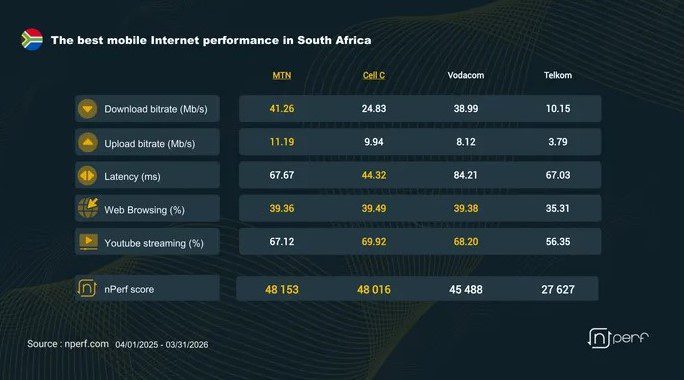
In its methodology, nPerf noted that the findings are based on millions of real-user tests conducted via nPerf’s measurement platform. Results were evaluated based on connectivity across download and upload speeds, latency, browsing, and streaming performance.
With Cell C tied with MTN at the top, the report shows the dynamics of competition in South Africa’s telecoms market and how operators are responding to growing demand for high-quality internet services.
Also Read: Vodacom sells 51,000 refurbished phones as South Africa battles e-waste crisis.
Lessons from Cell C roaming service
Cell C’s resurgence to the podium reveals how a strategic approach can prove decisive.
As part of the restructuring, which began in 2018, Cell C partnered with MTN on a roaming agreement. In the deal, Cell C leverages MTN’s towers for broader 4G coverage (covering 95% of the population).
Later, Cell C enhanced the process and migrated all network traffic to MTN and decommissioned its towers, as part of a three-year strategy. The migration of its network traffic to third-party networks was completed by July 2023.
With the arrangement, MTN operates a virtualized radio access network, allowing Cell C to offer services using its own spectrum.
In addition to MTN, Cell C also secured roaming service deals with Vodacom. In 2021, the telco migrated 1.1 million contract and broadband customers to the Vodacom network. As part of the roaming services, Cell C sold its infrastructure.
With the absence of a physical network to maintain and account for increasing operating expenditure (OPEX), Cell C was able to focus on services and network quality, which have improved significantly over the years.
The current operation to Cell C, leveraging on roaming services, provides a viable strategy to provide quality network service. The latest nPerf report for network quality in the past 12 months is a testament.
Aside from the roaming deal, Cell C’s managerial operation was restructured, a significant move that transitioned the company away from its long-incurred debts.
In the process, Blue Label Telecoms rebranded to Blu Label Unlimited on 3 September 2025. The significant restructuring process also involved the separation of its telecoms and non-telecoms business units.
Blu Label Unlimited has a 53.57% stake in the mobile operator through its subsidiary, The Prepaid Company (TPC).
Cell C currently has a total customer base of around 7.6 million, while the average revenue per user (ARPU) saw a slight decrease in the recent financial report, as a result of a massive 20% increase in data traffic.
T2mobile’s footprint
T2mobile (formerly 9mobile) is another instance of how roaming services are transitioning to alternatives for quality networks.
In its recent effort to transform from a struggling network with significant user losses into a competitive yet customer-centric service provider, the telecom company embarked on various partnerships since its rebirth from 9mobile to T2mobile.
It entered a strategic spectrum lease agreement with MTN Nigeria. The partnership allowed T2mobile to lease MTN’s 5 MHz in the 900 MHz band and 15 MHz in the 1800 MHz band for a period of three years, effective from October 2025.

Since the agreement, T2mobile’s subscribers have improved by 46.7% from 2.7 million in August 2025 to 3.4 million in February 2026. Also, the telco recorded the best network performance in rural areas with a download speed of 24.9 Mbps in Q4 2025.


You May Also Like

The changing face of elder care in Malaysia — Sayed Mohammad Reza Yamani Sayed Umar

Not a loophole: Singapore AI export controls let China tap US AI legally

Exclusive interview with Smokey The Bera, co-founder of Berachain: How the innovative PoL public chain solves the liquidity problem and may be launched in a few months



