👨🏿🚀TechCabal Daily – Crypto vacancies at Kenya’s Central Bank
Wazzup.
I still think about the bust Meta–Manus deal, and find it shocking that something so close to closing, with Manus even saying it was “now part of Meta,” ended the way it did. The Wall Street Journal (WSJ) reported that the Big Tech company rushed to undo the acquisition after it had already integrated Manus’ AI technology shortly after the December deal. Four months later, Meta is staring down an empty barrel.
It’s going to be a long week at Meta, but more importantly, what does the US–China relationship strain mean for businesses looking to operate in China or Chinese companies seeking foreign (read: the US) capital?
That said, this was my favourite tweet of the day. I’m tempted to say, “Don’t be Mark Zuckerberg,” but who am I kidding?
Let’s get into it.
—Emmanuel
- Kenya’s Central Bank is hiring crypto compliance roles
- Canal+ to list on the JSE in June
- Ethiopia-based e-mobility startup Dodai raises $13m
- South Africa delays long-expected public merger
- World Wide Web 3
- Opportunities
Cryptocurrency
Kenya’s Central Bank is hiring crypto compliance roles
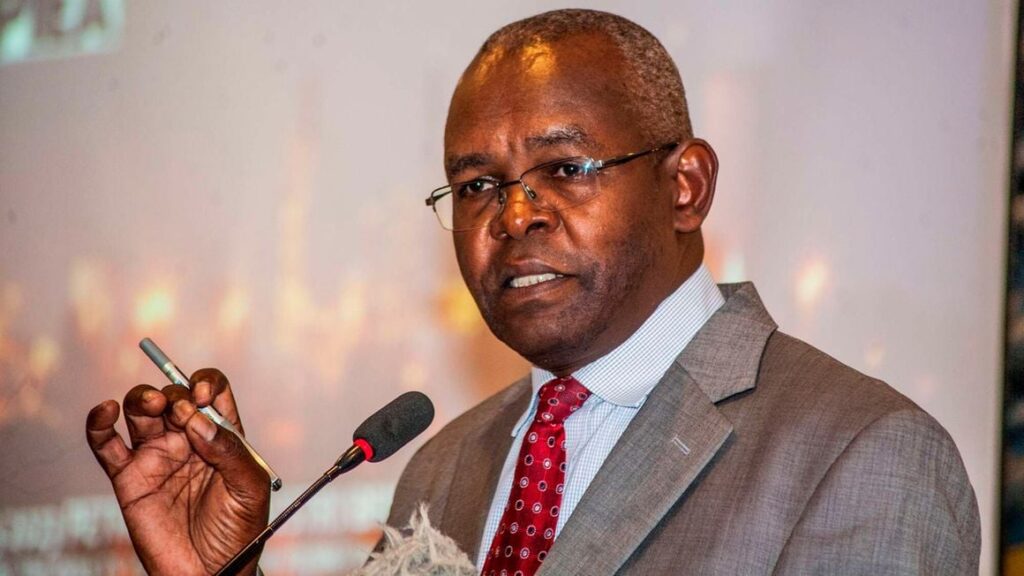 Central Bank of Kenya (CBK) governor Kamau Thugge. Image Source: Business Quest
Are you an experienced virtual asset compliance professional? Are you dogged, patient, not shy to engage irate industry stakeholders who may hold conflicting views on how cryptocurrencies should be treated—or even worse, call you clueless? And aha, the cherry on top: do you have banking and finance experience?
The Central Bank of Kenya (CBK) is hiring for virtual asset licencing and compliance roles as the country expands its move to regulate a sector that has thrived in informality and operated like a financial free-for-all for years. On Monday evening, the regulator opened four roles spanning licencing, product approval, compliance oversight, and regulatory analysis, all within its Digital Payment Services Division.
The timing is doing a lot of heavy lifting. Kenya passed its Virtual Asset Service Providers (VASP) Act in October 2025, but the actual rules that make the law usable are still in limbo. Draft regulations closed for public comment on April 10 and are yet to be gazetted. The CBK, it seems, is staffing up anyway.
Between the lines: This might be the most critical lock-in we’ve seen from a regulator since the crypto regulation fever hit African countries. Build the team first, figure out the rules later.
Yet, there is method to the scramble. Kenya’s crypto activity has long outgrown its experimental phase, driven by remittances, mobile money integrations, and a population comfortable moving money digitally. Oversight now looks less like a choice and more like a catch-up exercise.
Zoom out: Kenya is joining countries like Ghana and Rwanda in pulling crypto into formal oversight, but the pattern is familiar. Laws arrive first, details lag, and regulators are left racing to plug gaps in real time. In the meantime, the CBK is hiring people to enforce a playbook that industry stakeholders are still debating.
20+ Markets. One API.
Fincra connects your business to Africa’s payment rails without building market by market. For collection, payout, FX, and settlement through a single integration. See what this means for your business.
Companies
Canal+, MultiChoice’s new owner, said it will list on South Africa’s stock exchange in June
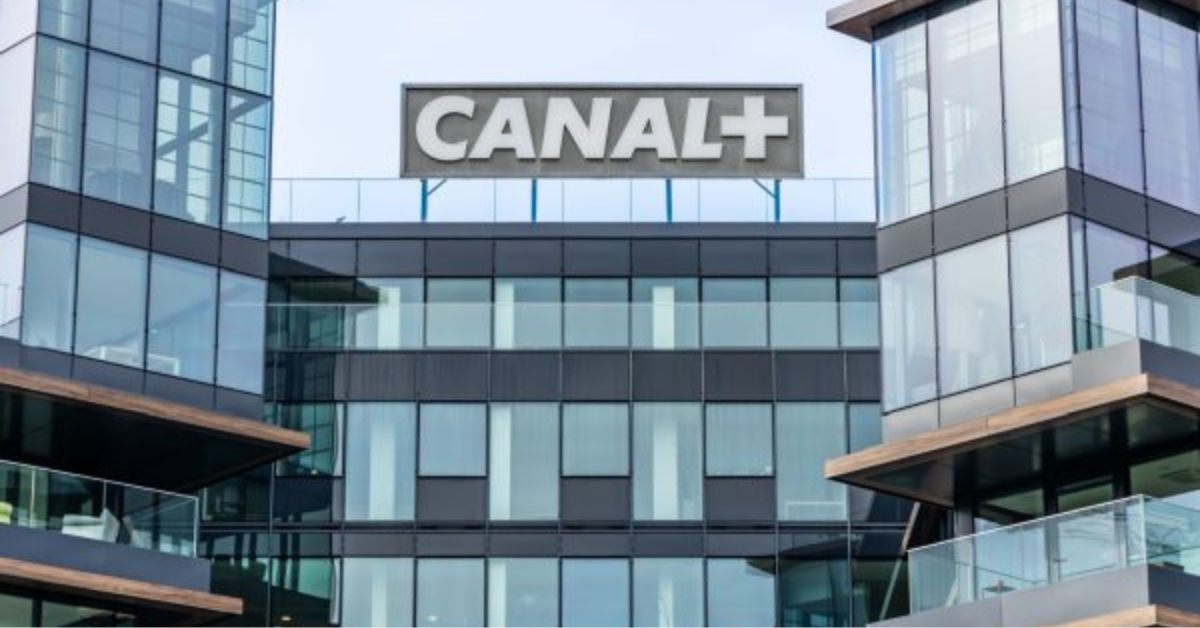 Image Source: CANAL+
MultiChoice stock was delisted from the Johannesburg Stock Exchange (JSE), South Africa’s bourse, in December. If you’ve been waiting to buy shares in the company again, there’s good news: there’s now a date for this; soon, you’ll be able to buy two for one, but as a single company.
Canal+, the French media group that acquired African pay-TV giant MultiChoice in 2025, has said it will list on the JSE on June 3. The company is planning a secondary listing on the local stock exchange, as it is already a public company listed on the London Stock Exchange (LSE). Following its announcement, Canal+’s share price rose by 0.7% on Tuesday to reach GBP 231 ($312).
Listing locally was part of the conditions set by South African regulators when the French media giant acquired MultiChoice.
Canal+ is not raising fresh capital here. The media giant is opting for an inward listing, which does not involve Canal+ issuing new shares or receiving any proceeds, so no fresh capital enters the company. What changes is where the existing shares can be traded. By listing on the JSE, those shares become accessible to South African investors who may have previously been unable or unwilling to buy on a foreign exchange.
This improves liquidity because it expands the pool of potential buyers and sellers for Canal+’s stock. More participants in the market generally means shares can be bought or sold more easily without significantly moving the price. Think of it less as Canal+ going to the market to raise money and more as Canal+ making its existing shares easier to reach for a new set of investors.
It exposes Canal+ to a broader set of investors, giving it a more liquid market for its shares.
Why this matters: Owning MultiChoice gives Canal+ distribution power across the continent and a massive subscriber base. Listing locally deepens that presence and signals commitment. Instead of being a foreign owner operating from afar, Canal+ is showing that it is present and can be accessed by locals.
However, a JSE listing comes with more public scrutiny of its operations and how it is running its African strategy for Multichoice. With its imminent April 30 shutdown of MultiChoice’s streaming arm, Showmax, and planned voluntary staff layoffs, Canal+ is posturing as an operationally ruthless company that still wants to appeal to the investing public.
The Safe and Reliable Banking App

With over 35 million users and a 99.9% transaction success rate, PalmPay is making digital banking safer, simpler, and more reliable for everyday Nigerians. Download the app to learn more.
Mobility
Dodai, an Ethiopia-based e-mobility startup, raises $13 million in Series A round
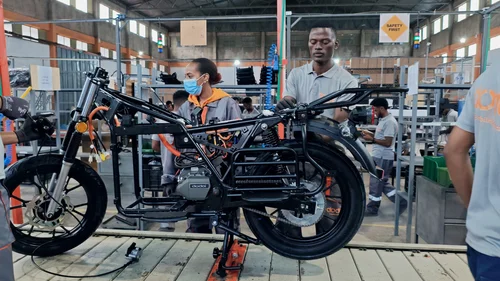 Image Source: Dodai
Africa’s e-mobility battle is no longer about the bike. It’s about who owns the network.
E-mobility players, including Roam and Ampersand, are increasingly focusing on expanding their battery-swapping networks to unlock scale.
Dodai, an Ethiopia-based electric motorbike startup, has raised $13 million to scale battery-swapping infrastructure across Addis Ababa. The round—$8 million equity, $5 million debt—includes backing from British International Investment (BII) and a cluster of Japanese investors: UTokyo Innovation Platform, Nagase, and CBC Co.
The investor mix is worth noting. Japanese capital is financing the buildout. Chinese hardware—battery cells, motors, controllers—is likely running underneath it. Africa’s EV value chain is increasingly bifurcated this way: foreign investors provide the risk capital, foreign manufacturers supply the components, and local startups like Dodai navigate the gap. Local assembly is not the same as local manufacturing, and the distinction matters when asking who actually captures long-term value.
What Ethiopia provides, uniquely, is policy certainty. A 2024 ban on private internal combustion engine (ICE) vehicle imports—later extended to trucks—has put roughly 100,000 EVs on its roads. That removes the adoption problem most e-mobility startups spend years trying to solve elsewhere. It also makes battery-swapping infrastructure essential rather than experimental. When riders can’t fall back on petrol, a depleted battery becomes a business emergency. Dodai’s network becomes critical infrastructure, not a convenience feature.
But the capital math is uncomfortable. Dodai plans 1,000 battery-swapping stations across Addis Ababa within three years. At conservative estimates of $112,000 per station, according to The Conversation, that’s $112 million in infrastructure spend. When you view it from that lens, the $13 million looks like a down payment, not a destination.
Yet, Dodai is betting on a philosophy: Scale fast enough, and you don’t just serve the market—you set the terms for how it runs. With its plan to deepen its Ethiopia play, it is moving first and wide before most other e-mobility operators catch up on the opportunity that exists in the market. But getting there will require multiples of what’s been raised.
TECHCABAL 4.0
In March 2013, TechCabal published its first article. Thousands of stories later, the work continues, and today, it goes deeper.
TechCabal has always been free. That’s not changing.
We’ve opened a new layer. Reporting that goes further, built on sources you won’t find anywhere else, and told in ways we haven’t tried before. You’re among the first to see it.
Getting in takes less than 15 seconds.
You’re one step away from the other side.
Click the button below to see what TechCabal 4.0 looks like and what it means for you.
M&A
South Africa delays Broadband Infraco–Sentech merger again
 Image Source: Zikoko Memes
It’s been a decade since this merger was first teased; you’d think this is an unending soap opera—and an unpleasant one with bad writing.
In 2017, South Africa’s cabinet approved the merger between state-owned signal distributor Sentech and Broadband Infraco (BBI), a state-owned fibre wholesaler, to form a new entity, the State Digital Infrastructure Company (SDIC).
The merger was meant to combine both companies into one stronger entity to avoid duplication in state-led infrastructure development and build a national infrastructure that could support South Africa’s digital ambitions.
Then it started slipping: Both BBI and Sentech have struggled in different ways. BBI has recorded consecutive losses since 2019, lost two key public sector contracts, and is insolvent. Its own CEO admitted it’s “a miracle” the company has survived without a government bailout.
Sentech isn’t thriving either. Traditional broadcasting, including pay-TV, is losing customers and becoming less relevant in a world moving toward streaming and digital platforms, which the country’s communications regulator has signalled plans to investigate such platforms. The worrying performance of both Sentech and BBI has stalled merger plans multiple times. South Africa’s regulators have promised (and failed) to deliver advanced-stage development plans, and the latest delay suggests that something is amiss.
The merger was pushed back again: In its performance plan for the 2026/2027 fiscal year, South Africa’s Department of Communications and Digital Technologies (DCDT) delivered the gut-wrenching news. The broadcasting regulator said the merger timeline has now been pushed back to the 2028/2029 fiscal year with a phased completion approach, restarting the entire due diligence process and extending the drawn-out deal to twelve years.
Why this matters: Sentech and BBI sit at the core of South Africa’s broadcasting and telecom infrastructure. The continuous delays with this merger affect fibre rollout, connectivity costs, how infrastructure is used, and how quickly the country can scale digital services.
CRYPTO TRACKER
The World Wide Web3
Source:

|
Coin Name |
Current Value |
Day |
Month |
|---|---|---|---|
| Bitcoin | $77,216 |
+ 0.45% |
+ 14.40% |
| Ether | $2,325 |
+ 1.59% |
+ 13.43% |
| Fluent | $0.1988 |
+ 120.76% |
+ 4.95% |
| Solana | $84.85 |
+ 0.70% |
+ 1.48% |
* Data as of 06.45 AM WAT, April 29, 2026.
Opportunities
- The Stellar Development Foundation has launched its first accelerator programme targeting Europe, the Middle East, and Africa, partnering with blockchain venture firm CV Labs to back ten early-stage startups building payments infrastructure, tokenised assets, and decentralised finance applications. The 12-week programme, beginning August 2026, will run primarily remotely but includes an on-site component in Cape Town and concludes with a demo day at Stellar’s Meridian conference in Lisbon in October. Each selected startup can receive up to $150,000 in XLM, Stellar’s native token, in initial funding. Apply by July.
- The Future Investment Initiative Institute (FII), in partnership with MIT Solve, has launched the 2026 FII Innovators Pitch, inviting startups building with AI and frontier technologies to apply. The programme targets solutions across sustainability, healthcare, AI & robotics, and education. Selected startups will pitch live at the 10th Future Investment Initiative in Riyadh, Saudi Arabia, this October (all expenses covered) and join the FII Ventures Programme, gaining access to investors, policymakers, and global partners to support their growth. Apply here.
- Google and UpSkill Universe have partnered to relaunch Hustle Academy, now offering free AI and business training to individuals and small businesses across Africa. The programme features 60-minute expert-led webinars and 1-day bootcamps (3–5 hours), covering digital marketing, e-commerce, business strategy, financial management, and AI tools. Open to students, jobseekers, entrepreneurs, and past applicants, it provides practical, hands-on skills that can be immediately applied to grow careers or businesses. Apply here.
- Applications are open for ClimateLaunchpad, the world’s largest green business ideas competition run by Climate-KIC. The programme helps early-stage climate founders turn rough ideas into viable startups through training, mentorship, and pitch competitions. Entrepreneurs from around the world, including Africa, can apply for the 2026 cohort and compete for up to €10,000 in prize money and access to a global cleantech network. Apply here.
- Google for Startups: Africa, a three-month hybrid accelerator for growth-stage startups on the continent, is now accepting applications. The accelerator will provides equity-free support for the duration of the programme, mentorship, training, cloud credits, and access to Google’s AI products designed to bring the best of its programmes, products, people, and technology to communities across Africa. Apply here.
- Francophone Weekly: This AI doctor answers the hardest questions women ask
- Rack Centre to train engineers as Nigeria’s data centre talent shortage grows
- Elon Musk appeared more petty than prepared
Written by: Emmanuel Nwosu and Opeyemi Kareem
Edited by: Emmanuel Nwosu and Ganiu Oloruntade
Want more of TechCabal?
Sign up for our insightful newsletters on the business and economy of tech in Africa.
- The Next Wave: futuristic analysis of the business of tech in Africa.
- Francophone Weekly by TechCabal: insider insights and analysis of Francophone’s tech ecosystem
P:S If you’re often missing TC Daily in your inbox, check your Promotions folder and move any edition of TC Daily from “Promotions” to your “Main” or “Primary” folder and TC Daily will always come to you.



You May Also Like

Stablecoin yield negotiations are pretty much done, Coinbase CLO Grewal says

France’s tokenized stock exchange Lise poised for first onchain IPO in Europe