The end of Showmax: a timeline of growth, struggle and death
After 11 years of bold ambition and great resilience, Showmax has finally shut down on Thursday, April 30, 2026, at 11:59 pm.
According to a statement by Canal+, the decision followed a strategic review by MultiChoice, after it suffered mounting losses and rising costs of competing in a global streaming war, which has ultimately proved unbearable.
“This decision was made by the Showmax Board of Directors and reflects the continued focus of MultiChoice, a CANAL+ Company, on financial discipline and investment optimisation, in an increasingly competitive and capital-intensive global streaming environment. The substantial annual losses experienced by the Showmax business have proved unsustainable. The decision to phase out Showmax reflects our focus on building a sustainable, competitive business for the long term in an increasingly demanding global streaming environment,” the statement said.
Showmax’s closure comes two years after Amazon MGM Studios shocked Nigeria and South Africa’s creative community in January 2024 when it announced that it would stop commissioning any new local original content in Africa, and also ended already-existing development deals with a dozen production companies.
Despite the closure, MultiChoice said no job losses would result from the move, noting that existing agreements tied to the Canal+ acquisition prevent staff retrenchment for a specified period.
It also added in emails sent to subscribers that Showmax’s content will migrate to DStv Stream and MultiChoice’s streaming platform for satellite TV subscribers. This means that the streaming platform’s Originals and exclusive content will still be available, but integrated into the DStv ecosystem rather than as a standalone streaming service.
MultiChoice has already started to quietly rebrand Showmax Originals as Africa Magic, M-Net, kykNET and Mzansi Magic Originals, with original series that will transition to these various DStv linear TV channels on the MultiChoice pay-TV platform.
But the story of Showmax is bigger than its ending.
Launched on August 19, 2015, by MultiChoice and backed by Napers, Showmax entered a market many believed wasn’t ready. On this day, Multichoice – a South African pay-television giant – launched Showmax in South Africa, making it the continent’s first homegrown subscription video-on-demand streaming service.
The timing was deliberate. Showmax arrived at a time when the idea of streaming in Africa still felt premature. Internet access was inconsistent, data was expensive, and digital payments were far from seamless.
However, the conviction behind the establishment was that African audiences were ready not just to consume global content, but to see their own stories reflected back to them on a platform built for them.
Read also: Showmax overtakes Netflix as Africa’s biggest streaming platform with 39% share
 Showmax
A timeline of growth
Rather than simply imitating global streaming giants, Showmax was engineered for the continent’s unique technical landscape. It became the first streaming service in Africa to offer mobile downloads for offline viewing.
It also introduced adaptive bitrate streaming and advanced video compression so that subscribers in areas with slower internet connections could still watch without constant buffering.
Payment was another frontier. International platforms required credit cards and global payment methods that most Africans lacked. Showmax solved this by integrating directly with DStv billing, mobile carriers, and retail partnerships, making subscriptions accessible to a far wider demographic.
By December 2015, just four months after launch, Showmax had already expanded to audiences in Europe, Oceania, and North America. By May 2016, it had expanded to 36 additional African countries, bringing its total footprint to 65 countries and over 10 million total views.
In 2020, it launched Showmax Pro in Nigeria and Kenya, bringing live sports into the mix with more than 450 million smartphone users and 250 million football fans representing a significant untapped market. Football became a major driver of engagement, with the platform streaming major tournaments like the 2022 FIFA World Cup and attracting record viewership during key matches.
By November 2023, Showmax reached a major milestone by surpassing Netflix in Africa with about 2.1 million subscribers. It became the most-subscribed streaming platform on the continent, compared to Netflix’s 2.8 million users at the time.
That same year, MultiChoice partnered with NBCUniversal and Sky UK to relaunch the platform in 2024. The new version came with a redesigned app, better recommendations, and a stronger focus on African original content. It also introduced a mobile plan for Premier League matches, making live football more accessible.
The response was strong at first. Subscriber numbers grew by 50% in the months following the relaunch. The platform also picked up industry recognition, including wins at the National Film and TV Awards South Africa and multiple nominations at the Africa Magic Viewers’ Choice Awards.
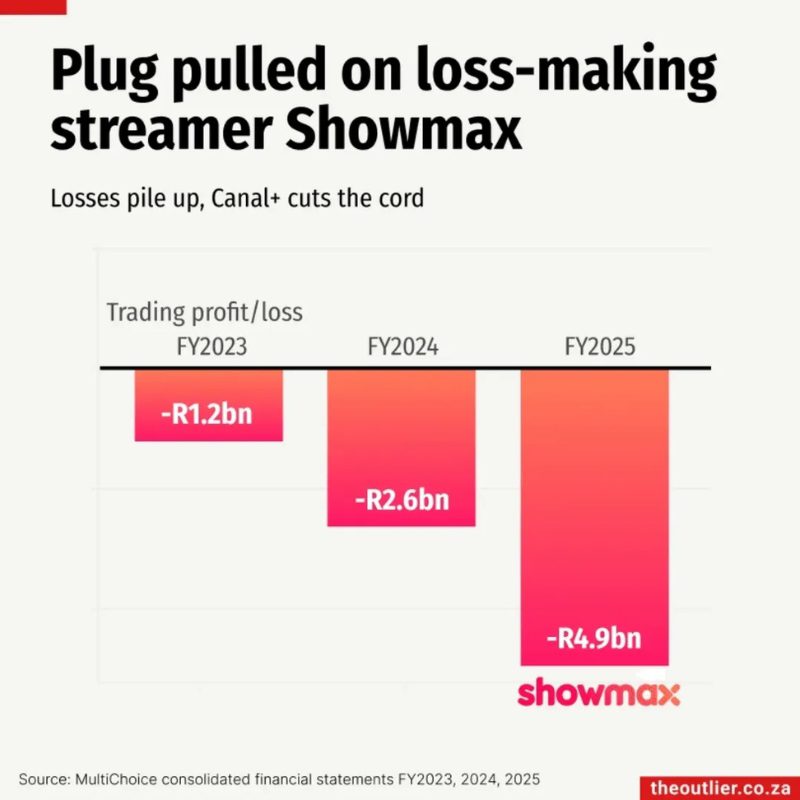 Source: Outlier Africa
Major challenges that Showmax faced
Throughout its existence, Showmax grappled with the African market’s structurally difficult relationship with paid digital content. Piracy remained a pervasive challenge across Nigeria, Kenya, and South Africa.
The platform also contended with high mobile data costs in most of its markets, which depressed streaming hours and increased subscriber churn.
In 2023, the streaming giant experienced a data breach, which was revealed in a report from MyBroadBand. More than 27,000 Showmax account usernames and passwords were exposed online.
As reported by Technext, a thorough analysis of the leaked file indicates that it consists of 27,911 lines, with each line containing an email address serving as a username. However, it is worth noting that the initial 100 or so lines appear to contain incomplete or truncated records.
Amidst all of these, Showmax also experienced significant leadership turbulence in its later years. CEO Yolisa Phahle stepped down in September 2023, just months before the pivotal NBCUniversal-backed relaunch. Marc Jury was appointed as interim CEO, but then announced his own resignation in November 2024 — barely nine months after the relaunch went live.
The 2024 relaunch of an investment of $177 million was meant to change everything. It was backed by NBCUniversal and came with big plans for growth. Showmax also had a dream to reach $1 billion in annual revenue by 2028, which would require millions of active subscribers.
However, things did not go as expected. Many users joined the platform but did not stay for long. Economic conditions also played a role, especially in Nigeria, where rising inflation and currency challenges made subscriptions harder to sustain.
At the same time, the company was spending heavily on technology, content, and marketing. Losses increased from R2.6 billion in 2024 to R4.9 billion in 2025. Over three years, the business lost more than $500 million, while revenue declined.
Another setback came in January 2026, when Warner Bros. Discovery ended its licensing agreement with Showmax. This meant that HBO content and other popular titles were removed from the platform at a time when it needed strong content to retain users.
All of these challenges added up over time and made it difficult for the platform to keep going.

The end of Showmax
For 11 years, Showmax proved that African stories, when told in African languages, set in African cities, drawing on African experiences, could command massive, loyal audiences.
Its closure is part of a wider crisis gripping the streaming industry globally. The capital-intensive model has run into a wall and has left a void in the hearts of its users.
Showmax served 44 countries and had become the primary commissioning platform for African original content at scale. Subscribers now face an unwelcome forced migration to DStv Stream, where Showmax Originals will eventually be hosted, but at significantly higher price points.
A streaming-only DStv Compact subscription costs roughly $17.77/month, compared to Showmax Entertainment’s $5.88/month. This is a more than threefold price increase for access to equivalent local content. Premier League mobile subscribers, who paid $5.88/month on Showmax, now face particular disruption.
The human cost extends well beyond subscriptions. Filmmakers and actors across South Africa, Kenya, and Nigeria who had relied on Showmax as a primary commissioning partner have expressed urgent uncertainty about the future of local productions.
Creators who had built entire careers around Showmax’s Originals pipeline must now seek out platforms that, in most cases, are less committed to local African storytelling.
Showmax's story is not a simple tale of failure. It is a deeply African story about ambition, ingenuity, cultural pride, and the brutal economics of trying to build a world-class streaming platform from the Global South.
Read also: Showmax to shut down permanently on April 1 as content migrates to DStv Stream


You May Also Like

XRP Leverage Drops to Zero: 6x Rally Signal?

Ripple Prime Just Won Best Prime Broker: The Institution Era for XRP Is Here