

Bitcoin Key Stakeholders Are Loading Up Again
On April 23, 2026, Bitcoin sat at roughly $78,300 after the broader crypto market cap posted a solid +15% gain for the month. Social sentiment had flipped hard: from extreme pessimism earlier in the week (when an $80K rejection sparked brief FUD) to ultra FOMO mode by Thursday. Traders were “licking their chops” for a breakout above $80K.
At the exact same time, Santiment dropped two interlocking insights that turned raw holder data into a high-conviction “smart money vs. crowd” framework:
- Key Stakeholders Adding Bitcoin Like It’s 2024 Again!
10–10K BTC wallets (the cohort Santiment flags as “key stakeholders”) collectively added 40,967 BTC in the prior two weeks (+0.3% of their holdings). Even micro-wallets (<0.01 BTC) showed modest accumulation (+46 BTC, +0.1%). - FOMO is Back With Traders Licking Their Chops For $80K+ Bitcoin Once Again!
The crowd swung from bearish despair to extreme bullishness in just days. Santiment’s social metrics showed FOMO climbing to levels not seen since late 2025.
And the Weekly Anomaly Report for W4 April 2026 recorded 149 total trigger events across six active anomaly signals—clear evidence that something unusual was unfolding on-chain and in social data.
This is not just another “whales are buying” headline. It is a textbook illustration of how on-chain accumulation by experienced holders can coexist with retail euphoria—and why that combination has historically preceded major moves. In this deep dive we unpack the mechanics, historical parallels, real-world implications, risks, and forward-looking signals so you can read these moments with clarity rather than chase price action.
What “Key Stakeholders” Actually Mean: On-Chain 101
On-chain analysis examines blockchain transaction data in real time to infer behavior without relying on self-reported exchange flows or price charts alone. Santiment tracks dozens of address cohorts by balance size because wallet size often correlates with investor sophistication:
- Key stakeholders (10–10K BTC wallets): These are large but not mega-whale addresses. They include early miners, long-term holders, institutions that self-custody, and sophisticated funds. Their net accumulation is one of the strongest bullish signals Santiment monitors because these players tend to buy during dips and hold through volatility.
- Micro stakeholders (<0.01 BTC wallets): Retail “dust” holders—everyday users, new entrants, or small speculators. When they accumulate aggressively it often signals late-cycle FOMO.
The April 23 data was crystal clear: key stakeholders were net buyers while micro-wallets showed only token accumulation. Santiment’s own chart (linked in the original insight) visualizes this divergence perfectly.
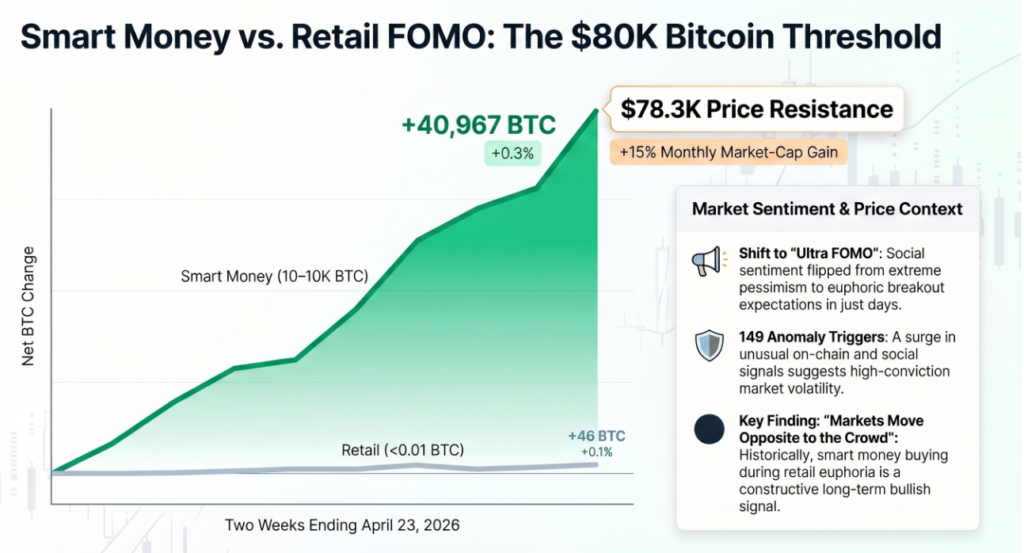 Bitcoin smart-money accumulation vs retail as of April 23, 2026.
Historical Parallels: 2024 Redux?
The headline “Like It’s 2024 Again” was deliberate. In 2024, similar accumulation phases by the same 10–10K cohort preceded strong rallies even as retail sentiment lagged. Fast-forward to 2026: the post-halving environment, institutional infrastructure (ETFs, corporate treasuries), and global macro backdrop (persistent inflation in emerging markets) echo that setup.
Recall the 2021 cycle for contrast:
- Late 2020–early 2021: Key stakeholders accumulated aggressively → price broke all-time highs.
- Q2 2021: Whales began distributing while retail piled in → classic top signal.
The April 23, 2026 snapshot showed the opposite of 2021’s distribution phase. Smart money was still buying; retail was only beginning to chase. That alignment is rare and historically constructive.
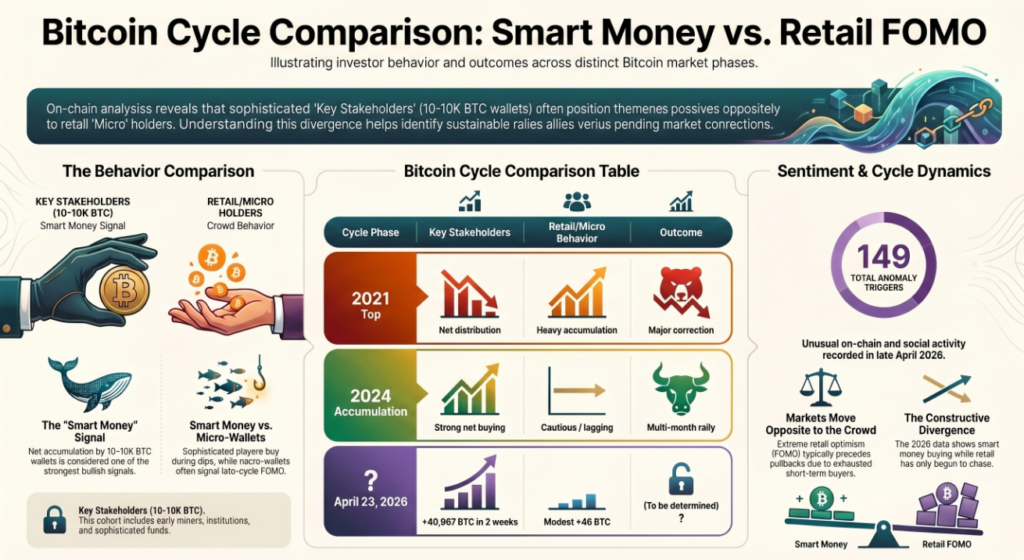 Bitcoin Cycle Comparison Table
| Cycle Phase | Key Stakeholders (10-10K BTC) | Retail/Micro Behavior | Outcome |
|---|---|---|---|
| 2021 Top | Net distribution | Heavy accumulation | Major correction |
| 2024 Accumulation | Strong net buying | Cautious / lagging | Multi-month rally |
| April 23, 2026 | +40,967 BTC in 2 weeks | Modest +46 BTC | ? (to be determined) |
The Sentiment Flip: Why FOMO Is a Caution Signal
Santiment’s social-volume and FOMO gauges are not vibes—they are quantifiable. The April 23 insight captured a textbook swing: Monday’s $80K rejection triggered FUD and liquidations; by Thursday the same crowd was euphoric. Santiment explicitly noted: “Markets move opposite to the crowd’s expectations.”
This is not new. Extreme crowd optimism has preceded pullbacks in every major cycle because it coincides with exhausted short-term buyers and profit-taking by early entrants. The ideal setup Santiment highlights is continued smart-money accumulation plus retail beginning to take profit—exactly the scenario the key-stakeholder insight flagged as “one of the strongest signals for a long-term bull run.”
Real-World Case Studies: When Accumulation + Sentiment Divergence Worked (and When It Didn’t)
Bullish precedent – 2024: Santiment repeatedly showed 10-10K wallets loading up while social volume remained subdued. Bitcoin climbed from sub-$60K ranges into six-figure territory later that year.
Cautionary precedent – late 2021: Retail FOMO metrics hit extremes while whale sell pressure emerged. The result was a painful 70%+ drawdown.
Emerging-market angle (relevant for readers in Argentina and similar economies): In high-inflation environments, Bitcoin’s role as a non-sovereign store of value amplifies these signals. When local currencies lose purchasing power rapidly, on-chain data showing global smart-money accumulation often precedes adoption spikes—precisely because those same stakeholders are positioning for long-term scarcity. The April 23 data, viewed through that lens, reinforced Bitcoin’s appeal as a hedge even as retail FOMO risked short-term over-optimism.
Challenges and Risks: On-Chain Data Is Powerful But Not Perfect
No metric is infallible. Key limitations include:
- Exchange obfuscation — Large transfers to or from centralized platforms can mask true intent.
- Wallet clustering — Some “key stakeholder” addresses may belong to the same entity.
- Short-term noise — The 149 anomaly triggers included social-dominance spikes around unrelated events (e.g., Aave fallout from the KelpDAO exploit). Not every anomaly equals a Bitcoin-specific move.
- Macro overrides — Geopolitical shocks, regulatory surprises, or liquidity crunches can overwhelm even the cleanest on-chain setup.
Retail readers should treat these signals as one high-conviction data point within a broader toolkit—not a crystal ball.
Future Outlook: Breakout Fuel or Trap?
As of early May 2026, Bitcoin continues to hover in the $77K–$78K zone—still teasing $80K but without a decisive breakout. The April 23 confluence remains relevant: if key stakeholders keep accumulating and retail profit-taking materializes (reducing euphoria), the setup favors continuation of the 2026 bull phase. A clean breach of $80K with moderating FOMO would be the textbook confirmation.
Conversely, if micro-wallet accumulation accelerates while key stakeholders pause, history suggests caution. The 149-anomaly week already showed elevated activity; sustained high triggers without corresponding price resolution often precede consolidation or sharp reversals.
Key Takeaways (actionable checklist)
- Monitor Santiment’s key vs. micro stakeholder chart weekly.
- Watch for divergence: smart-money buying + retail FOMO = constructive but requires calm optimism to sustain.
- Use on-chain data with price action and macro context—never in isolation.
- In high-inflation regions, treat accumulation phases as long-term positioning signals rather than short-term trade triggers.
Reading the Market Like the Smart Money
The April 23, 2026 Santiment double-feature—key stakeholders loading up while crowd FOMO hit ultra mode—distilled months of cycle analysis into one high-signal day. It reminded us that Bitcoin’s most reliable moves often happen when experienced holders accumulate quietly and the broader public is still catching up (or getting carried away).
Whether this becomes the spark for the 2026 rally many have waited for depends on what happens next: continued accumulation, measured retail participation, and a healthy dose of skepticism toward $80K euphoria. The data gives us the framework. The market will deliver the verdict.
Ready to level up your crypto understanding?
Subscribe to Cryptopress.site for more evergreen deep dives on on-chain analysis, Bitcoin mechanics, and timeless investing principles.
Your next move isn’t chasing price—it’s understanding the players behind it.
The post Bitcoin Key Stakeholders Are Loading Up Again appeared first on Cryptopress.


You May Also Like

Sui Perps Exploit Victims Get a Sheet, A Warning, and a Monday Deadline

Whale Bets Big $90M 20x Long on Bitcoin and Ethereum




