What Drift, Kelp DAO and Hyperbridge $600 million crypto hacks reveal about Web3 security
March seemed to be a triumphant moment for decentralised finance, as first-quarter data revealed a nearly 90% year-on-year decrease in smart contract vulnerabilities. We believed that DeFi had finally matured, moving beyond the chaotic smash-and-grabs of previous cycles. However, April violently corrected that optimism.
In less than three weeks, the crypto sector sustained a historic beating, logging its worst month on record. We watched over $600 million evaporate across a relentless string of exploits, a massive spike that dwarfed the entire first quarter.
According to data from the blockchain security firm Hacken’s Q1 2026 Blockchain Security & Compliance Report, Web3 projects lost a total of $482.6 million to crypto hacks and scams across 44 incidents in Q1, mostly driven by phishing and social engineering. April, by contrast, felt like a coordinated dismantling of Web3’s structural integrity.
The sheer density of the attacks was dizzying. Within an 18-day window, attackers picked off protocols one by one: ZetaBridge ($8.1 million), PulseVault ($3.4 million), AeroSwap ($1.7 million), NodeFi ($2.3 million), and LendHub v3 ($1.2 million).
Mid-month brought no relief. CrestDAO lost $4.8 million to a governance exploit, SolPay Bridge and VaultX were compromised, BridgeNet leaked validator keys for a $3.5 million hit, and StakePool Pro collapsed under a withdrawal logic bug.
 Hackers stole over $600 million from crypto hacks in April
But the true scale of the crisis was defined by the heavyweights. On 1 April, Drift Protocol, Solana’s premier perpetual futures exchange, lost $285 million to the notorious North Korean syndicates who spent months socially engineering Drift employees to bypass multi-signature security controls entirely.
Just over two weeks later, Kelp DAO lost $292 million. Attackers compromised a single-verifier configuration on its rsETH cross-chain bridge, bypassing validation checks to syphon off funds.
Then came the bizarre, quiet disasters like Hyperbridge. On 13 April, a hacker found a loophole in the Ethereum gateway contract used by the Polkadot bridge. By forging verification proofs, they minted one billion DOT tokens out of thin air.
While the counterfeit stash had a paper value of $1.2 billion, zero liquidity meant the attacker could only initially fence about $237,000 worth of Ether, but the company revised the value to $2.5 Million. Days later, Volo’s liquid staking vaults took a $3.5 million hit.
$600m ‘Drift’ hackss: The dark side of ‘Money Legos’
When you stack these incidents side-by-side, the narrative shifts. This is not merely a series of unfortunate events. It is a fundamental stress test of the very mechanics that make DeFi work. According to Diego Martin, CEO of Yellow Capital, the chaos of April is a symptom of a much larger architectural problem.
 Diego Martin, CEO of Yellow Capital
Martin explains, “The recent Volo, Drift, and Kelp DAO exploits are indicative of the industry’s transition from experimentation to critical infrastructure.” “Compromises are growing because the composability of Web3 is outpacing its security infrastructure. We are layering complex, yield-bearing assets across fragmented chains, creating operational bottlenecks in which human error and centralised verifiers become the weakest links.”
He is pointing directly at the “money legos” concept that Web3 heavily promotes. When protocols interlock so tightly, a compromised bridge or a flawed multi-sig setup doesn’t just damage one project; it triggers a cascading failure.
The stakes are higher now because the ecosystem is shedding its renegade origins.
“DeFi is also quietly mimicking an investment bank model, where market makers and infrastructure providers are not just anonymous liquidity sources but also reputational partners behind a project,” Martin notes. “That shift means a compromised protocol is no longer just a technical failure but also a reputational one that affects the whole ecosystem associated with it.”
This is exactly why the Drift and Kelp DAO hacks hit so hard. The institutions waiting on the sidelines to deploy capital are no longer impressed by high yields if the operational security underneath them is brittle.
A reputational hit to a major market maker or liquidity provider can freeze capital flows for months.
 Hackers stole over $600 million from crypto hacks in April
If April proved anything, it is that robust code is useless if the operational security surrounding it is weak. As the sector picks up the pieces, developers have to accept that we cannot secure billions of dollars with 1-of-1 bridge verifiers or human-managed keys susceptible to social engineering.
“Institutions need infrastructure that prioritises capital protection over rapid deployment,” Martin warns. “The firms that thrive in the next cycle will be those that treat treasury and security as survival functions, building enough resilience to operate through bad market conditions without compromising their users. As developers solve these structural friction points, we will see a new wave of reliable networks capable of handling trillions of dollars in real-world assets.”
April 2026 was a bloodbath, undoubtedly, but if the industry actually listens to operators like Martin, it might just be the exact catalyst DeFi needs to build infrastructure capable of surviving the real world.
You May Also Like
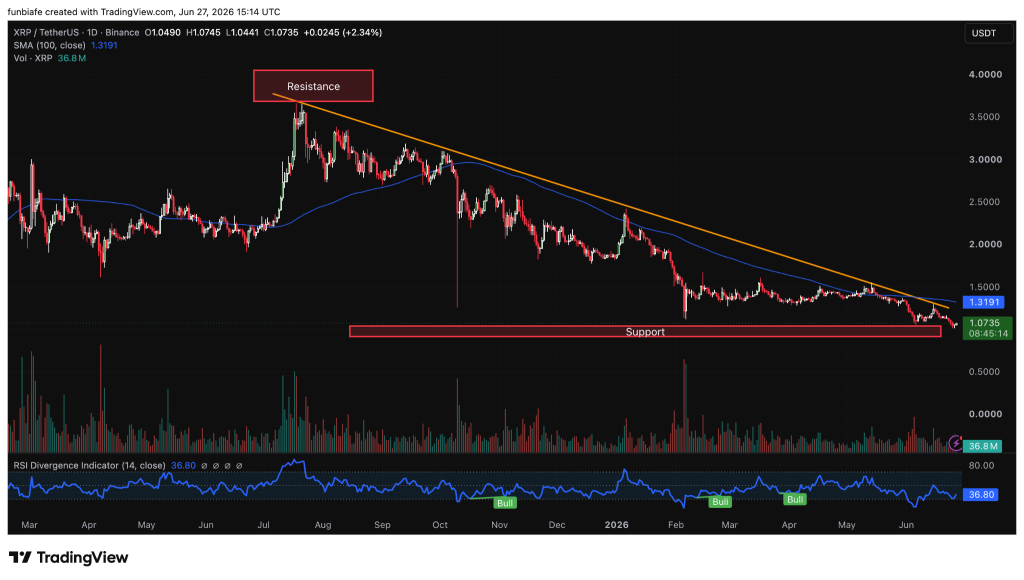
What Happens to the XRP Price if the Crypto Bear Market Gets Worse?

The Manchester City Donnarumma Doubters Have Missed Something Huge

Solana SOL Reclaims $72, But Fading On-Chain Metrics Signal Weakening DEX Momentum