BitcoinWorld Asian Markets Slide as Middle East Tensions Rattle Investors Asian stock markets opened sharply lower on Monday, extending a global sell-off as escalatingBitcoinWorld Asian Markets Slide as Middle East Tensions Rattle Investors Asian stock markets opened sharply lower on Monday, extending a global sell-off as escalating

Asian Markets Slide as Middle East Tensions Rattle Investors
2026/05/08 12:55
3 min read
For feedback or concerns regarding this content, please contact us at [email protected]
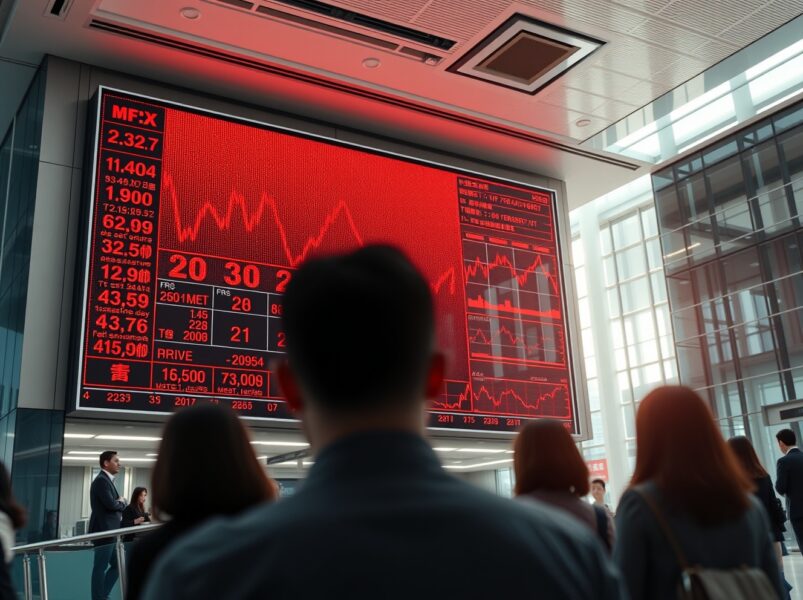
Stock market display board showing red numbers in an Asian financial district

BitcoinWorld

Asian Markets Slide as Middle East Tensions Rattle Investors

Asian stock markets opened sharply lower on Monday, extending a global sell-off as escalating geopolitical tensions in the Middle East fueled investor anxiety. Benchmarks across Japan, South Korea, China, and Hong Kong posted significant declines in early trading, reflecting a broad risk-off sentiment.

Geopolitical jitters drive market sell-off

The renewed uncertainty stems from the latest developments in the Middle East, where diplomatic efforts have stalled and military activity has intensified over the weekend. The lack of a clear resolution has prompted investors to reassess risk exposure, particularly in equities and currencies sensitive to energy price volatility.

Japan’s Nikkei 225 fell more than 2% in morning trade, while South Korea’s KOSPI dropped 1.8%. Hong Kong’s Hang Seng Index also slipped, losing 1.5% as tech and energy shares led the decline. China’s Shanghai Composite edged lower by 1.2%, weighed down by concerns over global supply chain disruptions.

Oil prices surge on supply fears

Crude oil prices jumped more than 3% in early Asian trading, adding to last week’s gains. Brent crude climbed above $78 per barrel, while West Texas Intermediate (WTI) rose to $74. The spike reflects fears that the conflict could disrupt shipments through key chokepoints in the region, including the Strait of Hormuz, through which about 20% of the world’s oil passes.

Higher oil prices are a double-edged sword for Asian economies. While energy exporters like Malaysia and Indonesia may benefit from increased revenue, import-dependent nations such as India, Japan, and South Korea face rising costs that could squeeze corporate margins and slow economic growth.

What this means for investors

The current environment underscores the fragility of global markets when geopolitical risks escalate. For Asian investors, the immediate concern is whether the conflict will broaden or de-escalate in the coming weeks. Analysts suggest that a prolonged standoff could lead to sustained volatility, particularly in sectors tied to energy, shipping, and defense.

Safe-haven assets, including gold and the US dollar, have gained traction. Gold prices rose 0.8% to $2,050 per ounce, while the dollar index strengthened against Asian currencies, adding pressure on emerging market equities.

Conclusion

The slump in Asian stock markets reflects a market recalibrating to heightened geopolitical risk. While the immediate sell-off may present buying opportunities for long-term investors, the path ahead remains uncertain. Market participants will closely monitor diplomatic developments and any signs of escalation that could further disrupt global trade and energy markets.

FAQs

Q1: Why are Asian markets falling?
Asian markets are declining due to renewed uncertainty over Middle East conflicts, which has triggered a broad risk-off sentiment among investors worried about energy supply disruptions and economic instability.

Q2: How does the Middle East conflict affect oil prices?
The conflict raises fears of supply disruptions through key shipping routes like the Strait of Hormuz, causing crude oil prices to spike. Higher oil costs impact import-dependent Asian economies and can slow growth.

Q3: What should investors do during geopolitical uncertainty?
Investors should focus on diversification, consider safe-haven assets like gold or bonds, and avoid panic selling. Staying informed on diplomatic developments and maintaining a long-term perspective is key.

This post Asian Markets Slide as Middle East Tensions Rattle Investors first appeared on BitcoinWorld.


Disclaimer: The articles reposted on this site are sourced from public platforms and are provided for informational purposes only. They do not necessarily reflect the views of MEXC. All rights remain with the original authors. If you believe any content infringes on third-party rights, please contact [email protected] for removal. MEXC makes no guarantees regarding the accuracy, completeness, or timeliness of the content and is not responsible for any actions taken based on the information provided. The content does not constitute financial, legal, or other professional advice, nor should it be considered a recommendation or endorsement by MEXC.

You May Also Like

Michael Saylor’s Strategy Buys $2,010,000 Worth of Bitcoin in One of the Firm’s Largest Acquisitions Ever

Michael Saylor’s Strategy Buys $2,010,000 Worth of Bitcoin in One of the Firm’s Largest Acquisitions Ever

The post Michael Saylor’s Strategy Buys $2,010,000 Worth of Bitcoin in One of the Firm’s Largest Acquisitions Ever appeared on BitcoinEthereumNews.com. Michael
Share
BitcoinEthereumNews2026/05/19 15:17
One Of Frank Sinatra’s Most Famous Albums Is Back In The Spotlight

One Of Frank Sinatra’s Most Famous Albums Is Back In The Spotlight

The post One Of Frank Sinatra’s Most Famous Albums Is Back In The Spotlight appeared on BitcoinEthereumNews.com. Frank Sinatra’s The World We Knew returns to the Jazz Albums and Traditional Jazz Albums charts, showing continued demand for his timeless music. Frank Sinatra performs on his TV special Frank Sinatra: A Man and his Music Bettmann Archive These days on the Billboard charts, Frank Sinatra’s music can always be found on the jazz-specific rankings. While the art he created when he was still working was pop at the time, and later classified as traditional pop, there is no such list for the latter format in America, and so his throwback projects and cuts appear on jazz lists instead. It’s on those charts where Sinatra rebounds this week, and one of his popular projects returns not to one, but two tallies at the same time, helping him increase the total amount of real estate he owns at the moment. Frank Sinatra’s The World We Knew Returns Sinatra’s The World We Knew is a top performer again, if only on the jazz lists. That set rebounds to No. 15 on the Traditional Jazz Albums chart and comes in at No. 20 on the all-encompassing Jazz Albums ranking after not appearing on either roster just last frame. The World We Knew’s All-Time Highs The World We Knew returns close to its all-time peak on both of those rosters. Sinatra’s classic has peaked at No. 11 on the Traditional Jazz Albums chart, just missing out on becoming another top 10 for the crooner. The set climbed all the way to No. 15 on the Jazz Albums tally and has now spent just under two months on the rosters. Frank Sinatra’s Album With Classic Hits Sinatra released The World We Knew in the summer of 1967. The title track, which on the album is actually known as “The World We Knew (Over and…

Share
BitcoinEthereumNews2025/09/18 00:02
Moody’s Assigns First-Ever Rating to Bitcoin-Backed Municipal Bond in Historic Crypto Finance Move

Moody’s Assigns First-Ever Rating to Bitcoin-Backed Municipal Bond in Historic Crypto Finance Move

TLDR: Moody’s assigned a provisional Ba2 rating to a $100M Bitcoin-backed New Hampshire municipal bond, a market first. The bond requires 160% Bitcoin overcollateralization
Share
Blockonomi2026/04/02 18:15

No Chart Skills? Still Profit

No Chart Skills? Still ProfitNo Chart Skills? Still Profit

Copy top traders in 3s with auto trading!