This method is designed to overcome challenges in a standard autoregressive approach, allowing the model to make targeted, grammatically correct changesThis method is designed to overcome challenges in a standard autoregressive approach, allowing the model to make targeted, grammatically correct changes

Syntactically Valid Code Editing: A Training Methodology for Neural Program Synthesis

2 min read

Abstract and 1. Introduction

  1. Background & Related Work

  2. Method

    3.1 Sampling Small Mutations

    3.2 Policy

    3.3 Value Network & Search

    3.4 Architecture

  3. Experiments

    4.1 Environments

    4.2 Baselines

    4.3 Ablations

  4. Conclusion, Acknowledgments and Disclosure of Funding, and References

    \

Appendix

A. Mutation Algorithm

B. Context-Free Grammars

C. Sketch Simulation

D. Complexity Filtering

E. Tree Path Algorithm

F. Implementation Details

3.4 Architecture

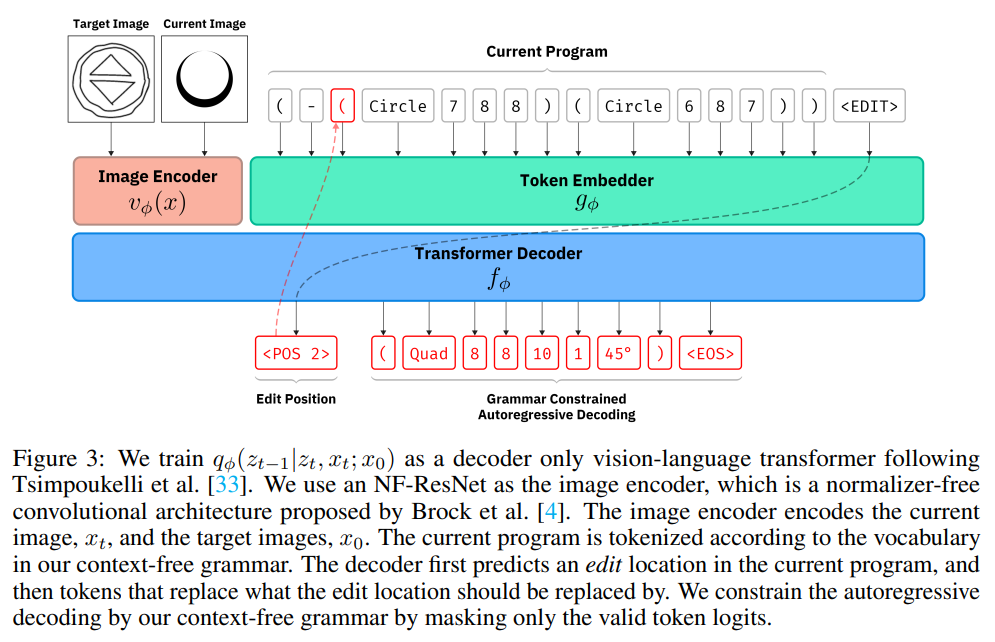
\ We add two additional types of tokens: an token, which serves as a start-of-sentence token for the model; and tokens, which allow the model to reference positions within its context. Given a current image, a target image, and a current tokenized program, we train this transformer model to predict the edit position and the replacement text autoregressively. While making predictions, the decoding is constrained under the grammar. We mask out the prediction logits to only include edit positions that represent nodes in the syntax tree, and only produce replacements that are syntactically valid for the selected edit position.

\ We set σsmall = 2, which means the network is only allowed to produce edits with fewer than two primitives. For training data, we sample an infinite stream of random expressions from the CFG. We choose a random number of noise steps, s ∈ [1, 5], to produce a mutated expression. For some percentage of the examples, ρ, we instead sample a completely random new expression as our mutated expression. We trained for 3 days for the environments we tested on a single Nvidia A6000 GPU.

\
\

:::info Authors:

(1) Shreyas Kapur, University of California, Berkeley ([email protected]);

(2) Erik Jenner, University of California, Berkeley ([email protected]);

(3) Stuart Russell, University of California, Berkeley ([email protected]).

:::


:::info This paper is available on arxiv under CC BY-SA 4.0 DEED license.

:::

\

Disclaimer: The articles reposted on this site are sourced from public platforms and are provided for informational purposes only. They do not necessarily reflect the views of MEXC. All rights remain with the original authors. If you believe any content infringes on third-party rights, please contact [email protected] for removal. MEXC makes no guarantees regarding the accuracy, completeness, or timeliness of the content and is not responsible for any actions taken based on the information provided. The content does not constitute financial, legal, or other professional advice, nor should it be considered a recommendation or endorsement by MEXC.

You May Also Like

EU may have had more leverage in U.S. trade talks, study finds

EU may have had more leverage in U.S. trade talks, study finds

The United States leans more on the European Union for imported goods than many assume, and that reliance has deepened over time, according to a new review by Germany’s IW economic institute. The study finds the EU now tops China for both the value and the count of product groups on which U.S. buyers depend, […]
Share
Cryptopolitan2025/09/18 18:28
BDACS Launches KRW1 Stablecoin Backed by the Won

BDACS Launches KRW1 Stablecoin Backed by the Won

The post BDACS Launches KRW1 Stablecoin Backed by the Won appeared on BitcoinEthereumNews.com. BDACS Launches KRW1 Stablecoin Backed by South Korean Won Custody service provider BDACS has launched KRW1, a new stablecoin pegged 1:1 to the South Korean won (KRW). The regulated custodian focuses on institutional clients and offers services including crypto asset custody and transaction infrastructure supporting multiple blockchains. The KRW1 project recently completed its proof-of-concept (PoC) phase, with the stablecoin launching on the Avalanche blockchain. Each KRW1 token is fully backed by fiat currency, with reserves held at Woori Bank, one of South Korea’s largest financial institutions. Transparency and Platform Features BDACS emphasizes full transparency: holders can monitor reserves in real time via banking API integration, although no dedicated portal is currently available. According to the press release, “The KRW1 launch goes far beyond token issuance. BDACS has developed a comprehensive platform, including issuance and governance systems, as well as a user application supporting peer-to-peer transfers and transaction verification.” The stablecoin is positioned for global use, with potential expansion through new network integrations and collaborations with dollar-pegged stablecoins like USDC and USDT. BDACS also plans to integrate KRW1 into government initiatives, though negotiations or official involvement have not been confirmed. Current Status and Market Outlook KRW1 remains in the concept stage and is not yet publicly traded or available to retail consumers, as South Korea currently lacks a stablecoin framework. However, the launch is reportedly supported by the country’s new president, Lee Je-moon. In related news, Kakao is also reportedly considering a won-pegged stablecoin, highlighting growing interest in this emerging asset class. Source: https://coinpaper.com/11089/bdacs-launches-krw-1-stablecoin-backed-by-the-won
Share
BitcoinEthereumNews2025/09/18 21:28
Jim Cramer Sounds Alarm On Bitcoin’s Unreliability As A Short-Term Currency After Brutal Weekend Drop To $74,000 ⋆ ZyCrypto

Jim Cramer Sounds Alarm On Bitcoin’s Unreliability As A Short-Term Currency After Brutal Weekend Drop To $74,000 ⋆ ZyCrypto

The post Jim Cramer Sounds Alarm On Bitcoin’s Unreliability As A Short-Term Currency After Brutal Weekend Drop To $74,000 ⋆ ZyCrypto appeared on BitcoinEthereumNews
Share
BitcoinEthereumNews2026/02/03 16:40