This study evaluates GPT-4’s ability to simulate game state transitions in the LLM-Sim task. Results show GPT-4 performs best on action-driven and static transitions but struggles with environment-driven dynamics, arithmetic, and common-sense reasoning. While GPT-4 can predict game progress with high accuracy when given rules, it still lags behind humans, who achieve ~80% accuracy compared to GPT-4’s ~50% in challenging cases. Findings highlight both the promise and current limitations of LLMs in complex simulation tasks.This study evaluates GPT-4’s ability to simulate game state transitions in the LLM-Sim task. Results show GPT-4 performs best on action-driven and static transitions but struggles with environment-driven dynamics, arithmetic, and common-sense reasoning. While GPT-4 can predict game progress with high accuracy when given rules, it still lags behind humans, who achieve ~80% accuracy compared to GPT-4’s ~50% in challenging cases. Findings highlight both the promise and current limitations of LLMs in complex simulation tasks.

Why GPT-4 Struggles with Complex Game Scenarios

Abstract and 1. Introduction and Related Work

  1. Methodology

    2.1 LLM-Sim Task

    2.2 Data

    2.3 Evaluation

  2. Experiments

  3. Results

  4. Conclusion

  5. Limitations and Ethical Concerns, Acknowledgements, and References

A. Model details

B. Game transition examples

C. Game rules generation

D. Prompts

E. GPT-3.5 results

F. Histograms

\

3 Experiments

Figure 1 demonstrates how we evaluate the performance of a model on the LLM-Sim task using

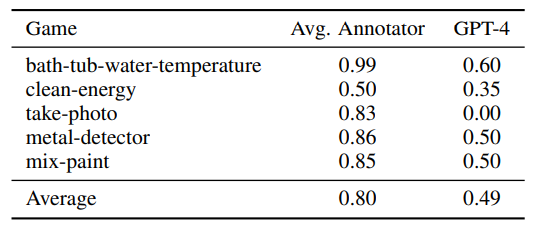
\ \ Table 4: Comparison between accuracy of human annotators and GPT-4 on a subset of the BYTESIZED32-SP dataset. Transitions were sampled to normalize GPT-4 performance at 50% (if possible) and annotators were tasked with modeling the complete transition function F and outputting the full state.
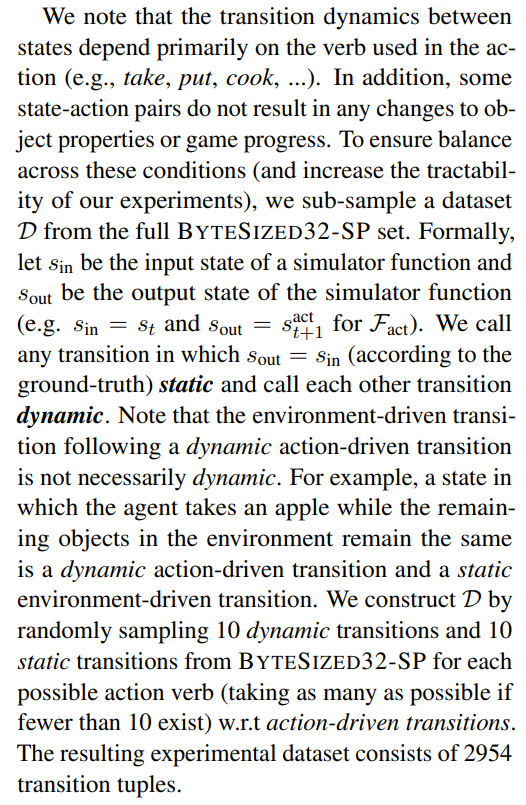
\ \ in-context learning. We evaluate the accuracy of GPT-4 in both the Full State and State Difference prediction regimes. The model receives the previous state (encoded as a JSON object), previous action, and context message, it produces the subsequent state (either as a complete JSON object or as a diff). See Appendix A for details.

\ \
\ \

4 Results

Table 2 presents the accuracy of GPT-4 simulating the whole state transitions as well as its accuracy of simulating action-driven transitions and environment-driven transitions alone.[2] We report some major observations below:

\ Predicting action-driven transitions is easier than predicting environment-driven transitions: At best, GPT-4 is able to simulate 77.1% of dynamic action-driven transitions correctly. In contrast, GPT-4 simulates at most 49.7% of dynamic environment-driven transitions correctly. This indicates that the most challenging part of the LLMSim task is likely simulating the underlying environmental dynamics.

\ Predicting static transitions is easier than dynamic transitions: Unsurprisingly, modeling a static transition is substantially easier than a dynamic transition across most conditions. While the LLM needs to determine whether a given initial state and action will result in a state change in either case, dynamic transitions also require simulating the dynamics in exactly the same way as the underlying game engine by leveraging the information in the context message.

\ Predicting full game states is easier for dynamic states, whereas predicting state difference is easier for static states: Predicting the state difference for dynamic state significantly improves the performance (>10%) of simulating static transitions, while decreases the performance when simulating dynamic transitions. This may be because state difference prediction is aimed at reducing potential format errors. However, GPT-4 is able to get the response format correct in most cases, while introducing the state difference increases the complexity of the output format of the task.

\ Game rules matter, and LLMs are able to generate good enough game rules: Performance of GPT-4 on all three simulation tasks drops in most conditions when game rules are not provided in the context message. However, we fail to find obvious performance differences between game rules generated by human experts and by LLMs themselves.

\ GPT-4 can predict game progress in most cases: Table 3 presents the results of GPT-4 predicting game progress. With game rules information in the context, GPT-4 can predict the game progress correctly in 92.1% test cases. The presence of these rules in context is crucial: without them, GPT-4’s prediction accuracy drops to 61.5%.

\ Humans outperform GPT-4 on the LLM-Sim task: We provide a preliminary human study on the LLM-Sim task. In particular, we take the 5 games

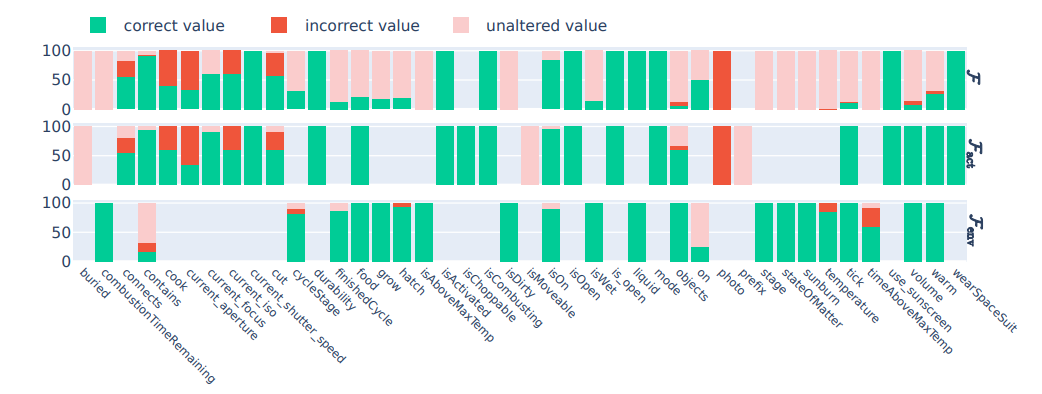
\ Figure 2: Simulation performance of whole state transition (top), action-driven transitions (middle) and environment-driven transitions (bottom) as a function of the property being modified, in the GPT-4, full state prediction, with human written rules condition. The x-axis represents specific object properties, and y-axis represents performance (0-100%). Errors are broken down into incorrect value and unaltered value. Refer to Table 7 for the meaning of each property.
\ from the BYTESIZED32-SP dataset in which GPT4 produced the worst accuracy at modeling Fact. For each game, we randomly sample 20 games with the aim of having 10 transitions where GPT-4 succeeded and 10 transitions where GPT-4 failed (note that this is not always possible because on some games GPT-4 fails/succeeds on most transitions). In addition, we balance each set of 10 transitions to have 5 dynamic transitions and 5 static transitions. We instruct four human annotators (4 authors of this paper) to model as Fact using the human-generated rules as context in a full game state prediction setting. Results are reported in Table 4. The overall human accuracy is 80%, compared to the sampled LLM accuracy of 50%, and the variation among annotators is small. This suggests that while our task is generally straightforward and relatively easy for humans, there is still a significant room for improvement for LLMs.

\ GPT-4 is more likely to make an error when arithmetic, common-sense, or scientific knowledge is needed: Because most errors occur in modeling dynamic transitions, we conduct an additional analysis to better understand failure modes. We use the setting with the best performance on dynamic transitions (GPT-4, Human-written context, full state prediction) and further break down the results according to the specific object properties that are changed during the transition. Figure 2 shows, for the whole state transitions, action-driven transitions, and environment-driven transitions, the proportion of predictions that are either correct, set the property to an incorrect value, or fail to change the property value (empty columns means the property is not changed in its corresponding condition). We observe that GPT-4 is able to handle most simple boolean value properties well. The errors are concentrated on non-trivial properties that requires arithmetic (e.g., temperature, timeAboveMaxTemp), common-sense (e.g., currentaperture, currentfocus), or scientific knowledge (e.g., on). We also observe that when predicting the action-driven and environment-driven transitions in a single step, GPT-4 tends to focus more on action-driven transitions, resulting in more unaltered value errors on states that it can predict correctly when solely simulating environment-driven transitions.

\

:::info Authors:

(1) Ruoyao Wang, University of Arizona ([email protected]);

(2) Graham Todd, New York University ([email protected]);

(3) Ziang Xiao, Johns Hopkins University ([email protected]);

(4) Xingdi Yuan, Microsoft Research Montréal ([email protected]);

(5) Marc-Alexandre Côté, Microsoft Research Montréal ([email protected]);

(6) Peter Clark, Allen Institute for AI ([email protected]).;

(7) Peter Jansen, University of Arizona and Allen Institute for AI ([email protected]).

:::


:::info This paper is available on arxiv under CC BY 4.0 license.

:::

[2] See Appendix E for the results of GPT-3.5.

Market Opportunity
SQUID MEME Logo
SQUID MEME Price(GAME)
$40.3678
$40.3678$40.3678
+1.08%
USD
SQUID MEME (GAME) Live Price Chart
Disclaimer: The articles reposted on this site are sourced from public platforms and are provided for informational purposes only. They do not necessarily reflect the views of MEXC. All rights remain with the original authors. If you believe any content infringes on third-party rights, please contact [email protected] for removal. MEXC makes no guarantees regarding the accuracy, completeness, or timeliness of the content and is not responsible for any actions taken based on the information provided. The content does not constitute financial, legal, or other professional advice, nor should it be considered a recommendation or endorsement by MEXC.

You May Also Like

VIRTUAL Weekly Analysis Jan 21

VIRTUAL Weekly Analysis Jan 21

The post VIRTUAL Weekly Analysis Jan 21 appeared on BitcoinEthereumNews.com. VIRTUAL closed the week up 3.57% at $0.84, but the long-term downtrend maintains its
Share
BitcoinEthereumNews2026/01/22 06:54
Dogecoin, Shiba Inu & XYZVerse: Three Meme Coin Paths — Stability, Gradual Growth & Explosive Upside?

Dogecoin, Shiba Inu & XYZVerse: Three Meme Coin Paths — Stability, Gradual Growth & Explosive Upside?

Three meme tokens are taking unique routes in the market. One is holding firm, another is making slow gains, and a third is causing excitement with its big jumps. What sets these coins apart and makes each path interesting? The coming analysis looks at how these strategies could shape their future and what it might mean for traders. From Meme to Mainstream: Is Dogecoin Ready for Another Lift-Off? Dogecoin burst onto the scene in 2013 with a grinning Shiba Inu and a shrug. Its creators, Billy Marcus and Jackson Palmer, wanted a light-hearted twist on serious crypto. They set no hard limit on coins; in fact 10,000 fresh DOGE roll out every minute. What began as a joke became a juggernaut. Social media rallies, led by Elon Musk, pushed its worth above $50 billion in 2021, planting it in the top ten. The surge proved one thing: an online crowd can turn a meme into a market force. Under the hood DOGE runs on the same proof-of-work idea as Bitcoin, yet blocks clear faster and fees stay tiny. That makes tipping gamers, streamers, and friends quick and cheap. The endless supply fuels spending but also keeps a lid on scarcity. In today’s cycle Bitcoin’s rebound has traders hunting for lagging plays. New meme coins flash brighter, yet many fade fast. Dogecoin still owns the biggest fan club and sits on every major exchange, giving it staying power. If utility grows—or another Musk tweet lands—momentum could return in a hurry. Shiba Inu: The Meme Dog That Sniffed Out a Spot on Ethereum Shiba Inu burst onto the scene in 2020, barking at Dogecoin’s heels. Built on Ethereum, it plugs into a huge network of apps and wallets. Its maker, known only as Ryoshi, unleashed one quadrillion tokens. Half went to Vitalik Buterin, who later gave much away and burned the rest. That bold move grabbed headlines and trust. At the same time, it showed the coin was more than a joke. Today, SHIB powers ShibaSwap, a place to trade tokens without a middleman. Soon, holders may vote on new changes and even mint art pieces called NFTs. This wider plan gives SHIB tools that Dogecoin still lacks. The market cycle now rewards coins with clear stories and active teams. Meme coins often ride big waves, and Ethereum-based ones get extra attention because they fit with popular chains like Uniswap and OpenSea. SHIB also has a huge, vocal fan base that can drive fast moves. Prices are still far below last year’s peak, so some see room for a fresh run if the next bull phase appears. Demand for $XYZ Surges As Its Capitalization Hits the $15M Milestone XYZVerse ($XYZ), recently recognized as Best NEW Meme Project, is drawing significant attention thanks to its standout concept. It is the first ever meme coin that merges the thrill of sports and the innovation of web3. Unlike typical meme coins, XYZVerse offers real utility and a clear roadmap for long-term development. It plans to launch gamified products and form partnerships with big sports teams and platforms. Notably, XYZVerse recently delivered on one of its goals ahead of schedule by partnering with bookmaker.XYZ, the first fully on-chain decentralized sportsbook and casino. As a bonus, $XYZ token holders receive exclusive perks on their first bet. Price Dynamics and Listing Plans During its presale phase, the $XYZ token has shown steady growth. Since its launch, the price has increased from $0.0001 to $0.0055, with the next stage set to push it further to $0.0056. With an anticipated listing price of $0.10, the token is set to launch on leading CEXs and DEXs. The projected listing price of $0.10 could generate up to 1,000x returns for early investors, provided the project secures the necessary market capitalization. So far, more than $15 million has been raised, and the presale is approaching another significant milestone of $20 million. This fast progress is signaling strong demand from both retail and institutional investors. Champions Get Rewarded In XYZVerse, the community calls the plays. Active contributors are rewarded with airdropped XYZ tokens for their dedication. It’s a game where the most passionate players win big. The Road to Victory With solid tokenomics, strategic CEX and DEX listings, and consistent token burns, $XYZ is built for a championship run. Every play is designed to push it further, to strengthen its price, and to rally a community of believers who believe this is the start of something legendary. Airdrops, Rewards, and More - Join XYZVerse to Unlock All the Benefits Conclusion DOGE offers steadiness, SHIB moves upward in steps, yet XYZVerse (XYZ) blends sports and memes, presale live, community-led, aiming to beat past 17,000% stars in the 2025 bull run. You can find more information about XYZVerse (XYZ) here: https://xyzverse.io/, https://t.me/xyzverse, https://x.com/xyz_verse   Disclaimer: This article is provided for informational purposes only. It is not offered or intended to be used as legal, tax, investment, financial, or other advice.
Share
Coinstats2025/09/20 16:32
YZi Labs invests in Ethena Labs to support the expansion of the USDe ecosystem

YZi Labs invests in Ethena Labs to support the expansion of the USDe ecosystem

PANews reported on September 19th that YZi Labs announced it has deepened its holdings in Ethena Labs and will continue its strategic support for the development of the USDe ecosystem. USDe is the fastest-growing and third-largest dollar-denominated crypto asset in history, with a current circulating supply exceeding $ 13 billion. YZi Labs' support will promote the expansion of USDe's application across centralized and decentralized platforms, and will contribute to the development of new products : USDtb (a fiat-backed stablecoin) and Converge (an institutional settlement layer).
Share
PANews2025/09/19 21:07