Bitcoin and Ethereum exchange-traded funds (ETFs) recorded a combined $244 million in outflows on September 23, marking the second consecutive day of investor withdrawals. This follows a sharp $439 million exit the previous day, as investors repositioned around the Federal Reserve’s recent rate cut and upcoming U.S. inflation data. ETF Flows Highlight Investor Caution With Bitcoin and Ethereum Facing Daily According to data from SoSoValue, Bitcoin spot ETFs saw net outflows of $103.6 million on Monday.BTC ETFs Analytics September 23 Source: SoSoValue Fidelity’s FBTC led the withdrawals with $75.6 million, followed by ARK 21Shares’ ARKB, which shed $27.9 million. In contrast, BlackRock’s flagship IBIT managed to secure a modest $2.5 million inflow, while Invesco’s BTCO recorded the highest inflow of the day at $10 million. Grayscale’s GBTC, along with VanEck’s HODL and Valkyrie’s BRRR, reported no major net flows. Ethereum ETFs, on the other hand, experienced even sharper redemptions, with $140.7 million flowing out in a single day. Fidelity’s FETH accounted for the bulk of losses with $63.4 million in outflows, followed by Grayscale’s ETH fund, which lost $36.4 million.ETH ETFs Analytics September 23 Source: SoSoValue Bitwise’s ETHW also saw heavy withdrawals of $23.9 million, while Grayscale’s ETHE posted $17.1 million in redemptions. BlackRock’s ETHA and VanEck’s ETHV remained flat, while smaller funds from Franklin, 21Shares, and Invesco showed no notable changes. A day prior On September 22, Bitcoin products had lost $363 million in a single session, led by Fidelity’s FBTC with $276.7 million in redemptions. Ethereum funds saw $76 million withdrawn the same day, led again by Fidelity’s FETH, alongside redemptions from Bitwise and BlackRock’s ETHA. As of September 23, Bitcoin spot ETFs hold $147.2 billion in net assets, representing 6.6% of the cryptocurrency’s total market capitalization. Cumulative inflows stand at $57.25 billion. Ethereum spot ETFs now hold $27.5 billion in net assets, representing 5.45% of the total ETH market, with cumulative inflows reaching $13.7 billion. The outflows come just one week after digital asset products recorded nearly $1.9 billion in inflows, according to CoinShares data. That surge followed the Federal Reserve’s first interest rate cut of 2025, which drew renewed investor demand for crypto exposure despite cautious signals from policymakers. Bitcoin funds had attracted $977 million during the week, while Ethereum products recorded $772 million, setting a year-to-date record of $12.6 billion for Ether-backed products. Market data shows that investor positioning remains sensitive to macroeconomic signals. Analysts note that ETF flows and derivatives leverage remain key indicators to watch as markets absorb both the Fed’s policy outlook and upcoming inflation readings. BlackRock’s Bitcoin ETFs Lead $260M Revenue Surge, Ethereum Adds $42M Bitcoin and Ethereum ETFs have gained widespread success in the past few years. BlackRock’s Bitcoin and Ethereum exchange-traded funds are now generating more than $260 million annually, showing that digital asset products have become a major profit engine for the world’s largest asset manager. According to Leon Waidmann, head of research at the Onchain Foundation, BlackRock’s Bitcoin ETFs account for $218 million of that figure, while Ethereum products contribute $42 million. “This isn’t experimentation anymore,” Waidmann said, noting that the firm has turned crypto ETFs into a revenue stream on par with established financial products. Analysts suggest that BlackRock’s success will set a benchmark for pension funds, sovereign wealth funds, and insurance companies considering exposure to digital assets. Bloomberg’s senior ETF analyst Eric Balchunas highlighted the structural advantages of crypto ETFs, which combine instant access, low costs, and yield potential with regulatory protection and anonymity, benefits not typically associated with direct token ownership. Market conditions remain mixed. Bitcoin traded at $113,717 on Monday, up 0.9% in the past 24 hours but moving within a tight range between $111,369 and $113,301. Ethereum slipped 0.4% to $4,173.88, marking a 7.1% decline over the past week. Despite short-term volatility, some industry leaders see rising institutional demand as a long-term price driver. Strategy’s Michael Saylor told CNBC that ETFs and corporations are collectively buying far more Bitcoin than miners produce daily, creating sustained upward pressure. Citigroup, however, is cautious on Ethereum, projecting a year-end target of $4,300, well below its $4,953 all-time high reached in AugustBitcoin and Ethereum exchange-traded funds (ETFs) recorded a combined $244 million in outflows on September 23, marking the second consecutive day of investor withdrawals. This follows a sharp $439 million exit the previous day, as investors repositioned around the Federal Reserve’s recent rate cut and upcoming U.S. inflation data. ETF Flows Highlight Investor Caution With Bitcoin and Ethereum Facing Daily According to data from SoSoValue, Bitcoin spot ETFs saw net outflows of $103.6 million on Monday.BTC ETFs Analytics September 23 Source: SoSoValue Fidelity’s FBTC led the withdrawals with $75.6 million, followed by ARK 21Shares’ ARKB, which shed $27.9 million. In contrast, BlackRock’s flagship IBIT managed to secure a modest $2.5 million inflow, while Invesco’s BTCO recorded the highest inflow of the day at $10 million. Grayscale’s GBTC, along with VanEck’s HODL and Valkyrie’s BRRR, reported no major net flows. Ethereum ETFs, on the other hand, experienced even sharper redemptions, with $140.7 million flowing out in a single day. Fidelity’s FETH accounted for the bulk of losses with $63.4 million in outflows, followed by Grayscale’s ETH fund, which lost $36.4 million.ETH ETFs Analytics September 23 Source: SoSoValue Bitwise’s ETHW also saw heavy withdrawals of $23.9 million, while Grayscale’s ETHE posted $17.1 million in redemptions. BlackRock’s ETHA and VanEck’s ETHV remained flat, while smaller funds from Franklin, 21Shares, and Invesco showed no notable changes. A day prior On September 22, Bitcoin products had lost $363 million in a single session, led by Fidelity’s FBTC with $276.7 million in redemptions. Ethereum funds saw $76 million withdrawn the same day, led again by Fidelity’s FETH, alongside redemptions from Bitwise and BlackRock’s ETHA. As of September 23, Bitcoin spot ETFs hold $147.2 billion in net assets, representing 6.6% of the cryptocurrency’s total market capitalization. Cumulative inflows stand at $57.25 billion. Ethereum spot ETFs now hold $27.5 billion in net assets, representing 5.45% of the total ETH market, with cumulative inflows reaching $13.7 billion. The outflows come just one week after digital asset products recorded nearly $1.9 billion in inflows, according to CoinShares data. That surge followed the Federal Reserve’s first interest rate cut of 2025, which drew renewed investor demand for crypto exposure despite cautious signals from policymakers. Bitcoin funds had attracted $977 million during the week, while Ethereum products recorded $772 million, setting a year-to-date record of $12.6 billion for Ether-backed products. Market data shows that investor positioning remains sensitive to macroeconomic signals. Analysts note that ETF flows and derivatives leverage remain key indicators to watch as markets absorb both the Fed’s policy outlook and upcoming inflation readings. BlackRock’s Bitcoin ETFs Lead $260M Revenue Surge, Ethereum Adds $42M Bitcoin and Ethereum ETFs have gained widespread success in the past few years. BlackRock’s Bitcoin and Ethereum exchange-traded funds are now generating more than $260 million annually, showing that digital asset products have become a major profit engine for the world’s largest asset manager. According to Leon Waidmann, head of research at the Onchain Foundation, BlackRock’s Bitcoin ETFs account for $218 million of that figure, while Ethereum products contribute $42 million. “This isn’t experimentation anymore,” Waidmann said, noting that the firm has turned crypto ETFs into a revenue stream on par with established financial products. Analysts suggest that BlackRock’s success will set a benchmark for pension funds, sovereign wealth funds, and insurance companies considering exposure to digital assets. Bloomberg’s senior ETF analyst Eric Balchunas highlighted the structural advantages of crypto ETFs, which combine instant access, low costs, and yield potential with regulatory protection and anonymity, benefits not typically associated with direct token ownership. Market conditions remain mixed. Bitcoin traded at $113,717 on Monday, up 0.9% in the past 24 hours but moving within a tight range between $111,369 and $113,301. Ethereum slipped 0.4% to $4,173.88, marking a 7.1% decline over the past week. Despite short-term volatility, some industry leaders see rising institutional demand as a long-term price driver. Strategy’s Michael Saylor told CNBC that ETFs and corporations are collectively buying far more Bitcoin than miners produce daily, creating sustained upward pressure. Citigroup, however, is cautious on Ethereum, projecting a year-end target of $4,300, well below its $4,953 all-time high reached in August

Bitcoin and Ethereum ETFs Suffer Massive $244M Outflow Amid Second Straight Day of Outflows

Bitcoin and Ethereum exchange-traded funds (ETFs) recorded a combined $244 million in outflows on September 23, marking the second consecutive day of investor withdrawals.

This follows a sharp $439 million exit the previous day, as investors repositioned around the Federal Reserve’s recent rate cut and upcoming U.S. inflation data.

ETF Flows Highlight Investor Caution With Bitcoin and Ethereum Facing Daily

According to data from SoSoValue, Bitcoin spot ETFs saw net outflows of $103.6 million on Monday.
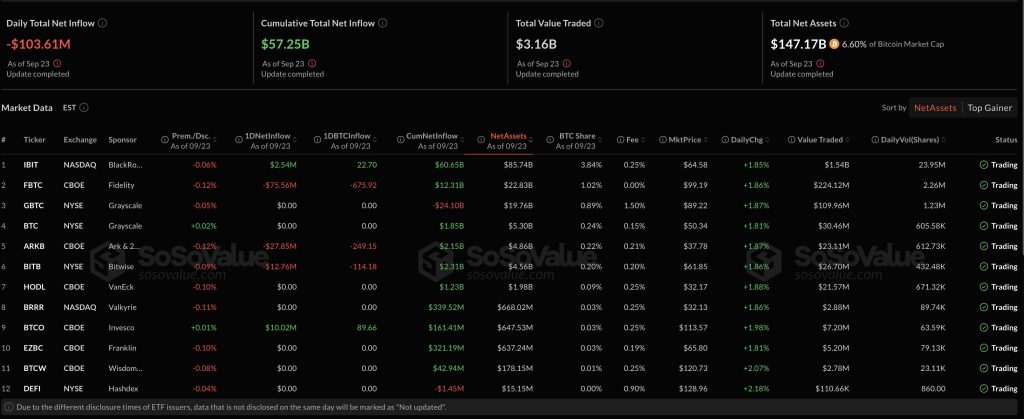
BTC ETFs Analytics September 23 Source: SoSoValue

Fidelity’s FBTC led the withdrawals with $75.6 million, followed by ARK 21Shares’ ARKB, which shed $27.9 million.

In contrast, BlackRock’s flagship IBIT managed to secure a modest $2.5 million inflow, while Invesco’s BTCO recorded the highest inflow of the day at $10 million.

Grayscale’s GBTC, along with VanEck’s HODL and Valkyrie’s BRRR, reported no major net flows.

Ethereum ETFs, on the other hand, experienced even sharper redemptions, with $140.7 million flowing out in a single day. Fidelity’s FETH accounted for the bulk of losses with $63.4 million in outflows, followed by Grayscale’s ETH fund, which lost $36.4 million.

ETH ETFs Analytics September 23 Source: SoSoValue

Bitwise’s ETHW also saw heavy withdrawals of $23.9 million, while Grayscale’s ETHE posted $17.1 million in redemptions.

BlackRock’s ETHA and VanEck’s ETHV remained flat, while smaller funds from Franklin, 21Shares, and Invesco showed no notable changes.

A day prior On September 22, Bitcoin products had lost $363 million in a single session, led by Fidelity’s FBTC with $276.7 million in redemptions.

Ethereum funds saw $76 million withdrawn the same day, led again by Fidelity’s FETH, alongside redemptions from Bitwise and BlackRock’s ETHA.

As of September 23, Bitcoin spot ETFs hold $147.2 billion in net assets, representing 6.6% of the cryptocurrency’s total market capitalization. Cumulative inflows stand at $57.25 billion.

Ethereum spot ETFs now hold $27.5 billion in net assets, representing 5.45% of the total ETH market, with cumulative inflows reaching $13.7 billion.

The outflows come just one week after digital asset products recorded nearly $1.9 billion in inflows, according to CoinShares data.

That surge followed the Federal Reserve’s first interest rate cut of 2025, which drew renewed investor demand for crypto exposure despite cautious signals from policymakers.

Bitcoin funds had attracted $977 million during the week, while Ethereum products recorded $772 million, setting a year-to-date record of $12.6 billion for Ether-backed products.

Market data shows that investor positioning remains sensitive to macroeconomic signals.

Analysts note that ETF flows and derivatives leverage remain key indicators to watch as markets absorb both the Fed’s policy outlook and upcoming inflation readings.

BlackRock’s Bitcoin ETFs Lead $260M Revenue Surge, Ethereum Adds $42M

Bitcoin and Ethereum ETFs have gained widespread success in the past few years.

BlackRock’s Bitcoin and Ethereum exchange-traded funds are now generating more than $260 million annually, showing that digital asset products have become a major profit engine for the world’s largest asset manager.

According to Leon Waidmann, head of research at the Onchain Foundation, BlackRock’s Bitcoin ETFs account for $218 million of that figure, while Ethereum products contribute $42 million.

“This isn’t experimentation anymore,” Waidmann said, noting that the firm has turned crypto ETFs into a revenue stream on par with established financial products.

Analysts suggest that BlackRock’s success will set a benchmark for pension funds, sovereign wealth funds, and insurance companies considering exposure to digital assets.

Bloomberg’s senior ETF analyst Eric Balchunas highlighted the structural advantages of crypto ETFs, which combine instant access, low costs, and yield potential with regulatory protection and anonymity, benefits not typically associated with direct token ownership.

Market conditions remain mixed. Bitcoin traded at $113,717 on Monday, up 0.9% in the past 24 hours but moving within a tight range between $111,369 and $113,301.

Ethereum slipped 0.4% to $4,173.88, marking a 7.1% decline over the past week. Despite short-term volatility, some industry leaders see rising institutional demand as a long-term price driver.

Strategy’s Michael Saylor told CNBC that ETFs and corporations are collectively buying far more Bitcoin than miners produce daily, creating sustained upward pressure. Citigroup, however, is cautious on Ethereum, projecting a year-end target of $4,300, well below its $4,953 all-time high reached in August.


Disclaimer: The articles reposted on this site are sourced from public platforms and are provided for informational purposes only. They do not necessarily reflect the views of MEXC. All rights remain with the original authors. If you believe any content infringes on third-party rights, please contact [email protected] for removal. MEXC makes no guarantees regarding the accuracy, completeness, or timeliness of the content and is not responsible for any actions taken based on the information provided. The content does not constitute financial, legal, or other professional advice, nor should it be considered a recommendation or endorsement by MEXC.

You May Also Like

VIRTUAL Weekly Analysis Jan 21

VIRTUAL Weekly Analysis Jan 21

The post VIRTUAL Weekly Analysis Jan 21 appeared on BitcoinEthereumNews.com. VIRTUAL closed the week up 3.57% at $0.84, but the long-term downtrend maintains its
Share
BitcoinEthereumNews2026/01/22 06:54
Dogecoin, Shiba Inu & XYZVerse: Three Meme Coin Paths — Stability, Gradual Growth & Explosive Upside?

Dogecoin, Shiba Inu & XYZVerse: Three Meme Coin Paths — Stability, Gradual Growth & Explosive Upside?

Three meme tokens are taking unique routes in the market. One is holding firm, another is making slow gains, and a third is causing excitement with its big jumps. What sets these coins apart and makes each path interesting? The coming analysis looks at how these strategies could shape their future and what it might mean for traders. From Meme to Mainstream: Is Dogecoin Ready for Another Lift-Off? Dogecoin burst onto the scene in 2013 with a grinning Shiba Inu and a shrug. Its creators, Billy Marcus and Jackson Palmer, wanted a light-hearted twist on serious crypto. They set no hard limit on coins; in fact 10,000 fresh DOGE roll out every minute. What began as a joke became a juggernaut. Social media rallies, led by Elon Musk, pushed its worth above $50 billion in 2021, planting it in the top ten. The surge proved one thing: an online crowd can turn a meme into a market force. Under the hood DOGE runs on the same proof-of-work idea as Bitcoin, yet blocks clear faster and fees stay tiny. That makes tipping gamers, streamers, and friends quick and cheap. The endless supply fuels spending but also keeps a lid on scarcity. In today’s cycle Bitcoin’s rebound has traders hunting for lagging plays. New meme coins flash brighter, yet many fade fast. Dogecoin still owns the biggest fan club and sits on every major exchange, giving it staying power. If utility grows—or another Musk tweet lands—momentum could return in a hurry. Shiba Inu: The Meme Dog That Sniffed Out a Spot on Ethereum Shiba Inu burst onto the scene in 2020, barking at Dogecoin’s heels. Built on Ethereum, it plugs into a huge network of apps and wallets. Its maker, known only as Ryoshi, unleashed one quadrillion tokens. Half went to Vitalik Buterin, who later gave much away and burned the rest. That bold move grabbed headlines and trust. At the same time, it showed the coin was more than a joke. Today, SHIB powers ShibaSwap, a place to trade tokens without a middleman. Soon, holders may vote on new changes and even mint art pieces called NFTs. This wider plan gives SHIB tools that Dogecoin still lacks. The market cycle now rewards coins with clear stories and active teams. Meme coins often ride big waves, and Ethereum-based ones get extra attention because they fit with popular chains like Uniswap and OpenSea. SHIB also has a huge, vocal fan base that can drive fast moves. Prices are still far below last year’s peak, so some see room for a fresh run if the next bull phase appears. Demand for $XYZ Surges As Its Capitalization Hits the $15M Milestone XYZVerse ($XYZ), recently recognized as Best NEW Meme Project, is drawing significant attention thanks to its standout concept. It is the first ever meme coin that merges the thrill of sports and the innovation of web3. Unlike typical meme coins, XYZVerse offers real utility and a clear roadmap for long-term development. It plans to launch gamified products and form partnerships with big sports teams and platforms. Notably, XYZVerse recently delivered on one of its goals ahead of schedule by partnering with bookmaker.XYZ, the first fully on-chain decentralized sportsbook and casino. As a bonus, $XYZ token holders receive exclusive perks on their first bet. Price Dynamics and Listing Plans During its presale phase, the $XYZ token has shown steady growth. Since its launch, the price has increased from $0.0001 to $0.0055, with the next stage set to push it further to $0.0056. With an anticipated listing price of $0.10, the token is set to launch on leading CEXs and DEXs. The projected listing price of $0.10 could generate up to 1,000x returns for early investors, provided the project secures the necessary market capitalization. So far, more than $15 million has been raised, and the presale is approaching another significant milestone of $20 million. This fast progress is signaling strong demand from both retail and institutional investors. Champions Get Rewarded In XYZVerse, the community calls the plays. Active contributors are rewarded with airdropped XYZ tokens for their dedication. It’s a game where the most passionate players win big. The Road to Victory With solid tokenomics, strategic CEX and DEX listings, and consistent token burns, $XYZ is built for a championship run. Every play is designed to push it further, to strengthen its price, and to rally a community of believers who believe this is the start of something legendary. Airdrops, Rewards, and More - Join XYZVerse to Unlock All the Benefits Conclusion DOGE offers steadiness, SHIB moves upward in steps, yet XYZVerse (XYZ) blends sports and memes, presale live, community-led, aiming to beat past 17,000% stars in the 2025 bull run. You can find more information about XYZVerse (XYZ) here: https://xyzverse.io/, https://t.me/xyzverse, https://x.com/xyz_verse   Disclaimer: This article is provided for informational purposes only. It is not offered or intended to be used as legal, tax, investment, financial, or other advice.
Share
Coinstats2025/09/20 16:32
YZi Labs invests in Ethena Labs to support the expansion of the USDe ecosystem

YZi Labs invests in Ethena Labs to support the expansion of the USDe ecosystem

PANews reported on September 19th that YZi Labs announced it has deepened its holdings in Ethena Labs and will continue its strategic support for the development of the USDe ecosystem. USDe is the fastest-growing and third-largest dollar-denominated crypto asset in history, with a current circulating supply exceeding $ 13 billion. YZi Labs' support will promote the expansion of USDe's application across centralized and decentralized platforms, and will contribute to the development of new products : USDtb (a fiat-backed stablecoin) and Converge (an institutional settlement layer).
Share
PANews2025/09/19 21:07