Polymarket has introduced a new incentive for prediction market participants, offering a 4% annualized yield on certain long-term positions. The reward, which is paid out daily, is designed to keep long-term pricing accurate and is currently funded through the Polymarket Treasury. According to the exchange, the yield applies to positions in a set of political and geopolitical markets, including the 2028 U.S. presidential race, the balance of power in the 2026 midterms, and leadership outcomes in countries such as Russia, China, Turkey, Israel, and Ukraine. Positions are valued based on the number of “Yes” and “No” shares held and the most recent mid-price, with rewards distributed after an hourly random sampling of accounts. The 4% rate is variable and may be adjusted or capped at the company’s discretion. Prediction Market Rivalry Heats Up as Kalshi Tops Polymarket by Volumes While Polymarket’s new holding rewards seek to attract long-term bettors, competitor Kalshi has been dominating in terms of trading activity. For three consecutive weeks, Kalshi has posted higher volumes than Polymarket, recording $728 million in trades last week. That figure is nearly 60% higher than Polymarket’s volume and close to Kalshi’s record $749 million during the run-up to the 2024 U.S. presidential election.Source: Dune Analytics Data from Dune Analytics shows that between September 11 and 17, Kalshi captured 62% of total on-chain prediction market volume, with more than $500 million in trades and $189 million in open interest. Polymarket, by comparison, registered $430 million in trading volume and $164 million in open interest over the same period. Analysts note that Polymarket’s higher open interest relative to volume reflects longer-term positions, while Kalshi’s lower ratio points to faster turnover and more active trading. The competition between the two platforms shows diverging strategies. Kalshi, operating as a CFTC-authorized exchange, has capitalized on regulated event-based contract trading in the U.S. Polymarket, meanwhile, has historically catered to international users through blockchain-based markets but is expanding in the U.S. following its acquisition of the regulated exchange QCX. The company also recently launched earnings-based prediction markets in partnership with Stocktwits. Despite the differences in structure and oversight, both platforms continue to grow, with Kalshi solidifying its lead in weekly volume and Polymarket focusing on user retention through higher yields and long-term markets. CFTC Clears Polymarket for U.S. Return as Kalshi Faces State Lawsuit The prediction market space is entering a new phase as regulators in the U.S. take divergent approaches to two of its biggest players. On September 3, the CFTC cleared Polymarket to re-enter the U.S. through a no-action letter covering event contracts. The move marks Polymarket’s official return after a 2022 settlement forced it to block American users. CEO Shayne Coplan hailed the clearance as “a green light” for U.S. operations, noting that it gives the company space to scale legally. The breakthrough comes as Polymarket pursues a valuation of up to $10 billion, more than triple its last known $1 billion valuation in June. The firm rose to prominence after its markets accurately predicted Donald Trump’s 2024 victory, drawing major institutional backing and user growth. While Polymarket is regaining ground, rival Kalshi is facing legal hurdles. On September 13, Massachusetts Attorney General Andrea Joy Campbell filed a civil lawsuit accusing Kalshi of running unlicensed sports betting disguised as “event contracts.” The suit alleges that between January and June 2025, 70–75% of Kalshi’s $1 billion in wagers came from sports markets, rivaling licensed operators like DraftKings. Regulators say the platform allowed underage betting and lacked safeguards required by state law. As Polymarket moves forward with regulatory cover, Kalshi’s future could hinge on a growing clash between state gambling laws and federal commodities oversightPolymarket has introduced a new incentive for prediction market participants, offering a 4% annualized yield on certain long-term positions. The reward, which is paid out daily, is designed to keep long-term pricing accurate and is currently funded through the Polymarket Treasury. According to the exchange, the yield applies to positions in a set of political and geopolitical markets, including the 2028 U.S. presidential race, the balance of power in the 2026 midterms, and leadership outcomes in countries such as Russia, China, Turkey, Israel, and Ukraine. Positions are valued based on the number of “Yes” and “No” shares held and the most recent mid-price, with rewards distributed after an hourly random sampling of accounts. The 4% rate is variable and may be adjusted or capped at the company’s discretion. Prediction Market Rivalry Heats Up as Kalshi Tops Polymarket by Volumes While Polymarket’s new holding rewards seek to attract long-term bettors, competitor Kalshi has been dominating in terms of trading activity. For three consecutive weeks, Kalshi has posted higher volumes than Polymarket, recording $728 million in trades last week. That figure is nearly 60% higher than Polymarket’s volume and close to Kalshi’s record $749 million during the run-up to the 2024 U.S. presidential election.Source: Dune Analytics Data from Dune Analytics shows that between September 11 and 17, Kalshi captured 62% of total on-chain prediction market volume, with more than $500 million in trades and $189 million in open interest. Polymarket, by comparison, registered $430 million in trading volume and $164 million in open interest over the same period. Analysts note that Polymarket’s higher open interest relative to volume reflects longer-term positions, while Kalshi’s lower ratio points to faster turnover and more active trading. The competition between the two platforms shows diverging strategies. Kalshi, operating as a CFTC-authorized exchange, has capitalized on regulated event-based contract trading in the U.S. Polymarket, meanwhile, has historically catered to international users through blockchain-based markets but is expanding in the U.S. following its acquisition of the regulated exchange QCX. The company also recently launched earnings-based prediction markets in partnership with Stocktwits. Despite the differences in structure and oversight, both platforms continue to grow, with Kalshi solidifying its lead in weekly volume and Polymarket focusing on user retention through higher yields and long-term markets. CFTC Clears Polymarket for U.S. Return as Kalshi Faces State Lawsuit The prediction market space is entering a new phase as regulators in the U.S. take divergent approaches to two of its biggest players. On September 3, the CFTC cleared Polymarket to re-enter the U.S. through a no-action letter covering event contracts. The move marks Polymarket’s official return after a 2022 settlement forced it to block American users. CEO Shayne Coplan hailed the clearance as “a green light” for U.S. operations, noting that it gives the company space to scale legally. The breakthrough comes as Polymarket pursues a valuation of up to $10 billion, more than triple its last known $1 billion valuation in June. The firm rose to prominence after its markets accurately predicted Donald Trump’s 2024 victory, drawing major institutional backing and user growth. While Polymarket is regaining ground, rival Kalshi is facing legal hurdles. On September 13, Massachusetts Attorney General Andrea Joy Campbell filed a civil lawsuit accusing Kalshi of running unlicensed sports betting disguised as “event contracts.” The suit alleges that between January and June 2025, 70–75% of Kalshi’s $1 billion in wagers came from sports markets, rivaling licensed operators like DraftKings. Regulators say the platform allowed underage betting and lacked safeguards required by state law. As Polymarket moves forward with regulatory cover, Kalshi’s future could hinge on a growing clash between state gambling laws and federal commodities oversight

Polymarket Lures Bettors With Highest 4% Yield Amid Kalshi’s Weekly Volume Surge

Polymarket has introduced a new incentive for prediction market participants, offering a 4% annualized yield on certain long-term positions. The reward, which is paid out daily, is designed to keep long-term pricing accurate and is currently funded through the Polymarket Treasury.

According to the exchange, the yield applies to positions in a set of political and geopolitical markets, including the 2028 U.S. presidential race, the balance of power in the 2026 midterms, and leadership outcomes in countries such as Russia, China, Turkey, Israel, and Ukraine.

Positions are valued based on the number of “Yes” and “No” shares held and the most recent mid-price, with rewards distributed after an hourly random sampling of accounts. The 4% rate is variable and may be adjusted or capped at the company’s discretion.

Prediction Market Rivalry Heats Up as Kalshi Tops Polymarket by Volumes

While Polymarket’s new holding rewards seek to attract long-term bettors, competitor Kalshi has been dominating in terms of trading activity. For three consecutive weeks, Kalshi has posted higher volumes than Polymarket, recording $728 million in trades last week.

That figure is nearly 60% higher than Polymarket’s volume and close to Kalshi’s record $749 million during the run-up to the 2024 U.S. presidential election.
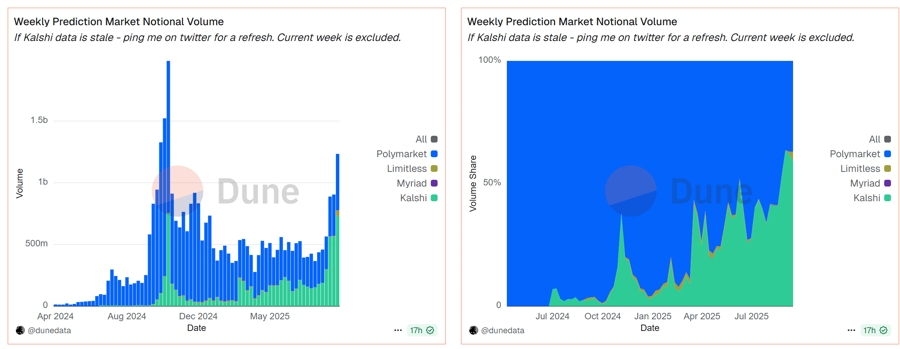
Source: Dune Analytics

Data from Dune Analytics shows that between September 11 and 17, Kalshi captured 62% of total on-chain prediction market volume, with more than $500 million in trades and $189 million in open interest.

Polymarket, by comparison, registered $430 million in trading volume and $164 million in open interest over the same period.

Analysts note that Polymarket’s higher open interest relative to volume reflects longer-term positions, while Kalshi’s lower ratio points to faster turnover and more active trading.

The competition between the two platforms shows diverging strategies. Kalshi, operating as a CFTC-authorized exchange, has capitalized on regulated event-based contract trading in the U.S.

Polymarket, meanwhile, has historically catered to international users through blockchain-based markets but is expanding in the U.S. following its acquisition of the regulated exchange QCX. The company also recently launched earnings-based prediction markets in partnership with Stocktwits.

Despite the differences in structure and oversight, both platforms continue to grow, with Kalshi solidifying its lead in weekly volume and Polymarket focusing on user retention through higher yields and long-term markets.

CFTC Clears Polymarket for U.S. Return as Kalshi Faces State Lawsuit

The prediction market space is entering a new phase as regulators in the U.S. take divergent approaches to two of its biggest players.

On September 3, the CFTC cleared Polymarket to re-enter the U.S. through a no-action letter covering event contracts.

The move marks Polymarket’s official return after a 2022 settlement forced it to block American users.

CEO Shayne Coplan hailed the clearance as “a green light” for U.S. operations, noting that it gives the company space to scale legally. The breakthrough comes as Polymarket pursues a valuation of up to $10 billion, more than triple its last known $1 billion valuation in June.

The firm rose to prominence after its markets accurately predicted Donald Trump’s 2024 victory, drawing major institutional backing and user growth.

While Polymarket is regaining ground, rival Kalshi is facing legal hurdles. On September 13, Massachusetts Attorney General Andrea Joy Campbell filed a civil lawsuit accusing Kalshi of running unlicensed sports betting disguised as “event contracts.”

The suit alleges that between January and June 2025, 70–75% of Kalshi’s $1 billion in wagers came from sports markets, rivaling licensed operators like DraftKings. Regulators say the platform allowed underage betting and lacked safeguards required by state law.

As Polymarket moves forward with regulatory cover, Kalshi’s future could hinge on a growing clash between state gambling laws and federal commodities oversight.

Disclaimer: The articles reposted on this site are sourced from public platforms and are provided for informational purposes only. They do not necessarily reflect the views of MEXC. All rights remain with the original authors. If you believe any content infringes on third-party rights, please contact [email protected] for removal. MEXC makes no guarantees regarding the accuracy, completeness, or timeliness of the content and is not responsible for any actions taken based on the information provided. The content does not constitute financial, legal, or other professional advice, nor should it be considered a recommendation or endorsement by MEXC.

You May Also Like

VIRTUAL Weekly Analysis Jan 21

VIRTUAL Weekly Analysis Jan 21

The post VIRTUAL Weekly Analysis Jan 21 appeared on BitcoinEthereumNews.com. VIRTUAL closed the week up 3.57% at $0.84, but the long-term downtrend maintains its
Share
BitcoinEthereumNews2026/01/22 06:54
Dogecoin, Shiba Inu & XYZVerse: Three Meme Coin Paths — Stability, Gradual Growth & Explosive Upside?

Dogecoin, Shiba Inu & XYZVerse: Three Meme Coin Paths — Stability, Gradual Growth & Explosive Upside?

Three meme tokens are taking unique routes in the market. One is holding firm, another is making slow gains, and a third is causing excitement with its big jumps. What sets these coins apart and makes each path interesting? The coming analysis looks at how these strategies could shape their future and what it might mean for traders. From Meme to Mainstream: Is Dogecoin Ready for Another Lift-Off? Dogecoin burst onto the scene in 2013 with a grinning Shiba Inu and a shrug. Its creators, Billy Marcus and Jackson Palmer, wanted a light-hearted twist on serious crypto. They set no hard limit on coins; in fact 10,000 fresh DOGE roll out every minute. What began as a joke became a juggernaut. Social media rallies, led by Elon Musk, pushed its worth above $50 billion in 2021, planting it in the top ten. The surge proved one thing: an online crowd can turn a meme into a market force. Under the hood DOGE runs on the same proof-of-work idea as Bitcoin, yet blocks clear faster and fees stay tiny. That makes tipping gamers, streamers, and friends quick and cheap. The endless supply fuels spending but also keeps a lid on scarcity. In today’s cycle Bitcoin’s rebound has traders hunting for lagging plays. New meme coins flash brighter, yet many fade fast. Dogecoin still owns the biggest fan club and sits on every major exchange, giving it staying power. If utility grows—or another Musk tweet lands—momentum could return in a hurry. Shiba Inu: The Meme Dog That Sniffed Out a Spot on Ethereum Shiba Inu burst onto the scene in 2020, barking at Dogecoin’s heels. Built on Ethereum, it plugs into a huge network of apps and wallets. Its maker, known only as Ryoshi, unleashed one quadrillion tokens. Half went to Vitalik Buterin, who later gave much away and burned the rest. That bold move grabbed headlines and trust. At the same time, it showed the coin was more than a joke. Today, SHIB powers ShibaSwap, a place to trade tokens without a middleman. Soon, holders may vote on new changes and even mint art pieces called NFTs. This wider plan gives SHIB tools that Dogecoin still lacks. The market cycle now rewards coins with clear stories and active teams. Meme coins often ride big waves, and Ethereum-based ones get extra attention because they fit with popular chains like Uniswap and OpenSea. SHIB also has a huge, vocal fan base that can drive fast moves. Prices are still far below last year’s peak, so some see room for a fresh run if the next bull phase appears. Demand for $XYZ Surges As Its Capitalization Hits the $15M Milestone XYZVerse ($XYZ), recently recognized as Best NEW Meme Project, is drawing significant attention thanks to its standout concept. It is the first ever meme coin that merges the thrill of sports and the innovation of web3. Unlike typical meme coins, XYZVerse offers real utility and a clear roadmap for long-term development. It plans to launch gamified products and form partnerships with big sports teams and platforms. Notably, XYZVerse recently delivered on one of its goals ahead of schedule by partnering with bookmaker.XYZ, the first fully on-chain decentralized sportsbook and casino. As a bonus, $XYZ token holders receive exclusive perks on their first bet. Price Dynamics and Listing Plans During its presale phase, the $XYZ token has shown steady growth. Since its launch, the price has increased from $0.0001 to $0.0055, with the next stage set to push it further to $0.0056. With an anticipated listing price of $0.10, the token is set to launch on leading CEXs and DEXs. The projected listing price of $0.10 could generate up to 1,000x returns for early investors, provided the project secures the necessary market capitalization. So far, more than $15 million has been raised, and the presale is approaching another significant milestone of $20 million. This fast progress is signaling strong demand from both retail and institutional investors. Champions Get Rewarded In XYZVerse, the community calls the plays. Active contributors are rewarded with airdropped XYZ tokens for their dedication. It’s a game where the most passionate players win big. The Road to Victory With solid tokenomics, strategic CEX and DEX listings, and consistent token burns, $XYZ is built for a championship run. Every play is designed to push it further, to strengthen its price, and to rally a community of believers who believe this is the start of something legendary. Airdrops, Rewards, and More - Join XYZVerse to Unlock All the Benefits Conclusion DOGE offers steadiness, SHIB moves upward in steps, yet XYZVerse (XYZ) blends sports and memes, presale live, community-led, aiming to beat past 17,000% stars in the 2025 bull run. You can find more information about XYZVerse (XYZ) here: https://xyzverse.io/, https://t.me/xyzverse, https://x.com/xyz_verse   Disclaimer: This article is provided for informational purposes only. It is not offered or intended to be used as legal, tax, investment, financial, or other advice.
Share
Coinstats2025/09/20 16:32
YZi Labs invests in Ethena Labs to support the expansion of the USDe ecosystem

YZi Labs invests in Ethena Labs to support the expansion of the USDe ecosystem

PANews reported on September 19th that YZi Labs announced it has deepened its holdings in Ethena Labs and will continue its strategic support for the development of the USDe ecosystem. USDe is the fastest-growing and third-largest dollar-denominated crypto asset in history, with a current circulating supply exceeding $ 13 billion. YZi Labs' support will promote the expansion of USDe's application across centralized and decentralized platforms, and will contribute to the development of new products : USDtb (a fiat-backed stablecoin) and Converge (an institutional settlement layer).
Share
PANews2025/09/19 21:07