Injective (INJ) or Hyperliquid (HYPE): Which Is Better for Millionaire Level Returns?
Injective and Hyperliquid have become two of the biggest DeFi-focused blockchain projects in the current market cycle. The recent recovery in the Injective price and Hyperliquid’s rise into the top tier of decentralized trading platforms have created an important debate among long-term crypto investors.
Which project has the better chance of turning large investments into millionaire-level returns over time?
The answer depends heavily on market cap structure, upside potential, tokenomics, and overall investment strategy.
Injective Price Recovery Has Put INJ Back Into Focus Again
Injective operates as a Layer 1 blockchain built specifically for Web3 financial applications and decentralized finance infrastructure. The project received early backing from Binance Labs alongside investors including Mark Cuban.
The ecosystem focuses on decentralized exchanges, derivatives markets, RWAs, interoperable finance, AI related infrastructure, and institutional DeFi tooling.
The INJ token powers governance, staking, collateral systems, and weekly buyback burns that permanently remove supply from circulation using dApp generated fees.
Injective launched publicly through Binance Launchpad in 2020 near $0.65 before exploding higher during the 2023 recovery phase. The INJ price climbed from around $1.30 to above $35 after the network introduced a $150 million ecosystem fund and expanded aggressively across DeFi infrastructure.
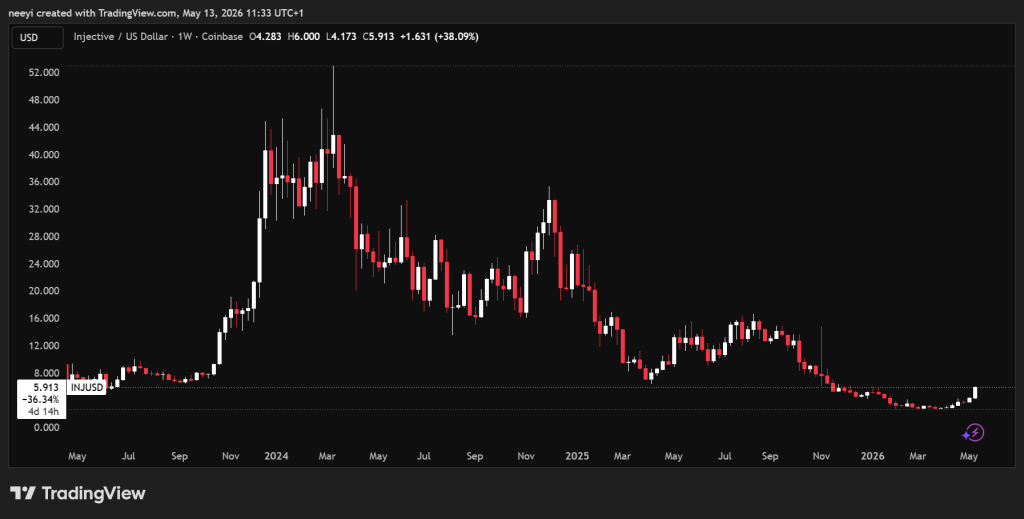 INJ Price Chart from TradingView.com
Momentum continued into March 2024 when Injective reached an all time high close to $52.75.
The broader market correction afterward pushed the Injective price sharply lower. INJ eventually dropped back into single digits before recovering recently alongside new ecosystem developments.
Recent catalysts include the deployment of native USDC and CCTP by Circle, a record token burn event, and the rollout of a native EVM mainnet designed to improve interoperability and access to liquidity.
Hyperliquid Has Already Become A DeFi Market Leader
Hyperliquid entered the market much later than Injective, although its growth happened far faster.
The project operates as a high-performance Layer 1 blockchain built specifically for decentralized trading. Hyperliquid powers perpetual futures, spot markets, leverage trading, and prediction markets through its own native exchange ecosystem.
Unlike many DeFi protocols, Hyperliquid does not depend on Ethereum infrastructure. The network uses its own HyperBFT consensus system and reportedly processes up to 200,000 orders per second with near instant finality and extremely low transaction fees.
The HYPE token supports governance, staking, gas fees, smart contracts, and daily buyback systems tied directly to trading revenue.
Hyperliquid launched during November 2024 through a Genesis Event airdrop distributed to nearly 100,000 early users without venture capital involvement.
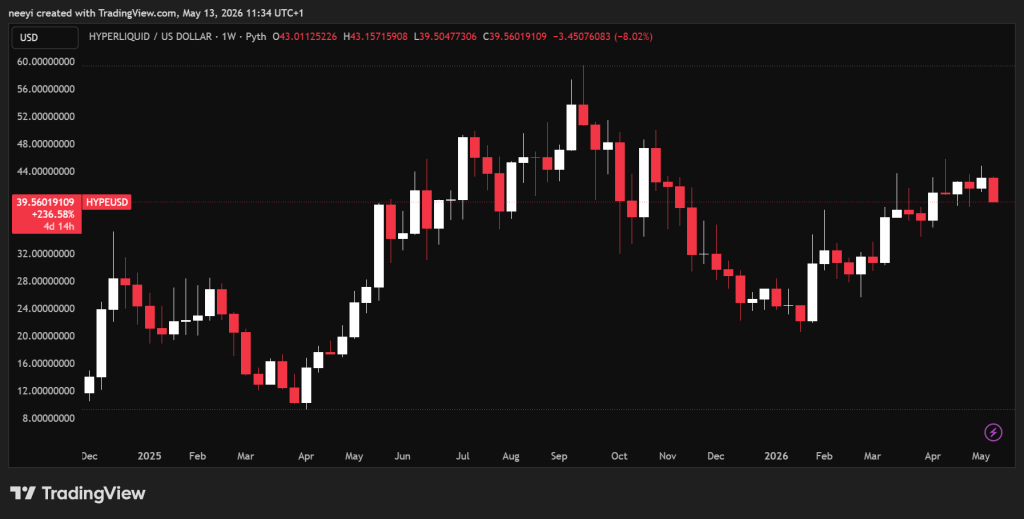 HYPE Price Chart from TradingView.com
The HYPE price quickly climbed from around $3 to above $12 before eventually reaching an all time high near $59.39 during September 2025.
Current HYPE price levels remain close to $40 with a market cap around $9.5 billion. Institutional attention surrounding products like 21Shares’ THYP ETF and anticipation around the HIP 4 upgrade continue supporting the ecosystem.
Miro Believes Injective Offers More Asymmetrical Upside Than Hyperliquid
Crypto analyst Miro recently compared Injective and Hyperliquid from a valuation perspective.
Miro explained that Hyperliquid already trades like a major market leader. The analyst pointed out that another 10x move for the HYPE price would likely require valuations approaching $100 billion.
Injective presents a completely different setup.
Miro noted that INJ price still trades more than 90% below its previous all time high despite continuous development across DeFi infrastructure, AI integrations, RWAs, and institutional finance tooling.
The analyst argued that Injective does not require anywhere near Hyperliquid’s current valuation to produce massive percentage returns. A recovery toward previous highs alone could generate roughly a 9x move from current levels.
Miro made it clear that his comparison was not dismissing Hyperliquid’s strength. Hyperliquid already dominates decentralized derivatives trading and continues attracting institutional interest. His argument focused primarily on asymmetrical risk-to-reward structure.
Lower market cap assets typically require far less capital inflow to produce aggressive expansion phases.
Market Cap Structure Creates Two Completely Different Investment Profiles
Choosing between Hyperliquid and Injective ultimately depends on investment goals and risk tolerance.
Hyperliquid currently trades near a $10 billion valuation. That scale gives the project stronger liquidity depth, institutional visibility, and market dominance across decentralized perpetual trading.
Large market caps, however, usually make explosive upside moves more difficult over time. Another major expansion phase for the HYPE price would likely require enormous global capital inflows.
Injective operates from a much smaller valuation base after enduring a deep correction from its all-time high. That lower market cap creates more room for aggressive upside expansion if ecosystem growth continues improving.
Tokenomics also create another important difference.
Hyperliquid still faces contributor and team unlock schedules during the coming years. Those unlocks can create recurring sell pressure during major rallies.
Injective already moved beyond most early vesting cycles. Weekly burn auctions continue removing INJ from circulation permanently through ecosystem fee generation.
| etric | Injective | Hyperliquid |
|---|---|---|
| Current Market Position | Recovering after a deep correction from previous highs | Already positioned as a top tier DeFi trading ecosystem |
| Estimated Market Cap | Around $550 million to $600 million | Around $9.57 billion |
| Upside Potential | Higher upside due to smaller valuation base | More limited upside due to large valuation size |
| Capital Needed For Major Growth | Requires less capital inflow for major price expansion | Requires massive capital inflow for another large rally |
| Previous All Time High Context | Still trades far below previous ATH near $52.75 | Trades relatively close to major cycle highs |
| Token Supply Structure | Mature vesting structure with most early unlocks completed | Contributor and team unlocks still active |
| Deflationary Mechanism | Weekly buyback and burn auctions remove INJ permanently | Daily buybacks and burns tied to trading fees |
| Potential Sell Pressure | Lower structural sell pressure | Ongoing unlock schedules may create selling pressure |
| Institutional Visibility | Growing institutional and DeFi infrastructure exposure | Strong institutional attention and ETF related visibility |
| Main Investment Appeal | Aggressive growth and asymmetrical upside potential | Stability, liquidity depth, and market leadership |
| Risk Profile | Higher risk with potentially larger reward | Lower relative risk with potentially slower expansion |
| Best Suited For | Investors seeking high multiplier opportunities | Investors prioritizing established DeFi dominance |
The comparison eventually becomes a choice between upside potential and market stability.
Injective may appeal more to aggressive growth investors searching for high multiplier opportunities from compressed valuations. Hyperliquid may appeal more to investors looking for exposure to an already established DeFi market leader with strong institutional positioning.
FAQs
Subscribe to our YouTube channel for daily crypto updates, market insights, and expert analysis.
The post Injective (INJ) or Hyperliquid (HYPE): Which Is Better for Millionaire Level Returns? appeared first on CaptainAltcoin.
You May Also Like

Ripple’s Monica Long to headline major XRP event in Seoul

Comfort Systems Stock Fell 8% This Week. Here’s Where the Stock Could Go in 2026
Base says same sequencer bug caused June 25 and 26 outages